EU-bound Express indispensable for world economy










It is ironic that the more hostile politicians and media in the European Union have become toward China over the past 10 years, the more reliant the economies of the EU have become on the China-EU Railway Express in the past 10 years of its existence. This paradox highlights how irrational and foolish adhering to a zero-sum-game mentality is. The real world of global economic interdependence shows that it is win-win cooperation that is the reality, not win-lose competition and geopolitical manipulations. Politicians, think tanks, and mainstream media in the West need to look at the companies involved in cooperation with their Chinese counterparts to better grasp this reality.
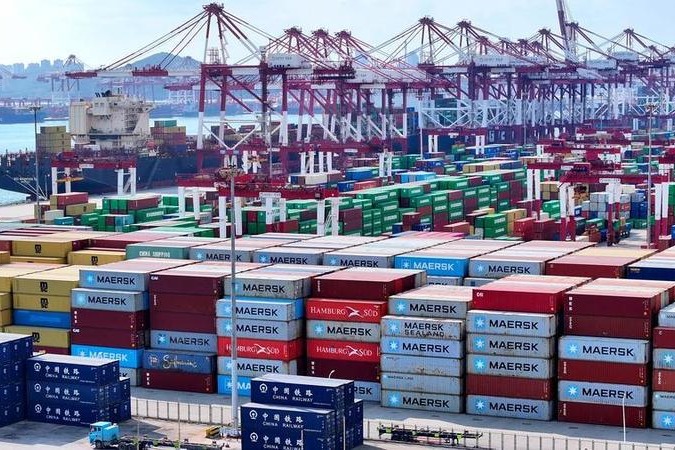
The CEER, which connects China with the EU by rail, has become part of the Belt and Road Initiative's China-Eurasia Corridor, which goes through Kazakhstan and Russia, and then branches through Belarus to Poland and to Finland, Scandinavia and the Baltic Sea. The busiest of the routes is the one from China through Russia (including that through Kazakhstan to Russia) and Belarus that goes to Poland and the rest of the EU. Germany is the most important destination for many of the CEER linkages, and German industries have increasingly relied on it to both receive important industrial goods such as parts and for exports' products such as auto vehicles.
The first direct freight train left Chongqing and arrived in the German city of Duisburg in 2011. That year 17 trains travelled between China and the EU. By July 2022, about 10,000 trains have made the trip. The number of trains kept doubling, sometimes tripling, from 2011 to 2021. Great efforts have been made by all nations along the routes to unify custom clearance procedures and build new facilities at the border crossings so as to make the freight corridor as efficient as possible. As a result, the duration of the trip between China and the EU has gradually shortened from 28 days to 14 days, sometimes 12.
New logistics hubs have emerged in western China's Xinjiang Uygur autonomous region, making it a strategically important logistics crossroad along the new Silk Road. This has contributed to the economic development of Xinjiang, in tandem with China's efforts to stabilize this important region. New hubs have emerged in Kazakhstan, Russia, Belarus, Finland and more are planned in Poland. The building of the Great Stone Industrial Park and logistics hub by China in Belarus was a milestone for China-Europe cooperation. The Finnish town of Kouvola, with just 80,000 inhabitants, became a major logistics center in Europe, when a logistics park was built there in 2017.
There are plans for the development of ports, railways, and logistics parks all along the routes. What this shows is that the Belt and Road Initiative is a bridge connecting people, improving their livelihoods, and breaking their isolation. The CEER now connects the Eurasia continent, 196 European cities and more than 90 cities in China. Besides Xinjiang, the major terminals of the CEER in China are in Xi'an, Chongqing, Chengdu, Wuhan and Yiwu.
The vitality of the CEER for China-Europe cooperation was most dramatically demonstrated during the COVID-19 pandemic. While most transport modes between Asia and Europe were hit hard, the CEER not only continued but dramatically increased its activities. The rail corridor became literally a lifeline for Europe in its fight against the novel coronavirus, because most of the personal protection equipment, ventilators, and many medicines and medical products produced in China and urgently needed in Europe were transported by rail. This made a crucial difference to the fight against the virus in Europe.
The vitality of the CEER for the EU in general and Germany in particular was demonstrated when Deutsche Bahn Cargo, the largest German rail freight company, decided to invest in this route in 2021. In September 2021, a new freight route was opened between Hamburg and Shanghai. In December, two more routes were launched, one from Deyang (Sichuan province) to Lodz and the other from Xi'an to the port city of Gdynia. In January 2022, the Hefei-Neuss (south of Duisburg) route was launched. In November 2021"DB Cargo Transasia", a Shanghai-based subsidiary, 100 percent owned by DB Cargo, was launched. This was a clear declaration of the German company's desire to maintain and enhance the CEER.
Many opponents of the Belt and Road Initiative in the West were gleefully proclaiming their "China's dream to revive the Silk Road" was finished after the Russia-Ukraine conflict broke out in February 2022. Reality has once again proved those politicians and think tanks wrong. Chinese companies have continued to use this route to transport goods to the EU as usual. There was even a 3.5 percent increase in the number of trains in the first half of 2022 and the number is set to further rise in the second half of 2022 as operations get back to normal.
The uninterrupted operation of the CEER amid the conflict shows how resilient and necessary the CEER is for most nations in Eurasia.
The views don't necessarily represent those of China Daily.
The author is a board member of the Belt and Road Institute in Sweden.