Shared responsibility









Cultivating friendly ties between China and Japan serves the fundamental interests of both peoples
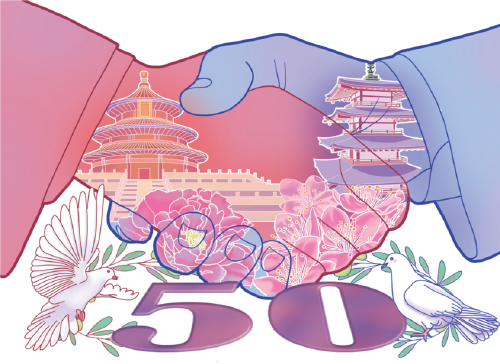
This year marks the 50th anniversary of the normalization of China-Japan diplomatic relations. It is an opportunity to review the history of and learn the lessons from the development of bilateral ties over the past half a century.
Over the past five decades, China and Japan have seen substantial progress in the development of their relationship, with peaceful co-existence and mutually beneficial cooperation bringing huge benefits to the two peoples.
In economic relations, bilateral trade has soared from $1.03 billion in 1972 to $371.4 billion in 2021. Japan has become one of the most important sources of foreign investment in China, and Chinese investment in Japan, though it started late, has been growing rapidly. As for people-to-people exchanges, personnel exchanges between China and Japan were less than 10,000 in 1972; by 2019, the number of Chinese tourists to Japan had surged to nearly 9.6 million. Academic exchanges have also become more frequent, with an increasing number of students studying in each other's country.
In the global arena, the two countries hold common or similar stances on many issues. Both countries are committed to safeguarding a free and open international trade system. Both are opposed to the proliferation of weapons of mass destruction. And both also advocate multilateral cooperation to cope with various challenges triggered by globalization.
How could the two countries manage to live in peace and develop a mutually beneficial relationship over the past 50 years?
First, China's official position on Japan's war of aggression against China and its policy toward Japan have played a crucial role. In 1961, Chairman Mao Zedong pointed out that it was only a handful of Japanese militarists who were responsible for the war. Most ordinary Japanese were themselves victims of the war. In his address to the China-Japan Friendship Exchange Meeting held on May 23, 2015, President Xi Jinping also stressed that "the Japanese people were also victims of that war".
The Chinese government's position on the war determines the basic goal, principle and means of its policy toward Japan. This basic goal is to develop good-neighborly and mutually beneficial cooperative relations with Japan. The basic principle is that the Japanese people are victims of the war and therefore should not be held responsible for the war, and cooperation between the two countries serves the fundamental interests and aspirations of the two peoples. The basic means is to encourage economic and trade cooperation and people-to-people exchanges.
It was against this background that China renounced its demand for war reparations from Japan while urging the Japanese government to adopt a correct understanding of history. And it is also because of this, the Chinese government has urged the two countries to take a future-oriented approach and promote friendly cooperation between the two countries.
Second, after the end of World War II, the Japanese people also felt deep remorse on their country's war of external aggression. Consequently, they embraced the pacifist Constitution, endorsed a peaceful foreign policy and opposed Japan's involvement in international conflicts as well as the development of nuclear weapons.
Third, some Japanese leaders and people of integrity have taken an appropriate stance on Japan's war of aggression against China and made many efforts to seek reconciliation with China. Former Japanese prime ministers Kakuei Tanaka, Takeo Fukuda, Morihiro Hosokawa, Tomiichi Murayama, and Yasuo Fukuda played important roles in the normalization of bilateral relations, the signing of friendly treaties, the implementation of yen loans to China, and Japan's correct understanding and handling of historical issues. They did what they believed to be the right thing despite strong opposition from the ultra-rightist forces.
Fourth, since the normalization of bilateral ties, the governments of the two countries have vigorously promoted economic and trade exchanges. From December 1979 to March 2022, Japan has provided China with Official Development Assistance for more than four decades. The two governments have also been encouraging nongovernmental, cultural and people-to-people exchanges.
Finally, the governments of the two countries have carefully managed their differences. In recent years, despite being at odds over a number of historical issues and territorial disputes, the two countries have steered clear of a military conflict. In 2019, China and Japan agreed on a 10-point consensus, pledging to "properly handle sensitive issues and manage disputes and differences constructively" and make joint efforts to "safeguard peace and stability of the East China Sea, so as to turn it into a sea of peace, cooperation and friendship".
But despite the achievements in the relationship, in recent years, their relations have been plagued by decreasing mutual trust, rows over historical issues, disputes over maritime territorial sovereignty and maritime rights, and Japan's provocative rhetoric on the Taiwan question. According to polls, perceptions of the two countries, both at the elite and popular levels, are very negative toward each other and have not improved significantly for many years.
Why have China-Japan relations been beset with conflicts and difficulties?
First, some Japanese politicians in high places have maintained an ambiguous attitude on historical issues. Since the 1980s, a number of Japanese politicians, including several prime ministers, have paid visits or sent ritual offerings to the Yasukuni Shrine, which honors 14 Class-A war criminals, sparking outrage among the Chinese people.
Second, there have been efforts in Japan to justify the war of aggression against China through revising its history textbooks.
Third, as China rises, there is a growing concern among people in Japan over the so-called China threat, which has been hyped up by the Japanese government and media. Fourth, some Japanese politicians have been trying to exploit the Taiwan question to contain China and even clamored for Japan to help "defend Taiwan "with the United States.
Fifth, since 2005, some Japanese politicians have advocated and promoted the so-called value diplomacy, an "arc of freedom and prosperity" and the Quadrilateral Security Dialogue in an attempt to isolate China ideologically.
Sixth, some people in the two countries have developed a revisionist view of history. They openly deny that Japan's ruling class should be held accountable for the country's war atrocities, and that Japanese and Chinese people are all victims of the war. Some even hold the view that there is "national hatred" between the two nations, and assume that "a war is inevitable between China and Japan".
Last but not least, the internet has served as a magnifier of the problems and differences between the two countries, making opinions of the two countries toward each other more emotional and polarized.
Looking to the future, friendly ties between China and Japan serve the fundamental interests of the two peoples and are essential for maintaining peace and prosperity in the region and the world at large. It is the shared responsibility of the two countries to make the utmost efforts to handle historical issues appropriately, manage disputes over territory and maritime rights and interests, advance economic cooperation, and promote people-to-people exchanges.
We hope that China and Japan can cherish the hard-won progress since the normalization of bilateral ties, adhere to the four political documents reached between the two countries and build a new-type of relations between the two countries characterized by mutual respect and mutual benefit.
Jia Qingguo is the director of the Institute for Global Cooperation and Understanding of Peking University and a professor of the School of International Studies at Peking University. Xia Weiyong is an associate professor of the School of Public Administration at Yunnan University. The authors contributed this article to China Watch, a think tank powered by China Daily.
The views do not necessarily reflect those of China Daily.
Contact the editor at editor@chinawatch.cn