Growth accelerators
Cooperation in industrial parks can help African countries build stronger capabilities for self-driven development









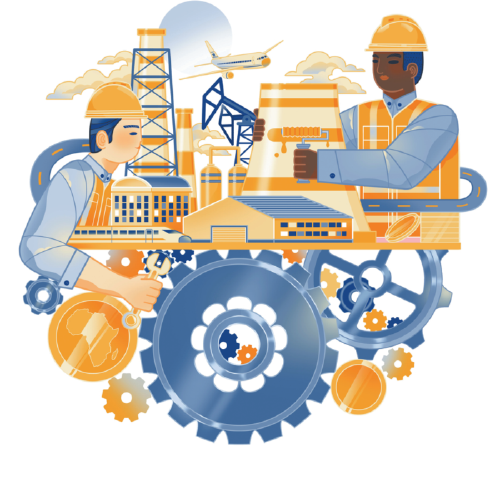
Cooperation in industrial parks can help African countries build stronger capabilities for self-driven development
Prior to their independence, African countries missed out on several global waves of industrialization, and therefore failed to establish sound and systemic economic systems. Most African countries became independent after the 1960s and implemented the import substitution industrialization strategy in the early stage of economic development. This resulted in industrialization being too costly and culminated in a lack of growth momentum.
In the 1970s, the global oil crisis wreaked havoc on Africa's industrialization, which had just started to show signs of growth, with many African nations slipping into debt distress. In the 1980s, many African nations started to rely heavily on external capital and indiscriminately followed the policy prescriptions of the Washington Consensus, ending up with decreasing international competitiveness.
Since the turn of the 21st century, African countries have started exploring new pathways of economic development, in particular by building industrial parks to attract foreign investment and implement an export-oriented strategy. The launch of some pro-economy and pro-cooperation policies worldwide accelerated this process.
In 2000, the US Congress approved the African Growth and Opportunity Act, which provides eligible sub-Saharan African countries with duty-free access to the US market. Some African, Caribbean and Pacific countries received full duty-free and quota-free access to the European Union for all their exports with the exception of arms and armaments under the EU's "Everything but Arms" arrangement in 2001.
At the 2006 Beijing Summit of the Forum on China-Africa Cooperation, the Chinese government proposed to set up the China-Africa Development Fund and economic and trade cooperation zones, and encouraged Chinese companies to invest in Africa. The African Continental Free Trade Area agreement entered into force in May 2019, giving African countries a major opportunity to boost manufacturing, promote trade, and attract investment.
The Belt and Road Initiative has opened a brand new chapter in China-Africa cooperation, with the joint construction of industrial parks taking the lead in boosting bilateral cooperation and successful cases constantly springing up, such as the China-Egypt TEDA Suez Economic and Trade Cooperation Zone, Lekki Free Trade Zone in Nigeria, Zambia-China Economic and Trade Cooperation Zone, Hawassa Industrial Park and Dire Dawa Industrial Park in Ethiopia, and the Djibouti International Free Trade Zone.
As of the end of 2021, African countries had built or co-built 237 industrial parks or zones. Nearly 60 of them were designed, constructed, or operated by Chinese companies.
Ethiopia was one of the first African nations to attach significance to using industrial parks to accelerate industrialization. Chinese companies have taken part in many collaboration projects "funded by the Ethiopian side and constructed by foreign companies".
In 2015, China Civil Engineering Construction Corporation won the bid to construct the Hawassa Industrial Park, the first and therefore flagship industrial park developed and supported by the Ethiopian government. Following that, Chinese companies signed contracts to build nearly 10 industrial parks in Kombolcha, Adama, and Dire Dawa, establishing a dominant position in the construction of industrial parks in Ethiopia. The Chinese-built Ethiopia-Djibouti Railway has slashed travel time between Ethiopia's capital Addis Ababa and Djibouti's capital Djibouti City, boosted economic development along its route, and produced the "Ethiopia-Djibouti Economic Corridor" model.
Another remarkable example is the Lekki Free Trade Zone in Nigeria, a pioneering public-private partnership between Chinese enterprises and the Nigerian government. Despite the adverse impacts of the COVID-19 pandemic, the number of companies in the zone had been rising rapidly to 54 by August 2022.
According to our survey, one of the biggest challenges facing companies in the industrial parks is the lack of technical skills among the local workforce. Although over 80 percent of local workers have received junior secondary education or above, they lack the technical skills required by the development of industrialization.
Meanwhile, China-Africa cooperation in industrial parks faces other challenges. To start with, policy implementation ability and policy consistency in African countries are yet to improve. Industrial parks are long-term projects. Political upheaval and frequent personnel changes will threaten the long-term effectiveness of policies associated with the development of industrial parks.
Most African countries are in the initial stage of industrialization, therefore positioning the industrial park as a cluster of labor-intensive industries. Homogeneous competition between those parks will result in difficulties in attracting companies into the parks. Also, since industrial parks have very limited revenue models, they are often threatened by inadequate financial liquidity and lack of financial support.
Furthermore, African countries are susceptible to policy changes made by their trading partners. For instance, the US revoked duty free access to the US for Ethiopia, Cameroon, and others, citing their noncompliance with the AGOA eligibility criteria. This has triggered the massive withdrawal of capital by companies in the industrial parks.
Therefore, China-Africa cooperation in industrial parks should further optimize factors and resource allocation to help African countries build stronger capabilities for self-driven development. In the meantime, the top-level design for China-Africa industrial cooperation should be strengthened and long-term coordination mechanisms between governments should be built. To this end, China's Ministry of Commerce has taken the lead in establishing a consultation mechanism with African countries on China-Africa cooperation in industrial parks, which is playing its due role in boosting long-term coordination mechanisms between governments.
Chinese financial institutions should accelerate their strategic layout in Africa to provide businesses with localized financial services, and strengthen the exchange rate risk-related financial service system to offer more diversified products that could help businesses hedge against risks.
On top of that, companies that have invested in the industrial parks should play a pivotal role in cultivating the local workforce and promoting technological transfers. They should pay attention to combining talent cultivation with businesses and the local development, and provide technical and skills-training programs for local employees in addition to creating job opportunities. Also, China-Africa cooperation in industrial parks should attach great significance to coordinated development with local communities by providing services to them so as to boost their sustainable development capability.
The author is a research assistant professor of the National School of Development at Peking University and director of the Research Office of the Institute of South-South Cooperation and Development at Peking University. The author contributed this article to China Watch, a think tank powered by China Daily.
The views do not necessarily reflect those of China Daily.
Contact the editor at editor@chinawatch.cn