



US climate vows inane for Pacific Island states









That US President Joe Biden is hosting the first-ever US-Pacific Island Country summit on Wednesday and Thursday shows Washington is desperate to strengthen relations with the Pacific Island countries after removing them from its priority list in the 1990s.
As the White House statement issued on Sept 2 said, the first US-Pacific Island Country summit will seek to deepen cooperation between the US and the Pacific Island countries on key issues such as climate change, pandemic response, global economic recovery, maritime security, environmental protection, and building a free and open "Indo-Pacific region".
This pivotal reach-out of the US to the Pacific Island countries suggests the United States not only acknowledges the strategic importance of the region but also is worried that its dominance of the Pacific since the end of World War II could be undermined by China's growing relations with the Pacific Island countries.
Rattled by rising Chinese investment in the Pacific Island countries and China's growing naval power in the Pacific, the US has accused China of building "military bases" in the Pacific while ignoring the fact that Washington has been intensifying military activities around the Pacific Island countries such as Guam, the Federated States of Micronesia and Palau.
However, the Pacific Island countries don't seem interested in the US' zero-sum game of geopolitical rivalry. So far, their response to the summit has been mixed. Although the leaders of the island nations have welcomed the summit, as they expect the US to make some concrete commitments on mitigating the threats faced by the region and hope the US accords priority to their needs, but they also fear that Washington may instead force them to choose sides between China and the US.
For the Pacific Island countries, the US' geopolitical approach to engage the region is questionable for two specific reasons. First, it is contrary to the value the island nations attach to inclusiveness, and second, and more fundamentally, it is the US, instead of the Pacific Island countries, which regards China's increasing presence in the region as a security threat.
China provides the island nations with economic options, even new strategic leverages. The benign interactions between China and the Pacific Island countries have their own rationale and logic, that is, of promoting common good.
In 1993, the US closed its embassy in the Solomon Islands. Almost at the same time, China began enhancing its engagement with the island nations.
In 2013, China proposed the Belt and Road Initiative and since then it has been working closely with the Pacific Island nations. Two-way trade has grown dramatically since 1992 and reached $5.3 billion in 2021, and China's direct investment in the Pacific Island countries touched $2.72 billion at the end of 2021.
China has also helped the island nations improve connectivity, reduce poverty, safeguard public health, and protect the environment. And in addition to deepening economic and development cooperation, China has taken the island nations' climate concerns very seriously, and realizes they are the most vulnerable to climate change-induced sea level rise and other natural disasters.
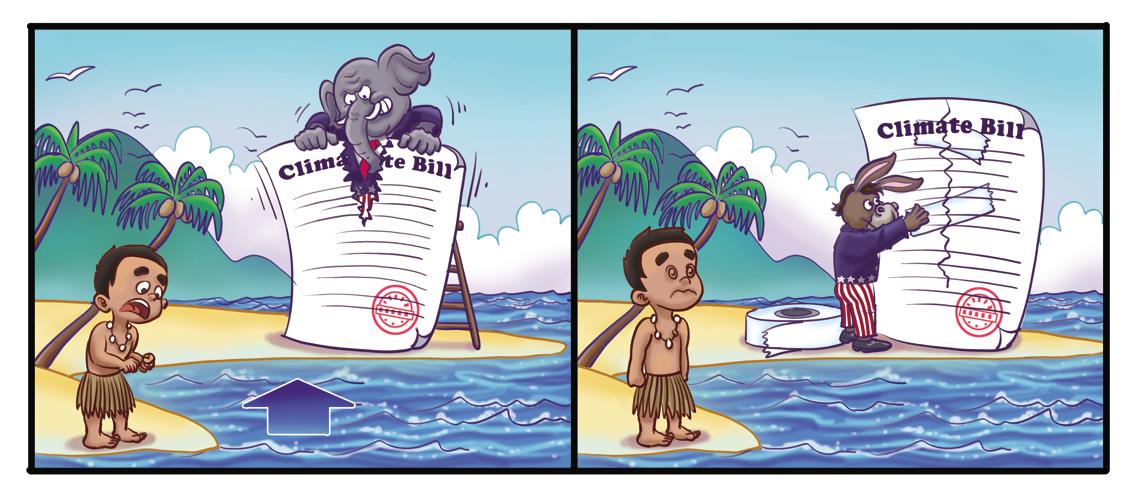
On the other hand, the US' commitment to climate change has been fluctuating over the past few years, leaving the world, including the Pacific Island countries, frustrated.
While in 2017, previous president Donald Trump withdrew the US from the landmark Paris Agreement that was agreed to by almost all the countries, dealing a major blow to the global response to climate change, four years later incumbent President Biden, on his first day in office in January 2021, signed the instrument to bring the US back into the Paris climate accord.
This back-and-forth policy has prompted the international community to question the US' commitment to the global fight against climate change. So to regain its climate leadership, the US needs to not only set an ambitious climate change mitigation target but also take consistent and concrete measures to overcome the climate crisis.
According to a Pew survey on July 14, Americans are divided over the direction Biden's climate change policy will take, creating doubts about whether the US will provide the Pacific Island countries with the money, other resources and expertise, as promised in the Paris Agreement, to fight climate change. This is especially important, because the island nations have long complained of facing difficulty in getting the due funds from the US.
Another factor that makes the US' climate leadership bid suspect is the midterm elections in November. If the Democrats lose their majority in Congress in the midterm elections, or fail to win the 2024 presidential election, Washington's climate commitment could change again.
After four years of being absent from the global climate community, the US-Pacific Island Country summit provides Washington with a good opportunity to catch up with the recent developments. And it can do so by fulfilling its due responsibilities including genuinely helping the Pacific Island countries fight climate change, not by trying to assume the global climate leadership.
The author is an associate professor at the National Institute of International Strategy, Chinese Academy of Social Sciences.
The views don't necessarily reflect those of China Daily.
If you have a specific expertise, or would like to share your thought about our stories, then send us your writings at opinion@chinadaily.com.cn, and comment@chinadaily.com.cn.





