



Second time a charm for used gadgets









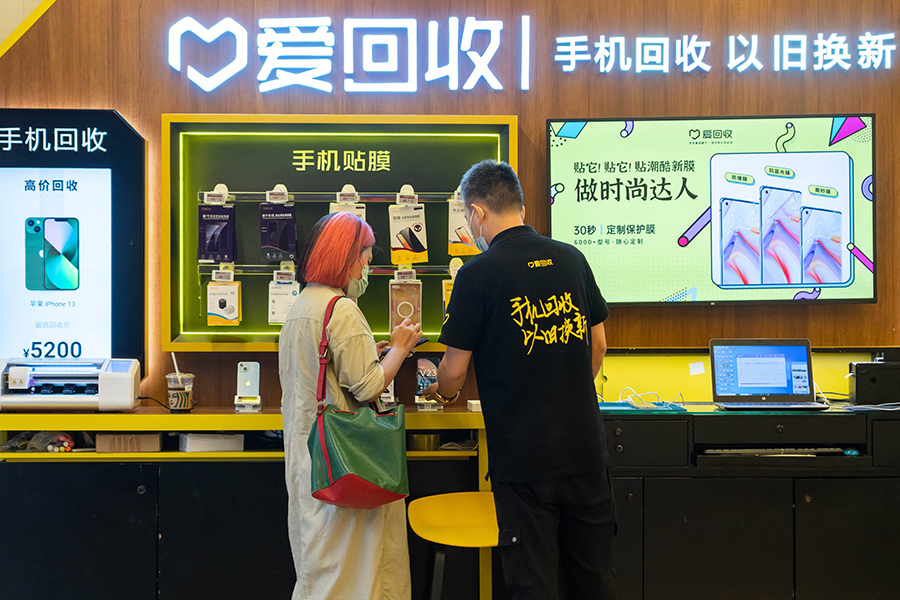
Tech-savvy, environmentally conscious youth embrace green, sustainable lives
Ever wondered what happens to hundreds of millions of unwanted smartphones, laptops and other discarded electronic devices as consumers switch to updated gadgets every once in a while?
Nowadays, such rejected devices are finding their way to online platforms, which either resell them as secondhand goods at attractive prices or channel them to recycling firms if they are deemed low-value items.
An increasing number of young internet-savvy shoppers, who are also environmentally conscious, are doing away with old habits of rejecting pre-owned goods and instead are looking for high-quality and affordable products on secondhand trading platforms.
China remains the world's largest smartphone market. According to a report by the China Association of Circular Economy, in the past five years, 430 million mobile phones have been sold annually on average in China, accounting for 30 percent of global smartphone sales.
Meanwhile, about 370 million handsets were discarded in 2020, and the figure rose to 404 million last year, the report said. However, only 2 percent of them have been recycled using regular channels, said a report in August, citing data from the Ministry of Industry and Information Technology.
Compared with street vendors who engage in mobile phone recycling, online platforms provide users with a more reliable and stable recycling channel with transparent pricing structures.
Shanghai-based electronics recycling platform ATRenew Inc, formerly known as Aihuishou — "love of recycling" — focuses on the trading and recycling of secondhand electronic products such as cameras, phones and laptops, with an aim to minimize the negative impact of discarded consumer electronics on the environment.
Established in 2011, ATRenew, which stands for "all things renew", has opened 1,629 brick-and-mortar stores in 241 cities across the nation as of June 30.
The company reported its total net revenue grew 14.9 percent yearon-year to 2.15 billion yuan ($298.6 million) in the second quarter, while its gross merchandise volume or GMV reached 8.6 billion yuan, up 10.3 percent.
"Although our business is facing short-term headwinds from the COVID-19 pandemic, we firmly believe that the demand for electronic device recycling, trade-ins and other value-added services will grow along with the long-term development of the circular economy in China," said Chen Xuefeng, co-founder, chairman and CEO of ATRenew.
The company now operates four business lines, covering consumer-to-business or C2B electronics recycling platform Aihuishou, B2B used electronics trading platform Paijitang, B2C secondhand platform Paipai as well as AHS Device, which concentrates on electronics recycling in the global market.
Recycled mobile phones firstly undergo irreversible information and data removal. Lower-end phones will be handed over to electronic waste recycling companies for dismantling and metal extraction, while premium castaways will be resold as used goods after professional processing.
Du Xiaochen, vice-president of ATRenew, said they are ratcheting up efforts to build online and offline recycling systems and boost supply chain capacity while reducing costs and improving transaction efficiency.
Du said the company is seeking new sources of revenue by offering smartphone maintenance, peripheral product sales and other value-added services, as well as expanding product categories covering luxury products and photographic equipment at its offline stores in first and second-tier cities.
It has collaborated with smartphone makers to launch the "trading in an old one for a new one "service, established standardized quality inspection systems, and improved after-sales services for secondhand electronic devices.
In 2019, the company merged with Paipai, a secondhand trading platform backed by e-commerce behemoth JD, in a bid to further standardize the electronics recycling process and improve efficiency by leveraging JD's retail, logistical and technological strengths.
Li Zhifeng, a 27-year-old software engineer from Taiyuan, capital of Shanxi province, is considering upgrading to the newly launched iPhone 14 from the iPhone X, which he bought about four years ago.
"I plan to sell my old phone. However, I don't trust street vendors who engage in mobile phone recycling as I fear my personal information might be leaked and the value of the used phone can't be fairly assessed," Li said.
Li added he would probably opt for a formal channel that offers a clear and reasonable price for secondhand commodities.
The market scale of China's secondhand consumer electronic products is expected to amount to 967.3 billion yuan in 2025 from 252.2 billion yuan in 2020, with a compound annual growth rate reaching 30.8 percent during this period, according to consultancy CIC.
Pan Helin, co-director of the Digital Economy and Financial Innovation Research Center at Zhejiang University's International Business School, called for efforts to bolster the standardized and regulated development of the smartphone recycling industry, and establish relevant industry standards covering the removal of personal information as well as market-based price setting for recycled phones.
Pan said electronics recycling platforms should strengthen cooperation with existing smartphone makers to further reduce transaction costs, and stimulate people's willingness to sell phones they no longer use.
Last July, the National Development and Reform Commission released a development plan to spur the circular economy during the 14th Five-Year Plan period (2021-25). Circular economy refers to a model focusing on recycling and reusing materials and resources.
The NDRC has called for efforts to accelerate the establishment of a recycling system for waste goods and materials, improve the discarded goods recycling network, enhance the processing and utilization of renewable resources, and develop the secondhand goods trading and refurbishing industry in an orderly manner.
Developing the circular economy is conducive to helping achieve the country's goal of peaking carbon emissions by 2030 and realizing carbon neutrality by 2060, experts said.
According to a report released by global consultancy Frost & Sullivan and the Institute of Energy, Environment and Economy at Tsinghua University, the trading of underutilized or unwanted goods — which serves as an important part of a circular economy — can effectively promote the efficient utilization of recyclable resources in China and achieve carbon emissions reduction.
The report said each transaction of an unwanted mobile phone can reduce at least 25 kilograms of carbon emissions, while trading a discarded refrigerator can realize 130 kg of such emission reductions.
"The recycling of smartphones via regular channels is conducive to prolonging the life cycle of mobile phones, reducing carbon emissions and contributing to the sustainable development of the environment," said Wu Shenkuo, law professor and assistant dean of the Internet Development Research Institute at Beijing Normal University.
More efforts should be made to select formal channels and reliable service providers to finish the recycling process, especially ensuring the full erasure of personal data, Wu said, adding that authorities should strengthen supervision and management to protect user privacy.
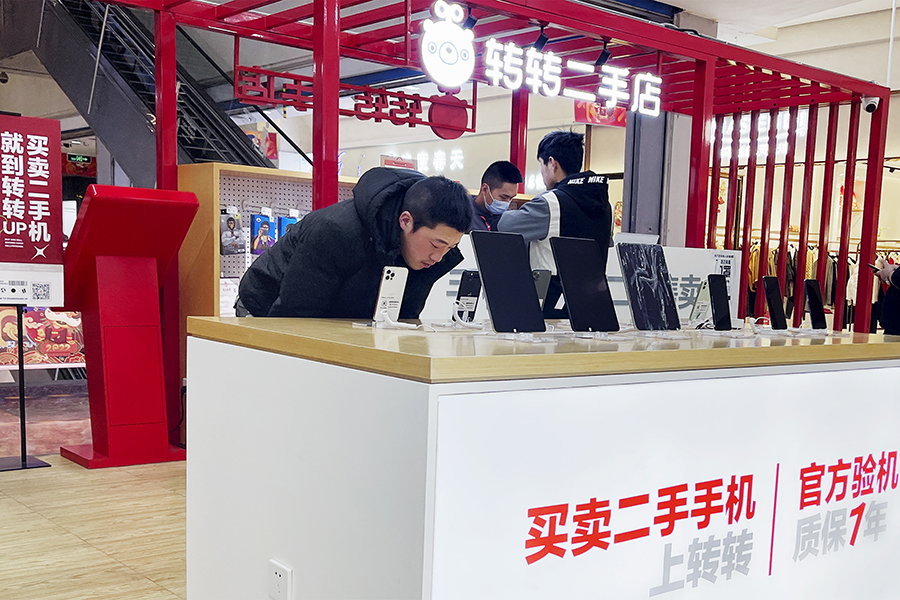
Zhuanzhuan, another online trading platform for used goods in China, has set up operation centers and stores in Beijing; Shenzhen, Guangdong province; Qingdao, Shandong province, and Chengdu, Sichuan province, to promote the recycling and circulation of idle resources, including used mobile phones. Its intelligent sorting, warehousing and quality inspection center for different types of secondhand goods in Qingdao went into operation in July.
Based on massive transaction data and artificial intelligence-powered algorithms, Zhuanzhuan has launched a secondhand commodity pricing guidance system, which can accurately match user needs and enhance the willingness of consumers to trade their unwanted goods on the platform.
Low-carbon, sustainable development has been an irresistible trend driving social and economic development, said Huang Wei, CEO of Zhuanzhuan. "We have seen that people's consumption concepts have changed significantly, with their demand becoming more and more diversified, as they are willing to buy and use secondhand goods and sell their unused and unwanted items."
Huang said its core business — the recycling of consumer electronics products — registered triple-digit growth in 2021, while noting the circulation and recycling of unused commodities, including secondhand smartphones, can effectively reduce carbon emissions.
"In the past six years, we have achieved more than 1.78 million metric tons of carbon emission reductions by working with users to bolster the circulation of unwanted goods, which is equivalent to reducing the energy consumption of fossil fuel-powered vehicles having traveled about 10 billion kilometers," Huang said.
Huang said the company will increase investment in AI-powered intelligent appraisals, dynamic pricing systems and other scientific and technological innovations, build digitalized platforms, and notably improve the circulation efficiency of secondhand goods so as to meet people's diversified consumption demand.
Mo Daiqing, a senior analyst at the Internet Economy Institute, a domestic consultancy, said the country's secondhand market, which is still at a nascent stage, has huge growth potential, and the penetration rate of online recycling and trading platforms is still relatively low.
Meanwhile, the new business model has encountered many problems. Mo said sellers have more information than buyers before transactions occur on these platforms, which may result in the appearance of some fake and low-quality products and the occurrence of fraudulent behavior during transaction processes.
"How to deal with the above issues and establish mutual trust between sellers and buyers is key to the secondhand market," Mo added.




















