



A new modernization choice for world









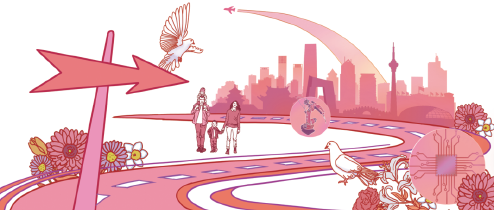
In his speech at the opening session of the 20th National Congress of the Communist Party of China on Sunday, CPC Central Committee General Secretary Xi Jinping highlighted China's achievements and future development and strategic trajectories. One example among these that carry inevitable implications for post-pandemic global resilience is Xi's enunciation of the Chinese path to modernization with its clearly defined benchmarks and timelines.
A careful reading of Xi's speech shows economic growth is but only a part of his prescribed indexes in his modernization philosophy. A tentative count of its pillars include upholding the overall leadership of the Party and socialism with Chinese characteristics, developing whole-process people's democracy, enriching the Chinese people's cultural lives and achieving common prosperity, promoting harmony between humankind and nature and a new form of human advancement, and building a community with a shared future for mankind.
As the world's second-largest economy — and possibly the world's largest economy by 2030 — Chinese modernization trajectories remain deeply intertwined with those of the rest of the world. As the world's largest trading nation with huge foreign exchange reserves and nearly 30 percent share of global manufacturing — and home to emerging global brands thanks to innovations and cutting-edge research — China has also increasingly become part of global governance structures and processes.
In 2016, the World Bank recognized China as an upper-middle income country. Given all this, Xi's underlying vision behind China's continued pursuit of modernization portends critical system-shaping possibilities. And, at its core, Xi's vision aims to present an alternative to war, violence and market competition-driven conventional Western models of national development.
The first distinction that calls for the world to take notice is Xi's continued stress on making the Chinese path to modernization peaceful and to strive for shared prosperity for all. This may appear idealistic. But China's successful eradication of absolute poverty makes Xi's contentions worth a careful scrutiny.
Second, the new era under Xi's leadership has also seen China playing a more prominent role in global governance structures and processes. One yardstick of this recognition is the US' National Security Strategy reports of February 2015, December 2017 and October 2022 mentioning China 12, 33 and 54 times respectively.
Third, many developing nations may also find the Chinese development model enticing. After all, China remains a developing country and its economic miracle is just more than four decades old. Being on a similar curve, emerging economies, too, will find China's development model engaging. In particular, the COVID-19 pandemic has disrupted the global industry and supply chains and slowed down the economic development of most countries, prompting them to seek serious course correction and explore alternative choices to revitalize their industry and supply chains and boost their economic growth.
The new era has already seen Xi launch global development alternatives such as the Belt and Road Initiative and propose to build a community with a shared future for mankind — and more recently put forward alternative development and security-safeguard paradigms like the Global Development Initiative and the Global Security Initiative.
All these remain closely connected with Xi's modernization drive that aims to realize common prosperity by improving income distribution. In his speech, Xi also talked about ensuring a "more work, more pay" system to enable people to work hard and achieve greater prosperity.
Having eradicated extreme poverty, China now seeks to focus on eliminating relative poverty by ensuring equality of opportunity and taking measures to raise the incomes of low-income earners. This will further expand the size of China's middle-income earners which already adds up to 500 million. Conversely, this calls for keeping tabs on accumulation of wealth and ensuring wealth distribution is well regulated.
Way back in December 2012, Xi introduced the idea of a "Chinese Dream" and the Chinese modernization drive marks the next step toward achieving that goal. The Chinese Dream is not to be confused with the proverbial "American Dream "that focuses on unleashing individual energy for personal prosperity. Indeed, this commitment remains enshrined in the United States Constitution that grants citizens the fundamental right to life, liberty and pursuit of happiness. The Chinese Dream, besides people's well-being, also visualizes national rejuvenation and cultural rejuvenation of the nation.
Taken together with Xi's Global Development Initiative, his modernization paradigm seeks to present a "new choice" for humankind where education, science and technology and human resources are to be the foundational and strategic pillars for developing China into a modern socialist country by creating an open, globally competitive innovation-driven ecosystem.
This is bound to make the Chinese modernization all the more closely intertwined with the rest of the world. And with the world's second-largest population and fifth-largest economy, India will have to pay closer attention to China's development trajectories and the vision behind it.
The author is a professor of diplomacy and disarmament at Jawaharlal Nehru University (New Delhi) and a visiting professor at the University of British Columbia (Vancouver, Canada).
The views don't necessarily reflect those of China Daily.
If you have a specific expertise, or would like to share your thought about our stories, then send us your writings at opinion@chinadaily.com.cn, and comment@chinadaily.com.cn.





