High-speed rail enables coordinated development









Congress inspires intercity commuters to envision even more convenient life
Sitting in the waiting room of a railway station in Hebei province on Sunday morning, Li Xin looked down at his smartphone and read news about the 20th National Congress of the Communist Party of China, looking forward to watching its opening later.
Li, 51, is a resident of Zhuozhou city in Hebei, which is about 60 kilometers southwest of downtown Beijing. He works in the capital and commutes on workdays by high-speed train.
He was excited to see what new policies the congress would roll out regarding the coordinated development of the Beijing-Tianjin-Hebei region, which had made his life easier since it was initiated in 2014.
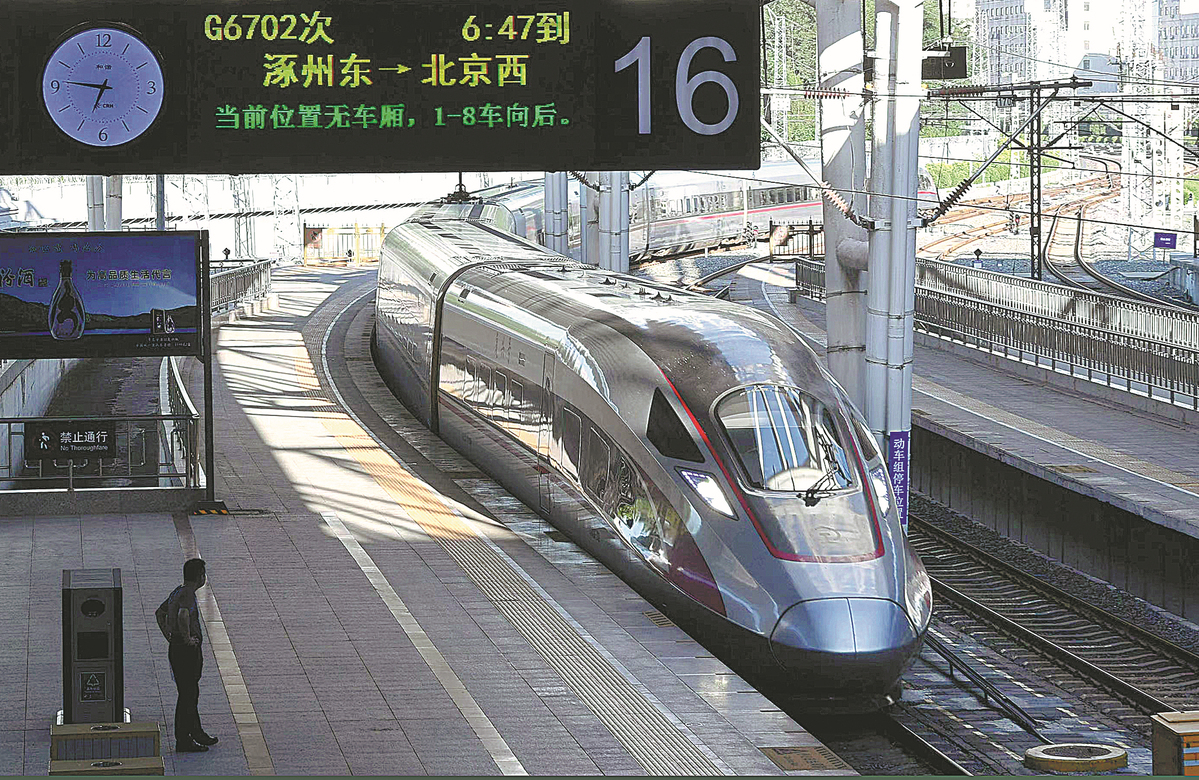
As usual, Li arrived at the Zhuozhou East Railway Station around 7:30 am on Sunday and would later take a high-speed train to Beijing.
The route, which costs less than 30 yuan ($4.20) for a single journey, arrives at Beijing West Railway Station in no more than half an hour.
"It's very convenient for intercity commuters like me," said Li, who has worked as an accountant at a company in Beijing's Chaoyang district for seven years.
Before the special high-speed train opened in July this year — customized for intercity commuters in Zhuozhou and Beijing — Li went to work mainly by bus.
"I needed to get up early at 5 am and spent more than two hours on the way to work," he said.
But with the high-speed commuter train, he could save more than an hour for a one-way journey. "I am just enjoying the fruits of the coordinated regional development," Li said.
According to Zhuozhou's development and reform bureau, the city houses more than 7,000 commuters working in the capital. And the train is one among many moves that were designed to coordinate the development of the Beijing-Tianjin-Hebei region.
"Maybe in the future, I can go to Beijing from Zhuozhou by subway or light rail, which will be more convenient," he said.
Li's expectations about the future have been given a confidence boost from the congress.
"China will thoroughly implement the coordinated regional development strategy, major regional strategies, the functional zoning strategy and the new urbanization strategy," according to a report submitted to the 20th CPC National Congress on Sunday.
It also said the country will promote coordinated development in the Beijing-Tianjin-Hebei region.
Such plans also impressed 38-year-old Li Xu, who went back home to Beijing via the high-speed train on Sunday afternoon. He works in Zhuozhou and commutes between the two cities every day.
At around 6:30 pm on Sunday, Li Xu read about the report on his phone while awaiting his train heading for Beijing at Zhuozhou East Railway Station.
"It's very exciting and inspiring for me. I can see an even greater future for our country and my own life," Li said.
He runs a training company in Zhuozhou, which he said can provide a lower cost for running an enterprise than in Beijing.
"Besides, Zhuozhou is close to the capital, and the transport is more and more convenient," he said.
Twelve employees at his company live in Beijing and need intercity travel every day. In the past, most of them commuted by car, which usually required more than one hour for a one-way journey.
"If we encountered traffic jams, it would be more time-consuming, which occurred frequently," Li Xu said.
"Now we take the train together and can chat on the way. How convenient!" he said.
"I believe that in the future, cities in the Beijing-Tianjin-Hebei region will be much closer to each other," Li Xu said after hearing the report.
zhangyu1@chinadaily.com.cn





- Tianjin launches youth program to cultivate university talent for tech market
- Local farmers combat desertification in Moyu county of Xinjiang
- N China's Hohhot launches winter amusement programs to boost local economy
- Viral app bares 'safety anxiety' among solo dwellers
- Research suggests causes of moon's two different 'faces'
- AI software under lens for facilitating porn talk