



A sizzling problem
Environmental experts have called for urgent action to deal with blistering temperatures arising from climate change, and for companies to reduce carbon emissions to cut operating costs. Ao Yulu reports from Hong Kong.









Fifty-year-old Yu Yanmei, her husband and their two daughters, who live in a top-floor, government-subsidized flat in a 12-story housing block in Sham Shui Po, were probably among the first Hong Kong residents to feel the abnormally scorching temperatures in the past few months.
For the family, this summer had been extraordinarily searing and unbearable, with even indoor temperatures hitting 40 C. The younger daughter was unwilling to go home after school because of their sweltering 15-square-meter flat. They sometimes had to turn on a fan and an air conditioner all day, but still, it wouldn't help.
"I've never experienced such a hot summer," groans Yu. "We even tried to pour water on the roof to cool down the building, but in vain."
In July, the Hong Kong Observatory recorded 21 "very hot" days with maximum temperatures exceeding 33 C - a monthly record since 1884. There were also six and 10 "very hot" days registered in June and August respectively.
The World Meteorological Organization warned in May that the hot climate is here for the long run. It said it's "93-percent likely" there will be at least one year from 2022 to 2026 when the hottest temperatures will be recorded. And the chance that average temperatures in that period will be higher than those in the past five years is 93 percent.
"The hot weather means we have to pay much more for our monthly electricity bills," says Yu. The family's monthly electricity bill is usually around HK$705 ($90), but it soared to HK$931 in June and about HK$1,050 in July and August this year during the summer peak - a world of difference compared with what they normally paid during the same periods in the past few years.
Painting it out
The Yu family suffered for several months under the intense heat until they found help from a local technology startup team through a community service center.
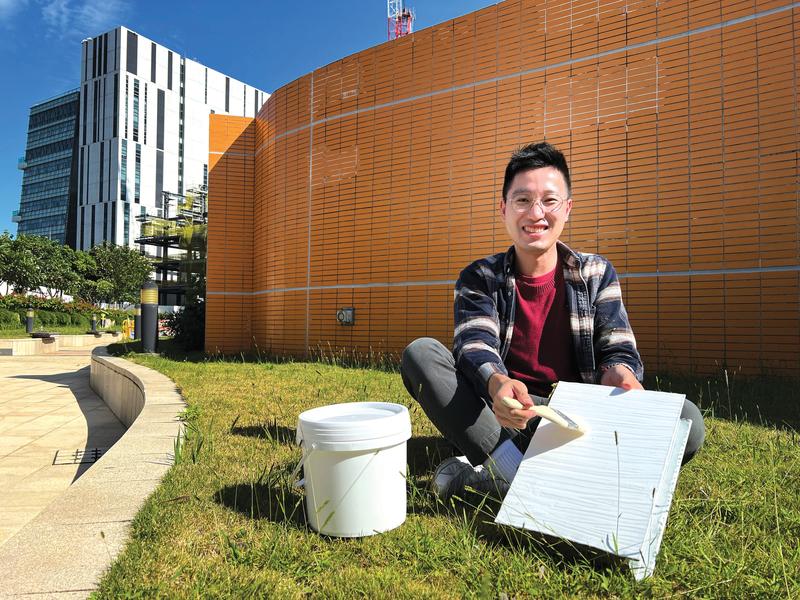
The startup, i2Cool, which was founded by a group of doctoral students and researchers from the City University of Hong Kong in 2021, found how climate change has been affecting people's lives on a global scale. It developed a special paint that can cool down temperatures on the surface of buildings.
Zhu Yihao, co-founder of i2Cool, says the paint can reflect thermal radiation and emit heat, thereby reducing the temperatures of materials. After applying the paint on the rooftop of Yu's home, the indoor temperatures in her flat went down 5 to 6 C within a day.
According to Zhu, applying the paint on every square meter of space would save at least 120 kilowatt-hours of electricity and reduce 70 kilograms of carbon dioxide emissions every year, or the equivalent of planting six trees.
He says i2Cool has teamed up with the Architectural Services Department and the Drainage Services Department of the Hong Kong Special Administrative Region government to use the paint to optimize the internal temperatures or storage conditions in buildings.
The company has also started pilot programs at shopping malls and other commercial buildings in various central business districts, in collaboration with major developers like Hong Kong Land, Hang Lung Group and Sun Hung Kai Properties.
The cooperation is evidence of how Hong Kong's major enterprises and institutions are actively responding to the challenges brought by extreme weather as the heat wave has raised the financial burdens of big companies through increased power consumption and soaring utility bills.
According to CLP Power Hong Kong - one of the city's largest electricity providers - its monthly local electricity sales had risen by 1 percent year-on-year in August to reach 3.68 billion kWh.
Another report by CLP revealed that every 1 C difference in the temperature for every 3,000 square feet (279 square meters) of space could translate into 750 kWh of electricity consumption each year and generate bills of HK$1,100 annually.

Safety problem
The scalding weather has not only created an uncomfortable living environment, but also adversely affected the health of workers, particularly those on construction sites or working outdoors.
A report by the International Labour Organization in 2019 said workers might lose half of their working capacity if daily temperatures stay at around 33 C. The organization also said it expects more than 2 percent of total working hours worldwide to be lost every year by 2030, either because it's too hot to work or because workers have to work at a slower pace, while accumulated financial losses from heat stress are projected to reach $2.4 trillion.
As far as Hong Kong is concerned, the report estimated that the city would lose about 0.81 percent of its total working hours by 2030 - equivalent to 43,000 full-time jobs - while the construction industry would bear the brunt of the losses among all sectors, accounting for 5.62 percent of the lost working hours.
"Hong Kong people are seeing extreme weather here and on the Chinese mainland, as well as in different parts of the world. There is a growing consistent narrative that global warming is a cause of extreme weather," says Christine Loh Kung-wai, chief development strategist at the Hong Kong University of Science and Technology and also a former undersecretary for the environment in the HKSAR government.
"On a personal basis, the extreme heat in Hong Kong creates discomfort and even health problems, especially for the elderly and children. The heat has been going on for an extended period, so it's becoming even harder to deal with. Extreme heat affects all outdoor work and activities, which means it becomes an occupational safety problem," she adds.
Taking actions
Some Hong Kong businesspeople realize that extreme weather causes global problems that can affect their businesses across the world, says Loh.
Ben Wong, head of open innovation at Eureka Nova - an accelerator powered by New World Group to support innovation and development of technology startups - says there is a global trend that more companies and entrepreneurs are realizing how climate change is affecting their operations.
"Many technology enterprises have begun applying new technology to help reduce carbon emissions and respond to the challenges from climate change, especially extreme heat waves, not only in the short term but also in the long run," he says.
Big companies are now aware of the importance of saving energy to balance rising electricity costs and strive for decarbonization, says Wong. Some enterprises are applying data-driven technology tools to help them track their carbon footprint in order to reduce carbon emissions.
Loh says climate change will not only affect big companies. Hong Kong's financial sector will have to take further specific measures.
"Financial sectors worldwide are looking at how to measure and price climate risks relating to extreme weather," she says. "They are now looking at scientific data and using their models to price climate risks. They want companies to disclose how they see climate risks, and what they are doing about it, such as adopting carbon neutrality targets or timelines."
"In assessing climate risks, investors also look at what governments are doing. For example, they may see that, at present, Hong Kong's climate risk is manageable because of the city's current infrastructure. But they will review it from time to time as the degree of risks will rise," says Loh.
"To some extent, (tackling) extreme climate problems, such as preventing floods or dealing with the rise in sea levels and landslides, will depend a lot on the government. Adaptation and resilience policies are essentially public sector investments. Usually, a place where the government has strong infrastructure presents a lower risk than a place with weak infrastructure."
Therefore, one of the most important things to mitigate the impact of climate change is for the government to act, says Loh.
"The HKSAR government should initiate relative policies and standards across different institutions and firms. That is the first step to make companies realize what they can do and to what extent they should do."
Contact the writer at aoyulu@chinadailyhk.com


- Spotted seals seen giving birth on land for the first time in China
- Nation's satellite data reception coverage reaches new heights
- Central govt to help build Shanghai into a green global shipping hub
- Grand community banquet attracts 2,600 guests in Chongqing
- Giant pandas filmed enjoying their meals at Shaanxi conservation base
- Smart Dragon 3 rocket lifts off at sea with seven satellites











