



Initiative to protect bird migration routes









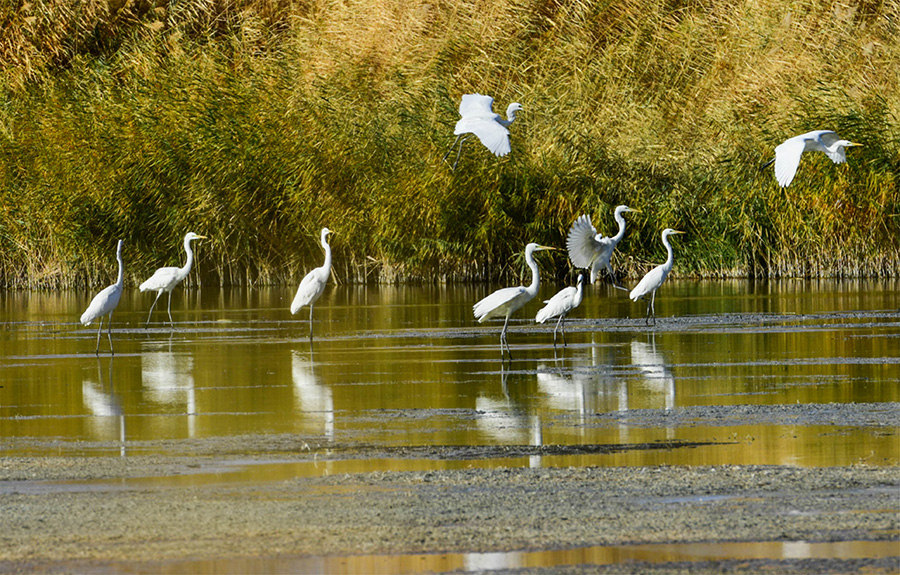
Experts call for improving international monitoring network across key areas
A China Bird Migration Channel Protection Network Initiative was announced on Wednesday at a forum during the ongoing 14th Meeting of the Conference of the Contracting Parties to the Ramsar Convention on Wetlands, calling for prioritizing the protection of wetlands on bird migration routes.
The conference, known as COP14, runs from Nov 5 until Sunday in Wuhan, Hubei province, and Geneva, Switzerland.
The initiative calls for making the protection of migratory channels for birds a major task by collecting bird and wetland data and building networks of conservationists.
Bird migration channels are the stable routes that birds travel along between breeding and wintering sites.
At the forum held online and on-site in Wuhan, experts shared stories of global flyover zones, bird conservation, and habitat protection and restoration.
Guan Lei, a project manager from the Beijing Entrepreneur Environmental Protection Foundation, said as a key area along migration routes, the Chinese mainland has 512 central bird areas. However, 37 percent of them are not protected and face threats from climate change, habitat loss, environmental pollution and illegal hunting.
"We are planning conservation work in key wetlands including figuring out which places are suitable habitats for birds, monitoring bird habits and numbers," he said.
Yu Qian from the Beijing office of the International Crane Foundation said it is necessary to build a monitoring and protection network with the extensive use of satellite tracking and field surveys, because key areas that fall short of protection need to be found.
More than 8 percent of the world's white cranes spend the winter at Poyang Lake in Jiangxi province, meaning that any problem in the lake's wetland ecosystem could have a catastrophic impact on the species, she said.
"Changes in their habitat conditions will also affect the habitat selection of cranes. The good news is that China's international and domestic conservation efforts over the years have increased the population of white cranes," she said.
Lei Gang, a senior adviser at the World Wildlife Fund, shared his experience of saving the breeding area for Baer's pochard, a critically endangered species.
In 2015, Lei and his colleagues prevented an intercity railway and highway construction project in Wuhan that would run through a crucial Baer's pochard breeding area. Their success was helped by support from the city's forestry bureau.
"The construction would disturb the breeding and our job was to prove that fact to the local government. I am proud to see that the bird's numbers have increased and their distribution area has expanded," he said.
Four of nine major bird migration channels in the world pass through China. To protect the channels, China has built more than 2,200 wetland-type nature reserves and a large number of wetland conservation communities, covering almost all key nodes on the channels, according to the National Forestry and Grassland Administration.
This important work has led to increases in bird populations, many of them classified as rare or endangered.
The number of crested ibises has increased from 7 in 1981 to more than 6,000 today. The number of oriental storks has risen from 3,000 in the 1990s to nearly 10,000, the administration said.


- Beijing-Pyongyang passenger rail service to resume Thursday
- Shanghai and Jiangsu integration boosts sports-tourism development
- China Eastern Airlines restores direct flights between Shanghai and Stockholm
- RedNote targets AI-run accounts with new governance rules
- China's draft law on ethnic unity aims to serve as global model, political adviser
- Spring blossoms complement the Honghe Hani Rice Terraces in Yunnan





