China boosts Africa's fight against poverty









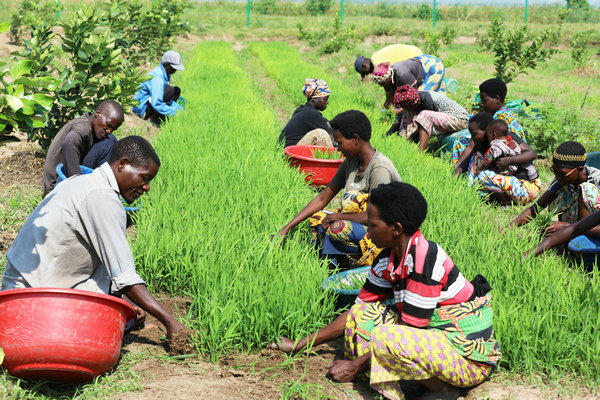
BUJUMBURA — On a sultry afternoon, Charles Ngendakumana, a farmer in Burundi's northwestern Bubanza province, was busy adding a handful of grass to the cattle trough in the backyard of his newly built rural home, a spacious single-floor bungalow with freshly painted lime walls.
About a dozen hens were running around. Pointing to them, he said the chickens had been given to his family by Chinese agricultural experts. "They also provided good rice seeds and fertilizer and taught me planting techniques so that I have enough food to feed my children," the 43-year-old father of six added.
Four years ago, Ngendakumana began growing hybrid rice introduced from China under the guidance of Chinese agricultural experts. Since then, his farmland has also increased from half a hectare to five hectares in Ninga, a village in the Commune of Gihanga.
"Next, I want to buy more land, more cows, as well as several new water pumps when the dry season comes," said Ngendakumana, asserting that this was "unthinkable" in the days when even food was scarce, before the arrival of Chinese expert teams.
Known as the "heart of Africa", the country of Burundi has a tropical climate with abundant rainfall. Its natural conditions are favorable to rice production, but the low yield of local rice production causes food shortages. To address the challenge, China has been implementing technical cooperation programs in Burundi since August 2009, sending a total of 45 experts to the African country in five batches to help develop agriculture.
The Chinese experts are currently planting hybrid rice in 22 villages in the country in an effort to help realize Burundian President Evariste Ndayishimiye's slogan — "Every mouth has food and every pocket, money".
The experts have visited fields in all 14 rice-growing provinces of the country to conduct research and trials, and successfully selected and introduced eight varieties of rice seed adapted to the local conditions. In this way, they have helped effectively address the problem of yield reduction or even extinction caused by rice plague in the mountainous areas of Burundi.
The Chinese experts also helped establish the first demonstration village of rice cultivation for poverty alleviation in Ninga village, where hybrid rice was grown for five consecutive seasons. Since hybrid rice was planted there, the village has increased its rice production by 1,661 metric tons, resulting in improved income for local households.
"Our hybrid rice yields are twice as much as the local varieties," Chinese expert Jiang Daiming said. "Rice yields here used to be only 2 to 3 tons per hectare, while the introduced disease-resistant varieties can yield four to 5 tons per hectare, sometimes even 7 tons.
"It will be important to improve the local rice crop (yield) if production can be expanded in the future," Jiang said.
To help Burundi build an independent and sustainable rice industry, Chinese experts have also conducted 82 training sessions in the country, training 3,050 people. Among them are dozens of bright young Burundians who are using the skills they have learned to help lift villagers out of poverty throughout the country.
Ernest Irankunda, a young man from Ninga, gave up the opportunity to attend university out of a sense of duty to his family and decided to learn rice cultivation techniques from Chinese experts. Now he has become a local expert in rice cultivation and was recently hired by the government to lead a team to share farming experience in the neighboring Democratic Republic of the Congo.
Agricultural cooperation with a view to reducing rural poverty in Africa has been an important area of China-Africa cooperation in recent years. During the 8th Ministerial Conference of the Forum on China-Africa Cooperation held a year ago in Senegal, China announced that it will implement the poverty reduction and agricultural development program with Africa over the next three years.
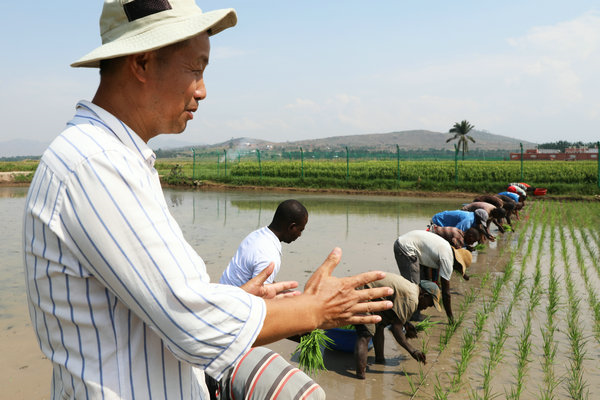
As part of the program, China will send 500 agricultural experts to Africa, set up a number of joint centers for modern agrotechnology exchange, demonstration and training in China, and encourage Chinese institutions and companies to build demonstration villages in Africa that support agricultural development and poverty reduction.
In October, such a village was inaugurated in the Matangi Tisa village in Kenya's Nakuru County. The chief official for agriculture in the county, Fredrick Owino, while welcoming the initiative, said that the project will promote China's advanced farming technologies in Kenya, boosting agricultural production and reducing poverty.
Also last month, a Demonstration Village for China-Africa Agricultural Development and Poverty Reduction was set up at the Shimwengwe village in Zambia's Lusaka province. Through the project, villagers will be equipped with the knowledge and small-scale technologies to improve their productivity, especially in rearing chickens.
"We are very grateful for the work of the Chinese expert teams," said Prosper Dodiko, permanent secretary of Burundi's Ministry of Environment, Agriculture and Livestock, adding that besides hybrid rice, Chinese experts have also introduced apple trees and promoted poultry farming, aquaculture, and rice-fish farming. "Next year, Burundi's agricultural development is ready to enter another stage, where we will develop irrigation systems and agricultural mechanization. I am glad that Chinese experts are here to help us."