Devising a new Sino-US strategic framework










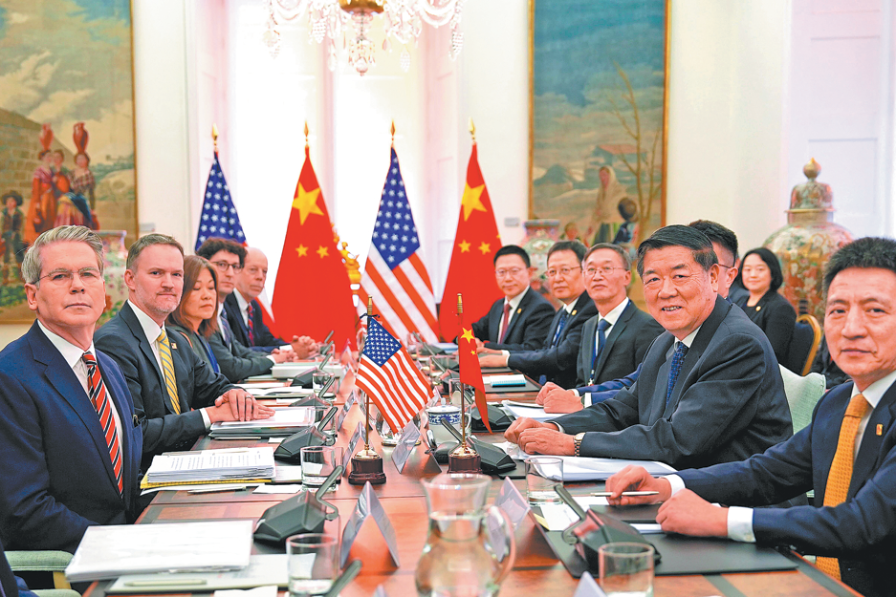
China may be the United States' "most consequential geopolitical challenge", as per the Joe Biden administration's recent National Security Strategy, but it is also one of its most globally significant political and economic partners. It is welcome therefore that President Xi Jinping and President Joe Biden were able to initiate a new phase of strategic communication on the sidelines of the G20 Summit in Bali, Indonesia, last month.
In Bali, the two sides re-established a baseline of in-person, leader-led communication, resumed senior official-level dialogue channels, and provided a measure of strategic reassurance to the other side that lowered their respective levels of mistrust. By achieving the intended purpose of having in-depth communication and clarifying both strategic intentions as well as redlines, the two leaders' meeting has hopefully set a new direction, established a framework, and kicked off a process that will cement a "floor "under their all-important bilateral relationship framework in 2023.
At the time of his inauguration on the steps of the US Capitol in January 2021, it was hoped by some that President Biden would gradually return China-US relations to the normal track of dialogue and cooperation after the destructive decoupling-related policy measures of the Donald Trump administration. Those hopes have not borne fruit and may not bear fruit going forward either if there is no change in bilateral ties.
The "old normal" in China-US relations has been fundamentally transformed over the past half a decade.
The broad-minded and farsighted five decade-long consensus on China-US relations that was inaugurated in February 1972 by Chairman Mao Zedong and then premier Zhou Enlai, former US president Richard Nixon and his secretary of state Henry Kissinger is no longer purpose-fit for this more fraught age of geopolitics.
The consensus that was memorialized in the Shanghai Communiqué should be revised and renewed with a fresh strategic framework of Sino-US coexistence that suits the era of strategic competition. This new framework should aim to keep tensions within a manageable range, prioritize stability and coexistence, encourage communication, and privilege a constructive working relationship in areas of common interest without trampling on the other party's system, values and regional commitments.
The Shanghai Communiqué era in China-US relations may be receding into the past but its lessons remain just as enduringly relevant in sketching the new framework for the 21st century age of US-China strategic competition. In Shanghai, the two sides had focused on the big picture and were not shy to voice their differences. No effort was made to mask their divergent stances. Just as importantly, no effort was spared to situate these divergent perspectives within a broader framework of stable, cooperative and peaceful coexistence.
On Nov 16, 2021, almost exactly one year earlier to the day they met in Bali, Xi and Biden held an important virtual meeting. In his remarks, Xi suggested that the two sides adopt a "peaceful coexistence, no conflict, no confrontation" bottom line and sincerely adhere to it. For his part, Biden spoke of the need to manage strategic risks responsibly and equip the bilateral relationship with common sense "guardrails" so as to ensure that competition did not veer into conflict — a policy he reiterated in Bali.
Xi and Biden should now use their respective approaches as a common bottom line and articulate a new paradigm of ties founded on the principles of "stability and clear-eyed but constructive coexistence" for an era of strategic competition. In 2023, the two sides should commence work on an overarching document that juxtaposes, and memorializes, their divergent policy positions within a steadying new framework.
Much like the Shanghai Communiqué was an objective lesson in the constructive management of differences, a new framework could yet yield a balance of harmony between the goals pursued by Washington and Beijing and the requirements of the Asian and international systems at large.
In his famous treatise on European peacemaking in the wake of the Napoleonic Wars, Kissinger observed that the essence of wise international relations was the transformation of force into reciprocal agreement by identifying a principle of order that is based on a loose consensus among the parties on the nature of justice in the international system.
China and the US should commit to a relationship founded on these principles for this new era of strategic competition. Given the importance of their bilateral relationship to Asia and the world, it is essential that both Washington and Beijing rise above their parochial visions of ideology and justice and sculpt a durable consensus for the betterment of all.
The views don't necessarily reflect those of China Daily.
The author is a senior fellow at the Institute for China-America Studies in Washington, D.C.