UK shortages egged on by several crises









Sustainable diet
Promoting a healthier and sustainable diet was stressed in the strategy, as the latest data shows that around 64 percent of adults and 40 percent of children in England are overweight or living with obesity due to the "Junk Food Cycle", which means food companies invest more money creating calorie-dense foods to makes people eat more of them and expand the market, leading to a feedback loop promoting more investment and making people eat more.
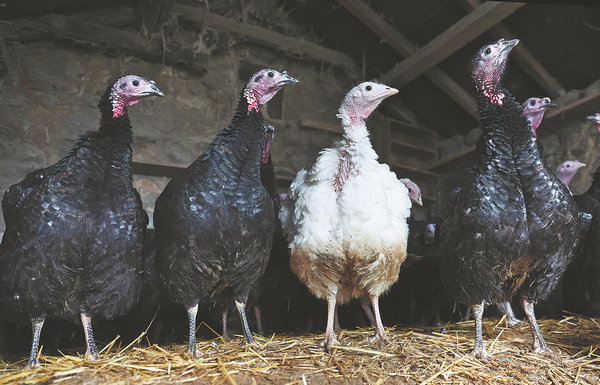
An analysis by consulting firm SYSTEMIQ shows that by cutting meat production by just 13 percent — the equivalent of European consumers going meat-free for one day a week — the EU could reallocate enough grain and land currently used to feed livestock to offset the 23 million metric tons of wheat produced by Ukraine in 2020.
Sarah Lake, executive director of Madre Brava, a nonprofit organization advocating the reduction of the centrality of meat in food sales, said in a commentary to China Daily: "Simply put, the meat industry's inefficient use of fertilizers drives up food prices, exacerbates world hunger, and pushes farmers into poverty.
"Reallocating land from meat production to grains, vegetables, legumes, and alternative proteins would be a far more effective way to feed a growing population on a warming planet."
China example
To put the food crisis issue in a broader context, some scholars suggested that the global food crisis is the natural consequence of the international capitalist food system, in which developed countries buy cheap food from around the world to sustain their industrialization.
Xu Zhun, associate professor of economics at The City University of New York, wrote an article Granary or Food Crisis: Coming Out of the 200-Year International Food System, arguing that the large-scale food trade emerged as a result of unequal development of capitalism, while the UK, as the first industrial country, sought food supplies from its colonies. After World War II, the United States supplanted the UK and dominated the global food system by exporting its cheap agricultural products to the countries in the Third World.
"It's not saying to stop food trade, but developing countries should be able to hold the rice bowl in their own hands… countries should see food production, farmers and the agricultural industry as a whole development strategy," said Xu.
"China is a good example. It participated in the global trade of agricultural products, but in general, it has maintained autonomy in the process of industrialization and urbanization," he added.
China has long adopted a national strategy for food security, characterized by self-sufficiency based on domestic grain production, moderate imports and technological support. It has also established a strict farmland protection system and adopted a policy to ensure the sustainable use of farmland and self-reliance in seeds.
Earlier in October, Cong Liang, director of the National Food and Strategic Reserves Administration, said China's ability to ensure its national food security continues to improve, with grain output reaching a record high of 683 million metric tons last year.
"With good grain conditions, our rice bowls are held firmly in the hands of Chinese people and are mainly filled with Chinese food," Cong said.
China has also been providing support to African countries for more than two decades, with farming techniques and personnel training. The continent has 60 percent of the world's potentially arable land, but many African countries still suffer from food insecurity and a low-productive agricultural sector.
Philip Isdor Mpango, vice-president of Tanzania, said during the Averting a Global Food Crisis session at the World Economic Forum in May, that more investment is needed in agriculture, including in irrigation, rural roadbuilding, and involving the younger population of the continent.
"We must strategize so that we have the young people involved throughout the agricultural value chain," he said. "If we do this for the very short term in Africa, we can turn this crisis into an actual opportunity for the continent. But, critically, it is important that we get global partnerships, and this is what has changed on the continent recently."