Chinese economy eyes reform, opening-up and turnaround in 2023










After a year of domestic economic volatility and international turmoil, China is expected to focus on economic growth this year, which means the country will further deepen reform and expand opening-up. In fact, judging by the Central Economic Work Conference held in Beijing last month and the speeches of the Chinese leaders, the top policymakers will indeed focus on economic growth, with the aim to restore the pre-pandemic high growth environment.
The Economist magazine has called it "this year's biggest economic event". But as always, the devil is in the details: How do policy authorities plan to stimulate private sector growth?
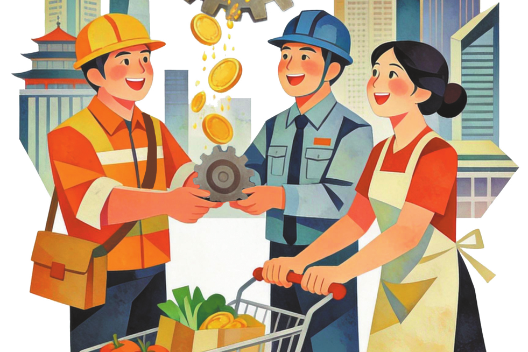
In 2023, China will tackle growth challenges with its "dual circulation" development paradigm. While external circulation (or foreign trade) will deepen regional and international trade and investment ties, internal circulation (or the domestic economy) will seek to accelerate domestic demand.
Now that most of the COVID-19 restrictions have been lifted, the government will implement a variety of measures to boost consumption. The idea is to increase the incomes of urban and rural residents so they can help boost the housing sector, raise new energy vehicles' sales, and improve eldercare.
But the momentum is on the supply side, particularly infrastructure investment. Government incentives seek to increase financing, especially by encouraging more private capital to participate in large national projects on energy, water, transportation and data centers, among others.
As such, fiscal support will be targeted and focused, whereas monetary policy is likely to remain cautious and neutral until the end of the US Federal Reserve's tightening. In turn, sectoral success is predicated on three critical areas: COVID-19, the technology sector and the property market.
With the lifting of the COVID-19 restrictions, stringent top-down restrictions are effectively giving way to bottom-up responses. The faster China can avoid the kind of short-term reactions and disruptions, which are typical of the transition, the speedier will be the return to the growth momentum.
In 2023, China could outpace many other emerging economies, with its secular long-term trend growth around 4 to 5 percent through the 2020s.
In the technology sector, the efforts of the policymakers to foster more competition began with a fast and broad momentum last year. Such initiatives will cultivate Chinese "little giants" and particularly small and medium-sized enterprises. In Germany, Mittelstand SMEs have proved resilient during periods of rapid economic change. After all, SMEs are less capital-intensive than big business but provide broader job opportunities in the long run.
But as John Maynard Keynes once put it, "in the long run, we will all be dead". It is vital to pace new technology-regulation regimes so that they will foster steady growth rather than cause disruptions or create bottlenecks. After all, Chinese world-class technology giants from Huawei to ByteDance also have to cope with Washington's suppressive strategies that exploit geopolitics to foster the United States' ailing competitiveness.
After half a decade of volatility, even turmoil, the Chinese property market could be heading toward a turnaround. In real estate, the new support measures, particularly the government's 16-point recovery plan, will contribute to stabilization. In 2022, property sales might have fallen by 25 percent or so. But in 2023, it might be only by 5-10 percent.
While highly leveraged private developers continue to struggle, higher-quality developers will gain in strength over time. As S&P Global Ratings recently concluded, the rising dominance of State-owned developers means the Chinese market will be more stable with more focus on completing unfinished housing units.
In the past decade, the US steadily escalated "great power competition" with China. Having little to do with economic efficiency, it promotes destabilization aimed at weakening China, even at the expense of US welfare and big business. Purposely defined ambiguously, the "enhanced" US restrictions on the sale of advanced semiconductors to China are a prime example. They will hit the hardest the biggest global technology giants in the US, and in the Republic of Korea and the Chinese island of Taiwan.
In contrast, China continues to shun trade protectionism and expansive geopolitics. The quest for global economic cooperation and development is central to China's external circulation. It will deepen trade and investment ties, especially with the member states of the Regional Comprehensive Economic Partnership, which could be a game changer as the RCEP bloc accounts for almost one-third of China's total trade value.
Despite trade protectionism in the West, the Belt and Road Initiative will promote steady progress on the back of recovery in Southeast Asia. China's trade with the Association of Southeast Asian Nations is growing two-three times faster relative to that with the European Union and the US. China's goal is also to expand bilateral trade with the ROK and Japan in spite of political and strategic differences.
The Belt and Road projects are also intensifying from South Asia and Eurasia to the Middle East and Africa. And in Latin America, the third presidency of Luiz Inácio Lula da Silva in Brazil and the rise of other progressive leaders hold a promise for more multipolar world trade.
Finally, as consumption in China is about to increase, the use of the renminbi as a settlement currency will gradually increase with and within these trade blocs.
The risk of recession has cast a dark shadow over the US economy. The eurozone is facing a deep recession, Japan's economy is shrinking, and the United Kingdom is struggling with the worst fall in living standards since records began. Consequently, the penchant of their policymakers to increase military expenditure, when their economies can least afford it, is self-destructive.
Ironically, as the overstretched West moves toward closed society and protectionism, China will stay the course of economic reform and opening-up, and high-quality development. So will most of the other large emerging and developing economies. Development is not viable without peace and stability.
The views don't necessarily reflect those of China Daily.
The author is the founder of Difference Group, and has served at the India, China and America Institute (USA), Shanghai Institutes for International Studies (China) and the EU Centre (Singapore).
If you have a specific expertise, or would like to share your thought about our stories, then send us your writings at opinion@chinadaily.com.cn, and comment@chinadaily.com.cn.