



Ban on firecrackers should continue









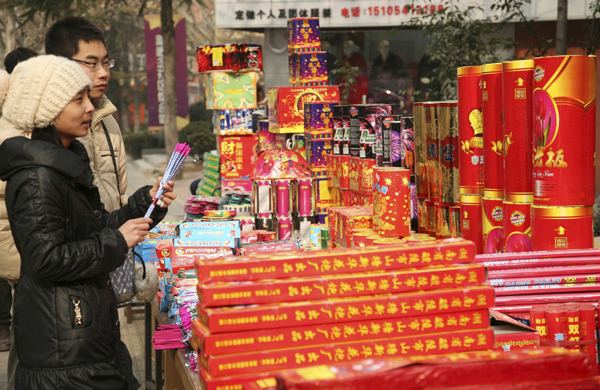
The Chinese people have been setting off fireworks and firecrackers to mark celebrations and even solemn occasions for the past 2,000 years. The earliest record of fireworks is from the Han Dynasty (202 BC-AD 202) when people threw bamboo stems into a fire to produce an explosion with a loud sound, in order to ward off evil spirits. As for gunpowder, it was first used to make firecrackers and fireworks during the Song Dynasty (960-1279).
This Chinese folk custom has influenced neighboring countries, too. As a result, people in Japan, the Republic of Korea, Myanmar and Singapore also set off fireworks and firecrackers to mark special occasions.
But opinions in China today are divided on whether to relax the restrictions on setting off firecrackers and fireworks. Those in favor of fireworks even claim that fireworks and firecrackers can eliminate the novel coronavirus while others say firecrackers should be burst to "celebrate" special occasions including the end of the COVID-19 pandemic.
Some have even compared fireworks with "faith", saying setting off fireworks is the ideal way of promoting group activity to strengthen national unity. Still others say that bursting firecrackers is a way of continuing the cultural tradition of Spring Festival, while others argue that since some countries are trying to get fireworks included in tangible and intangible world heritage lists, China should lift the ban on fireworks and firecrackers.
First, there are strong grounds, both environmentally and legally, for banning firecrackers and fireworks in certain areas. Since the 1990s, firecrackers and fireworks have been banned in some places in order to prevent environmental pollution, ensure people's safety, protect property, and maintain a harmonious social order. The decision was taken by local legislatures and governments based on local conditions and in line with the wishes of the general public.
The Beijing municipal government, for instance, has banned fireworks and firecrackers in urban areas, although it was not the first to do so. The capital promulgated the Regulations of Beijing Municipality on the Prohibition of Fireworks and Firecrackers in October 1993. It further made clear the regulations in the Beijing Fireworks and Firecrackers Safety Management Regulations issued in September 2005, stipulating that bursting of firecrackers and fireworks within and including the Fifth Ring Road is prohibited.
The Regulations on Fireworks and Firecrackers Safety Management, which was introduced by the State Council, China's Cabinet, in January 2006, says local governments at or above the county level can fix the time, place and type of restrictions or prohibitions on fireworks according to the real local conditions.
Second, from the perspective of environmental protection, the ban on setting off fireworks and firecrackers is fully justified, because the main components of fireworks are carbon, nitrate and sulfur, which produce sulfur dioxide on being set off.
Sulfur dioxide is not only one of the main air pollutants, but also a typical carcinogen. It could also damage the human respiratory tract and cardiovascular system, and induce acute attacks of coughing and asthma in some allergic children. In addition, firecrackers also produce nitrogen dioxide and various metal oxides. Even adults can feel discomfort in the smoke emitted by fireworks and firecrackers.
Besides, firecrackers cause noise pollution, which could irritate and scare the sick, aged people and infants. So completely lifting the ban on fireworks will harm the health of many apart from inconveniencing people.
Third, in terms of people's safety and property protection, the ban on fireworks and firecrackers is valid. From ancient times to the present, loss of life and property in fires triggered by fireworks and firecrackers has been a recurring tragedy. For instance, the Meridian Gate Tower caught fire while Yongle Emperor Zhu Di was watching the display of fireworks in 1415, killing many people on the spot. Governor Ma Wang who led the army to bring the fire under control, too, became a victim of the fire. There are similar examples from the ancient to modern times.
The harm caused by firecrackers and fireworks is often directly proportional to the density of buildings and population in a given area. Yet the reverse is not true, because in the vast rural areas with relatively shorter buildings and low population density, the damage to people's lives and properties is not necessarily small. This is because people in rural areas have relatively poor awareness of protection, protective measures are often not in place, and some risk groups (mainly children and adolescents) receive relatively little education on how to handle fireworks.
Fourth, economically speaking, the ban on fireworks and firecrackers will result in losses for some people and companies, but there is another side to the issue. The national output value of this industry is 60-70 billion yuan ($8.9-10.4 billion), and the entire industrial chain employs 3-4 million people.
But controlling the air pollution caused by fireworks and firecrackers, putting out fires caused by fireworks or firecrackers, and addressing the health hazards created by fireworks and firecrackers will cost a lot of money, social resources and time. Thus it is not advisable to completely lift the ban on firecrackers and fireworks.
Furthermore, nationwide, the areas where setting off firecrackers and fireworks is banned are densely populated which need to be specially protected (such as archaeological sites). Also, it is necessary to study how fires caused by fireworks or firecrackers in China's vast countryside can be prevented. On the whole, the ban on firecrackers and fireworks should not be lifted.
The author is a professor in the department of literature and history research at the Party School of the CPC Central Committee. The views don't necessarily reflect those of China Daily.
If you have a specific expertise, or would like to share your thought about our stories, then send us your writings at opinion@chinadaily.com.cn, and comment@chinadaily.com.cn.





