Chinese civilization runs deep, but how deep exactly?










One gets the impression sometimes that Chinese civilization is something that has simply always been there. For example, in recent reports from the Sanxingdui archaeological site in southwest Sichuan province, which display enigmatic figurines and burial masks that seem as though they were fashioned by an alien civilization. In public accounts, the striking uniqueness of this cultural complex is seamlessly incorporated into dominant narratives of the diversity of Chinese civilization. In the scholarly literature, however, the picture is more complicated.
The 3,000-some-year-old Sanxingdui, which sheds light on the ancient Shu state, the earliest large-scale political entity in Sichuan, is a sprawling, trapezoidal urban area replete with labor-intensive infrastructure such as palatial living quarters, religious centers and a massive fortification wall, one of the largest still intact from the time. The site was first occupied many centuries before the area was conquered by China's founding imperial dynasty, the Qin (221-206 BC). Its rediscovery is one of the great archaeological success stories of the 20th century, conducted by archaeologists from universities, research institutes and government bodies across China. Starting in the 1980s, they excavated sacrificial pits containing thousands of precious artifacts, torched and buried as part of a decision to abandon the site for reasons still unknown.
Historical information on the Shu is hard to come by. They left behind no known records, and using Chinese records is problematic, as most references to them were written at a long distance, or in later periods. One of the earliest mentions of the kingdom in Chinese records, for example, is in the Records of the Lands South of Huashan, written in the Jin Dynasty (265-420), centuries after the founding of the Qin Dynasty. It is partly mythological, reflecting the lack of source material, and represents the Shu kingdom as a distant, wild periphery through stock tales common to descriptions of different frontier areas.
There is some contemporary evidence that points to the Shu being in contact with early-stage Chinese states along the Yellow River basin, in particular serving as allies of the Western Zhou Dynasty (c.11th century-771 BC) in their struggles against the Shang Dynasty (c.16th century-11th century BC).Many of the artifacts uncovered at Sanxingdui show signs of deep cultural influence from the central plains, especially the bronzes, the casting of which was an imported technology, initially limited to ceremonial and military use.
However, objects with heavy influence from the central plains only appear in large numbers in the archaeological record when the founders of the Shu state knit together surrounding villages and made Sanxingdui their political and ritual focal point; Neolithic cultures in the region appear largely unconnected. Furthermore, these bronzes were for ritual, not daily use, suggesting that their function was primarily to bolster elite prestige by displaying connections to the central plains. Additionally, they bear the marks of extensive hybridity.
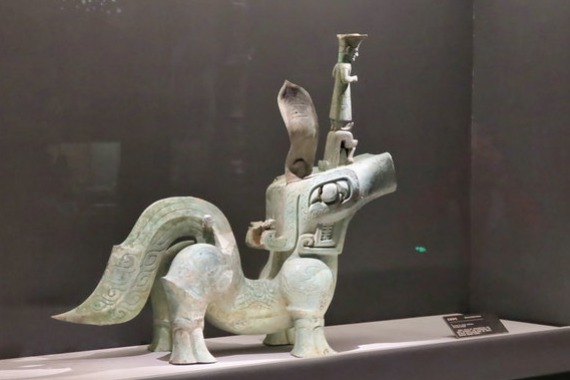
Take for example one of the most breathtaking finds from the site: a stunning sculpture of a mythical beast with a human head and the body of a snake, featuring bulging, manic eyes and sharp tusks and horns. The creature also doubled as a wine vessel, and functionally bears resemblance to those found in the central plains. The naga-like snake, though, does not. Its origin seems to be in the Shu kingdom's local culture, still poorly understood, though the excavation has yielded tantalizing hints of what it was like.
Characteristics that have been inferred from the finds include heavy social stratification, a system of dual rule by aristocrats and priests, and worship of the sun, birds and eyes. Images of eyes in particular stand out — large and round, often accompanied by triangular, pointed ears, suggesting that they were possibly meant to demarcate ethnic difference. The Shu script, which postdates Sanxingdui, is still undeciphered.
The Shu occupied a protected geographical location surrounded by mountains, and the pre-Qin cultures that developed there were strongly idiosyncratic in nature. Though they borrowed extensively from the central plains, they were ultimately of local origin. It was the Qin, who conquered the Sichuan basin, commandeered its rich resources, co-opted the Shu aristocracy and enlisted local people in its armies to fuel the creation of China's first centralized empire, that put the Shu on the path toward true assimilation.
Sanxingdui is a small piece of the wider puzzle scholars will have to knit together to trace the historical process by which Chinese civilization was forged; it is not a timeless object waiting to simply be dug out of the ground.
Contact the writer at conradanthony@chinadaily.com.cn