Mastering an ancient art










After much trial and error, a Ru porcelain producer sees his determination pay dividends, Yang Feiyue reports.
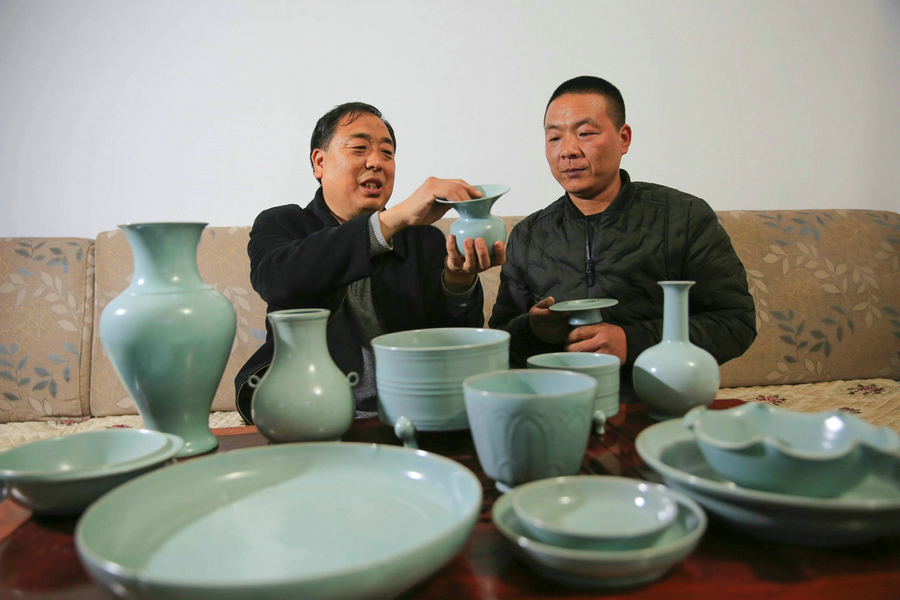
Wang Junzi just returned a few days ago from a porcelain exchange meeting in Japan. "I shared our Ru porcelain culture with artists from abroad and also got a better look at what has recently been going on with porcelain development," says Wang, who is from Qingliangsi village, Baofeng county, Pingdingshan city, Central China's Henan province.
He believes that these exchanges will help Ru porcelain thrive. Ru is one of the top five porcelains in China. It gets its name from the location in which it has been made: Ruzhou in Henan.
As life has returned to normal after the pandemic policy was relaxed, so has Wang's trade.
"I receive thousands of orders for Ru porcelain now," Wang says.
The man, who is in his 60s, spends most of his time around the kiln and is teaching his disciples to grasp the finesse required to produce impeccable porcelain works so they can carry forward the Ru porcelain firing craft, which was listed a national intangible cultural heritage by the State Council in 2011.
The Ru porcelain ware was first produced for the Song Dynasty (960-1279) imperial court for a brief period around 1100 and features a distinctive pale blue glaze. It can be found in dishes, small vases and incense burners, among other goods.
Fewer than 100 complete original pieces have been found intact.
In the 1950s, archaeologists discovered a kiln site in Qingliangsi. Shards resembling Ru ware were found there in 1977.
In 1986, porcelain experts from the Shanghai Museum conducted two surveys on the site. They collected more than 40 porcelain specimens and kiln items and confirmed Qingliangsi as home to official Ru porcelain kilns.
This led to extensive investigations at Qingliangsi between 1987 and 2002 by the Henan Provincial Institute of Cultural Heritage and Archaeology, revealing a complex of workshops that still contained the remnants of production.