



Experts: Reform to help boost sci-tech self-reliance









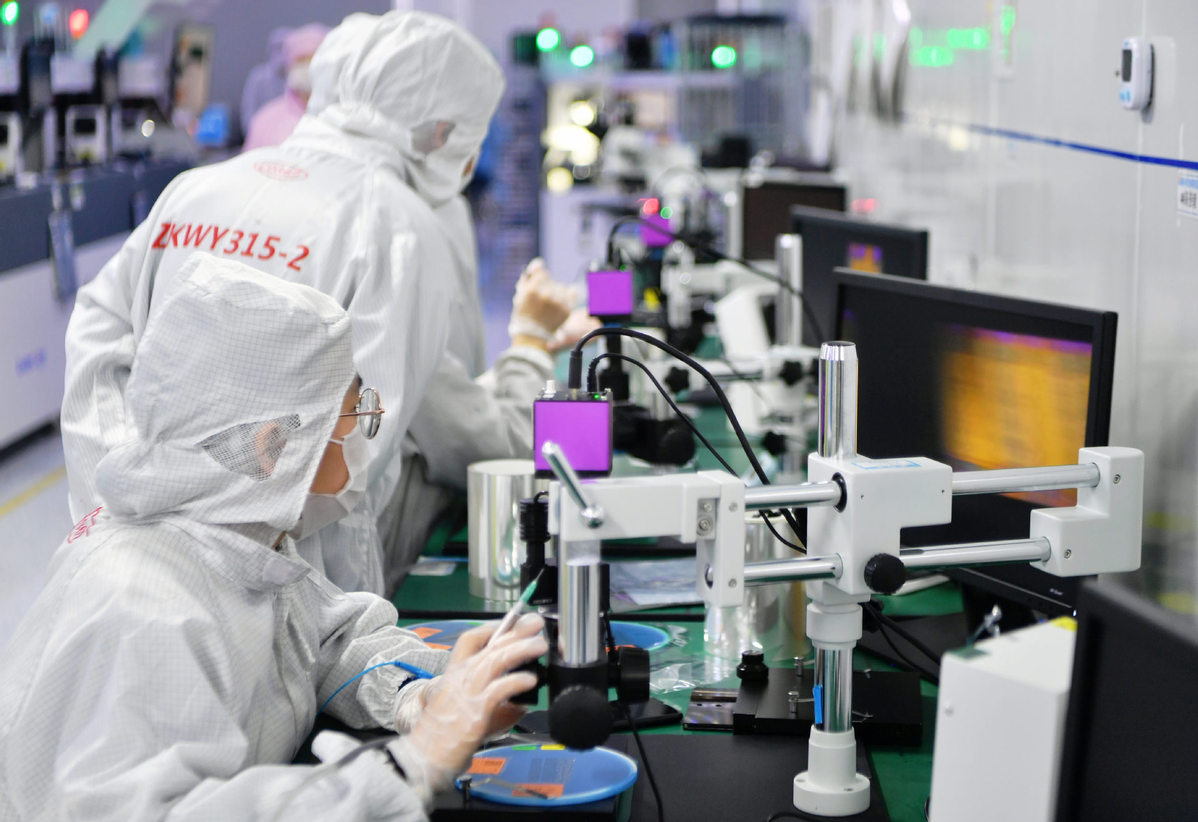
Reform: Optimized management of sci-tech undertakings expected
China's revamp of its Ministry of Science and Technology would allow the country's sci-tech administration to be more efficient in supporting basic sciences and using innovation to promote socioeconomic growth, and achieve quality self-reliance in science and technology at a faster rate, experts said.
According to a proposed government restructuring plan released on Tuesday by the State Council, China's Cabinet, the science ministry would undergo a massive revamp that would delegate many of its existing functions to other government bodies. The country would also establish a central commission on science and technology, whose responsibilities would be borne by the restructured science ministry.
The function of organizing and formulating plans for promoting scientific and technological development in agriculture and rural areas would be transferred from the science ministry to the Ministry of Agriculture and Rural Affairs. The agricultural ministry would also operate the China Rural Technology Development Center.
The science ministry's responsibilities for crafting plans and policies to promote social progress using science and technology would be allocated to other ministry-level bodies, such as the National Development and Reform Commission, the Ministry of Ecology and Environment and the National Health Commission.
The Ministry of Industry and Information Technology would take on the role of formulating policies for the growth and industrialization of high-tech industries. It would also guide the construction of science and technology parks, such as the national high-tech industrial development zones, as well as the development of technology service industries and technology markets.
The Ministry of Human Resources and Social Security would adopt the duty of managing foreign experts. The science ministry's China National Center for Biotechnology Development would operate under the National Health Commission, while the Administrative Center for China's Agenda 21 and the High-tech Research and Development Center would be under the National Natural Science Foundation of China.
After the restructuring, the Ministry of Science and Technology will retain many critical duties such as administering the nation's basic research, State laboratories and major scientific projects; building systems for technology transfer, commercialization of scientific findings, and supervision and evaluation of science and technology; and promoting academic integrity, international cooperation and the quality of China's science workforce.
Through these reforms, the restructuring plan aims to strengthen the macro-management functions of the science ministry, including strategic planning, institutional reform, resource allocation, comprehensive coordination, policy and regulation formulation, and supervision and inspection of the sci-tech sector.
Sui Jigang, a researcher at the Chinese Academy of Sciences' Institutes of Science and Development, said the revamp would optimize the management of scientific and technological undertakings across the board, facilitate the commercialization of scientific findings, and help create a new system for mobilizing resources nationwide.
For instance, the Administrative Center for China's Agenda 21 and the High-tech Research and Development Center are crucial for managing research projects in frontier sciences and core technologies. Therefore, their roles are closely related to the National Natural Science Foundation of China, one of China's main funders of basic research.
"This kind of restructuring makes sense, and it is in line with China's greater emphasis on basic research in recent years," Sui said.
He also said one of the key goals for China's science and technology administration reforms is to promote close integration of science and technology with the economy.
The administration of high-tech development zones, which are the pillars of China's high-tech industries, by the Ministry of Industry and Information Technology will be conducive to the commercialization of scientific achievements and the implementation of China's innovation-driven development strategy, he said.
More streamlined ministry
Xue Lan, dean of Tsinghua University's Schwarzman College, said that after the restructuring, the new Ministry of Science and Technology will be more streamlined and can play a more prominent and effective role in macro-managing the country's science and technology sector.
Xue noted that the National Natural Science Foundation of China would still operate under the new science ministry, signaling that facilitating basic sciences would remain a fundamental mission for the ministry.
"The future priority of the Ministry of Science and Technology should be pooling resources nationwide and focusing on tackling key bottleneck issues in technology," Sui said.
Shen Renfang, the director of the Chinese Academy of Sciences' Institute of Soil Science and a deputy to the 14th National People's Congress, said that the revamp would allow scientists to focus more on basic research.
"Without breakthroughs in basic sciences, there won't be applications," he said. "With the revamp, our country will surely attach greater importance to basic research, and scientists working in basic sciences will have a more favorable and less distracting environment."
Jin Shuanggen, vice-president of Henan Polytechnic University, said the reform of the science ministry will strengthen top-level design while clarifying the leadership and managerial roles of science and technology administrations.
"This allows them to coordinate scientific and technological resources more efficiently to solve major technological challenges," he said. "It will also allow the country to enhance basic research, pursue original innovation and accelerate quality self-reliance in science and technology with greater confidence."
Cui Jia contributed to this story.


- Beijing-Pyongyang passenger rail service to resume Thursday
- Shanghai and Jiangsu integration boosts sports-tourism development
- China Eastern Airlines restores direct flights between Shanghai and Stockholm
- RedNote targets AI-run accounts with new governance rules
- China's draft law on ethnic unity aims to serve as global model, political adviser
- Spring blossoms complement the Honghe Hani Rice Terraces in Yunnan





