



Reject the provocateurs of war









While Washington rattles its swords, Beijing promotes peaceful solutions around the world
"No war really comes unexpectedly; the drums are beating long before a single shot is fired," said Margaret Case Harriman, the American author, and history bears her out.
In the run-up, for example, to World War I in 1914, belligerence was in the air. The great powers interpreted big issues in simplistic terms, all the while ramping up their military preparations. Although everybody claimed to want peace, war fever meant conflict was not far away, though its trigger was unexpected.
After a Serbian nationalist, Gavrilo Princip, assassinated Archduke Franz Ferdinand, heir presumptive to the Austro-Hungarian throne, in Sarajevo, on June 28, 1914, all hell broke loose. Once Austria declared war on Serbia, various alliances were mobilized, and Europe found itself engulfed in war. Whereas the imperial powers hoped at the very least to consolidate their positions, few envisaged the scale of the conflict, its wanton destruction or its political consequences.
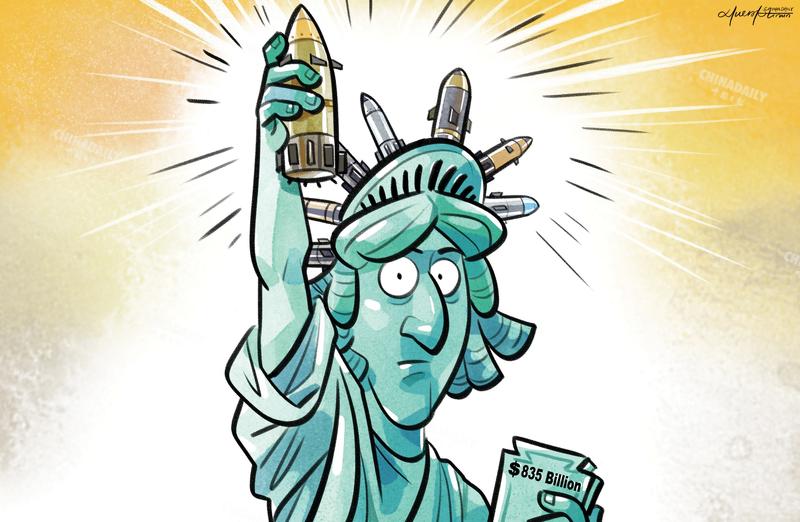
As always, the lessons of history have not been learnt, and the warmongers are again in the ascendant. This time, however, it is not Europe that is in the driving seat but the United States, and its motives are clear. Whereas its military-industrial complex, which employs over 800,000 people, feeds off conflict, Washington always wants to expand its influence, tie its allies ever closer, and recruit new vassals.
As NATO’s leading member, the US knew how alarmed Russia, post- Soviet Union, would be over the bloc’s eastward expansion onto its borders, yet it insisted on doing exactly that. Having signed up the former Warsaw Pact states of Hungary, Poland and the Czech Republic in the 1990s, NATO then hoovered up the three former Soviet Republics of Estonia, Latvia and Lithuania in 2008. It also coveted Ukraine, and, at its Brussels summit in 2021, the NATO leadership reiterated the decision taken at the Bucharest summit in 2008, that Kyiv would eventually join the bloc, knowing this prospect would incense Moscow, as wiser heads predicted.
In 2017, for example, the former US defense secretary, William Perry, commented that "our first action that really set us off in a bad direction was when NATO started to expand, bringing in Eastern European nations, some of them bordering Russia."
Even though Moscow felt threatened by these developments, the US insisted on upping the ante, stationing its missiles in places like Poland and Romania, and mounting provocative "war games" in Russia’s backyard. In 2017, for example, US and British troops, aircraft and helicopters carried out the first large-scale NATO drills on the border between Poland and Lithuania, together with troops from both countries, as well as from Croatia.
Once NATO raised the prospect of recruiting Ukraine, the US would have known it was playing with fire. In 2008, William Burns, who was the American ambassador in Moscow (and is now the CIA director), told the secretary of state, Condoleezza Rice, that "Ukrainian entry into NATO is the brightest of all red lines for the Russian elite (not just Putin)," and "I have yet to find anyone who views Ukraine in NATO as anything other than a direct challenge to Russian interests."
As the Ukraine conflict has unfolded, the US has taken full advantage of the situation, even moving to recruit Finland and Sweden into NATO. On March 3, 2023, its defense department announced that military equipment worth up to $400 million is being transferred to Ukraine, and this is on top of materiel worth $30 billion despatched since the invasion began on Feb 24, 2022. While this is a huge boost for the US arms industry, the fighting itself is being undertaken by the Ukrainians, meaning Washington has the best of both worlds. If Russia, moreover, as one of its geopolitical rivals, can also be humiliated, so much the better.
These tactics, of course, are only too familiar, and have been widely deployed in Asia. Whereas Washington now has military bases in Japan, the Philippines and Republic of Korea, they all have a China focus, and it is never happier than when stoking regional tensions, particularly over Taiwan, a part of China but a key market for US weaponry. By exacerbating the regional arms race, creating Beijing-hostile alliances, conducting provocative military drills, and flaunting itself in contested waters, the US has brought the prospect of big power conflict in Asia ever closer.
In the US, moreover, the Democratic People’s Republic of Korea is always seen as fair game, with its leader, Kim Jong-un, being portrayed as the "rocket man," even though there is invariably method in his madness. Whereas, for example, he fired a short-range ballistic missile toward the sea on March 19, this was only in response to the largest joint field exercises conducted by the US and ROK militaries in five years, lasting from March 13 to 23. Entitled "Freedom Shield," the exercises included computer-simulated command post training, a combined amphibious drill, and the deployment of a long-range B-1B bomber to the Korean Peninsula, and the US would have known there was no way Kim would have acquiesced in its provocations.
With brazen hypocrisy, however, the US, having infuriated the DPRK with its 10-day exercises, then, together with its client states, the ROK and Japan, had the effrontery to condemn the missile launch as a provocation, and as a threat to peace on the Korean Peninsula and the region.
Having deliberately inflamed North-South tensions, Washington cannot have been surprised when, on March 13, Seoul’s Mayor, Oh Se-hoon, told Reuters that the ROK should build nuclear weapons of its own to bolster its defences against the DPRK. He is a key member of President Yoon Suk-yeol’s People Power Party, and a growing number of his fellow politicians are now talking openly about developing nuclear weapons, or at least redeploying American tactical nuclear bombs and missiles, which were withdrawn from the Korean Peninsula in the 1990s.
If the ROK were to go down the nuclear route, it might not please everybody in the West, but it would certainly delight the US arms industry, which would sense another AUKUS-type profit-making bonanza.
Although the US, like the UK and Australia, is a party to the Treaty on the Non-Proliferation of Nuclear Weapons (NPT), this has not inhibited it from agreeing to supply Australia with nuclear-powered submarines. As Australia is a non-nuclear power, the US is encouraging nuclear proliferation, and there is nothing to stop it from doing likewise in the ROK.
Under the A$368 billion ($246.3 billion) AUKUS deal, Canberra has agreed to buy three Virginia class submarines from the US in the early 2030s, with the option of acquiring two more. As US shipyards are already overloaded with submarine orders for the home fleet, they will now have to expand exponentially, creating many more jobs (part of the White House’s re-election strategy).
Although the US is never happier than when meddling in the affairs of others, it is a different story at home. If it gets paranoid over a stray balloon, imagine its reaction if foreign rivals flexed their muscles in its surrounding waters, let alone established military bases in its neighboring states (or formed alliances with them). When the Soviet Union placed missiles in Cuba in 1962, the US response was to demand their removal as a threat to national security. Yet, it not only disregards the parallel sensitivities of other countries around the world these days, but tramples them underfoot.
Under its Monroe Doctrine of 1823, the US insists not only that the Americas are within its sphere of influence, but also that, as the dominant power in the Western hemisphere, it has the right to intervene in any country that threatens its interests, wherever situated. As Senator Bernie Sanders reminded the Senate on Feb 10, 2022, the US, by resorting to this policy, "has undermined and overthrown at least a dozen countries throughout Latin America, Central America, and the Caribbean."
It has also sought, under the guise of promoting democracy and thwarting objectionable ideologies, to impose its will further afield, in places like Iraq, Laos and Vietnam, and many have perished in its maelstroms, with broken societies often its legacy.
If anybody imagined the Monroe Doctrine was ancient history, let them think again. In 2018, the then secretary of state, Rex Tillerson, called the doctrine "as relevant today as it was the day it was written.’’ In 2019, the then national security advisor, John Bolton, said "the Monroe Doctrine is alive and well." And, while the doctrine was originally regional in scope, it is now deployed globally, whether directly, as in Asia, or indirectly, as in Eastern Europe, with NATO complicity.
What this means, therefore, is that US foreign policy is not only hypocritical, but grounded in the notion that "might is right." Expansionist in nature and hegemonistic in outlook, its dual standards pose an existential threat to humanity.
The peace-loving nations of the world, therefore, must resist both Washington’s blandishments and its provocations, and reject its intimidation. Although it has a vested interest in conflict, harmonious relationships among global rivals remain the key to mankind’s survival.
On March 20, President Xi Jinping said China was ready "to stand guard over the world order based on international law," which offers hope in troubled times. While the warmongers rattle their swords, Beijing, at least, is trying to promote peaceful solutions, whether in Europe, the Middle East or Asia. This will hopefully continue, notwithstanding setbacks, as the world deserves long-term stability, not perpetual conflict.
The author is a senior counsel and law professor, and was previously the director of public prosecutions of the Hong Kong SAR.
The views do not necessarily reflect those of China Daily.





