Green and grin









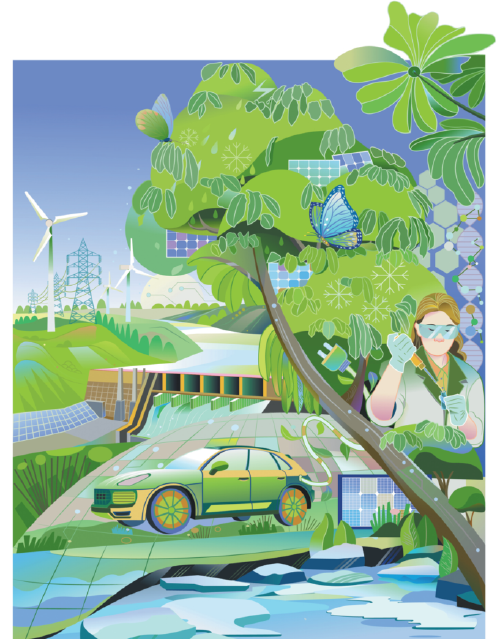
YANG MEINI/FOR CHINA DAILY
Generating cheaper, greener and more secure energy and promoting its wider application should be shared by governments, businesses and consumers alike
In February, Southwest China's Yunnan province asked aluminum producers to make another round of production cuts to ease a power crunch in the region amid a severe shortage of hydroelectricity output. This is the third round of production cuts within six months and will reduce aluminum output by one-third. Yunnan's power crisis is yet another example of unstable green electricity supplies severely affecting factory production and local people's lives, following a short-lived power crunch last summer in Sichuan province caused by extreme heat waves and drought.
China has pledged to accelerate the low-carbon and green transition of the economy in the carbon peaking and carbon neutrality goals. The country is targeting to have 80 percent of non-fossil fuel sources in its energy mix by 2060, which entails a gradual process of replacing electricity generated by fossil fuels with green electricity.
Coal-fired power generation accounted for 69.77 percent of China's total power generation in 2022, whereas hydropower, wind power and solar power accounted for 14.33 percent, 8.19 percent and 2.73 percent respectively. Green electricity accounted for 30.23 percent of China's total power generation in 2022.
Green power, electricity produced from solar, wind and hydroelectric sources, among others, lives "at the mercy of nature" — not only confined by resource endowments, but also affected by many factors including the weather. Amid frequent occurrence of extreme weather events, it has become an urgent task for China to address the uncertainty in green power generation and ensure the security of its energy system.
As the share of green electricity rises, reducing the uncertainty in green electricity generation to the greatest extent has become a primary task for China. Sichuan and Yunnan provinces rely on hydroelectric plants to generate over 90 percent of their electricity, and their power woes offer a valuable lesson for China. Green electricity generation is closely related to seasonal factors and the weather. With excessive power in peak periods and power shortages in trough periods, it has become extremely important to build load-shifting capacity within a region's power system. Industrial structure adjustment and inter-regional energy allocation have become all the more important.
As the share of green electricity further increases, the contradiction between greater electricity demand from economic growth and inefficient use of green power will become even more acute. The impact of volatility in green power generation will not be confined to a certain region, but will spread to wider areas. Furthermore, although large-scale energy storage and battery storage technologies could help reduce the uncertainty in green power generation, large-scale and long-term storage is yet to be achieved worldwide.
Sufficient, timely, stable and cost-competitive supplies of electricity are a barometer for assessing the security of an energy system. The development of green electricity also needs to solve the affordability issue.
Right now, green electricity is sold at a higher price than traditional power. In 2023, the average trading price of green electricity is 0.077 yuan per kilowatt-hour above the coal power prices in Jiangsu and Guangdong provinces, a further increase from 2022. Shanghai sells green electricity at a price of 80 percent higher than that of the coal-fired electricity, making green electricity nearly twice as costly as that from traditional sources. Electricity powers economic growth; too pricey green power will inevitably drive up consumption and production costs, thus dealing a blow to economic growth.
China has been supporting the development of green electricity by such means as subsidies, which has greatly advanced technological progress in wind and solar power generation. Over the past 10 years, the cost of solar photovoltaic power generation dropped by 88 percent, that of onshore wind power generation and concentrated solar power generation declined by 63 percent, and that of offshore wind power generation decreased by 60 percent. However, to further slash the cost of green electricity, lots of key technologies need to be developed.
China's wind and solar power resources are mainly concentrated in the Xinjiang Uygur autonomous region, the northwestern part of the Tibet autonomous region, the Inner Mongolia autonomous region and Northeast China, while hydropower is mainly concentrated in Southwest China. Long-distance, large-scale power transmission is a must.
Previously, the power transmission distance was constrained by technological bottlenecks. In 2019, an ultra-high-voltage direct current transmission line was built in China, with a high transmission distance reaching 3,324 kilometers, a record in the world. However, the transmission costs are still very high. To achieve energy security, we need to further lower the transmission costs and eventually reduce the cost of green electricity.
From a long-term perspective, to further advance the development of green energy, we should not only focus on hydro, wind and solar power, but also urgently need to develop energy from more stable, reliable sources such as hydrogen and nuclear fusion power. This could, to the greatest extent, reduce the impacts from natural endowments and weather and will have great significance to China's future energy security and the realization of the "dual carbon" goals.
Global investment in low-carbon energy technology, including renewable energy, electrified transport and sustainable materials, surged by 31 percent to a record level of $1.1 trillion in 2022. China accounted for nearly half of the global total, according to a new report from research company Bloomberg NEF. However, hydrogen, which has great potential as a clean energy solution, is the sector that received the least financial commitment at just $1.1 billion in 2022, accounting for only 0.1 percent of the total.
Only when relevant technologies are mature enough to enter the market can the field of green electricity attract large amounts of capital. Hydrogen and controlled nuclear fusion technologies are far from being commercialized, which requires more state investment from a strategic perspective to quicken the pace to the marketization of technologies.
The replacement of traditional electricity with green electricity is not a simple process of changing supplies from coal to renewable energy sources, but rather a systemic grand project closely linked to economic prosperity and sustainable growth. Promoting wider application of green electricity is a common responsibility shared by the governments, businesses and consumers.
Li Yan is a professor with the School of Environment and Natural Resources at Renmin University of China. Wang Zhangchi is a PhD student with the School of Environment and Natural Resources at Renmin University of China. The authors contributed this article to China Watch, a think tank powered by China Daily. The views do not necessarily reflect those of China Daily.
Contact the editor at editor@chinawatch.cn.