



BRI and Brazil's contribution to a more inclusive international system









Brazilian President Luiz Inácio Lula da Silva kicked off his official visit to China on Wednesday, accompanied by a large delegation of businesspeople, state governors, congress members and ministers, demonstrating a shift in the conduct of Brazilian foreign policy. One agenda item is Brazil's possible adhesion to the Belt and Road Initiative (BRI).
The BRI Initiative put forward in 2013 rescues the historical origins of the Silk Road, which for many centuries was one of the significant commercial and cultural connections between East and West. This initiative has begun to be considered as one of the first expressions of what became known as globalization.
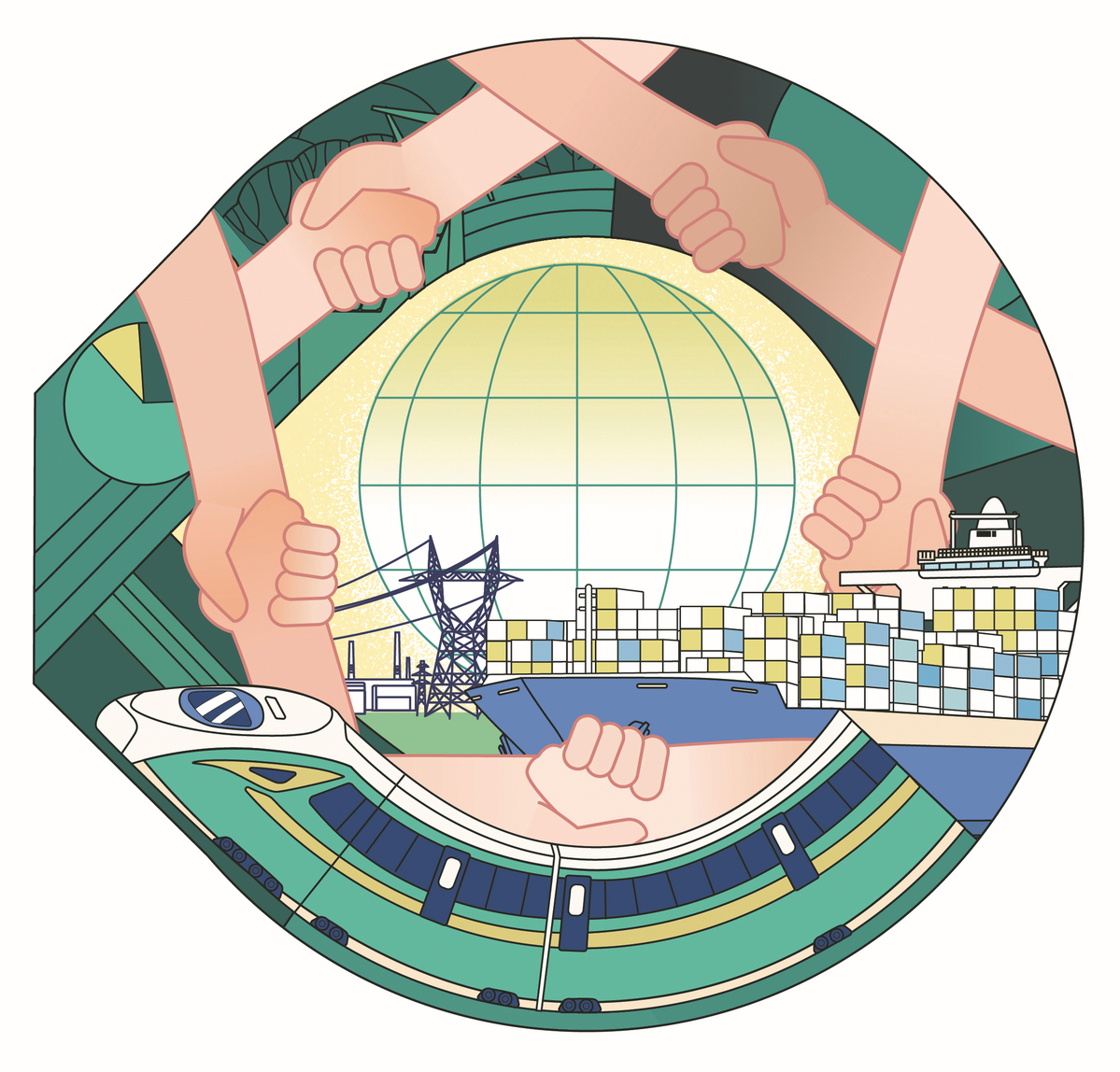
The BRI has been boosting connectivity and economic cooperation between Asia, Europe and Africa. It involves building infrastructure and trade networks across Asia, Europe and Africa, including highways, railways, ports and power grids, to enhance regional connectivity, promote trade and boost economic development.
The BRI promotes economic development and regional integration through increased trade and investment, cultural exchanges and people-to-people exchanges. Not limited to a geographic region, the initiative has attracted participation from more than 100 countries and international organizations, including some countries in Latin America.
Since its inception, the BRI has undergone several adjustments, which in my view, were natural given the magnitude and complexity of the projects and the variety of countries and jurisdictions involved. Much of the criticism in the early years was centered on the lack of labor and environmental standards in major infrastructure works in the participating countries, which has been resolved over the years and helped in the adjustments of the legal systems of the countries receiving the investments.
The Brazilian president's trip and the possibility of joining the BRI raise the question of why a country like Brazil should join China in this endeavor. Quantitative elements are associated with the relationship between the two countries, which would be enough to sustain Brazil's accession politically. Here, we introduce an ideational element: the BRI is a decolonization project, an alternative to the neoliberal development model, which has made the world insecure and unjust.
The neoliberal development model, based on the Bretton Woods Institutions, deepened the existing economic and social gap between the countries of the North and the South. For example, the world food system has an insurmountable contradiction: there is pressure to produce more and more food to eradicate hunger while an increase in production does nothing to eradicate hunger. The fact is an increase in production only produces more inequalities and environmental concerns – in other words, more problems.
Moreover, the neoliberal development model has contributed significantly to climate change, whose impacts are more felt in developing countries that have less adaptation and mitigation conditions (two crucial factors in the climate change regime as without investments and technology they are not operational).
Thus, the creation of the BRI and the possible accession of Brazil are ways of contesting this development model that favors developed countries and maintains the gap between them and developing countries. Moreover, unlike the neoliberal model premised on the continued expansion and accumulation of capital, the BRI is based on the vector of humanity's common or shared destiny, which implies an inclusive approach to the conduct of Chinese foreign policy.
This inclusion is in line with the national objectives of China, which, for example, has eradicated poverty in a few decades and is in an accelerated march toward an energy transition to renewable sources.
In an article I published with a colleague from the University of S?o Paulo, we point out that the economic relationship between Brazil and China follows a pattern of interest coupling. That is, there is a convergence of interests in both countries' economic sectors. In this article, we use the example of soy. On the one hand, we have China with an internal demand for soybeans, and on the other, Brazil, with significant dependence on the export of commodities to sustain its GDP.
We understand that this coupling of interests may become more robust with Brazil's adherence to the BRI. Therefore, we share the opinion with Karen Vasquez, who understands that the partnership between Brazil and China can produce "joint added value," which would greatly benefit Brazil.
In this way, the closeness between China and Brazil, in addition to contributing significantly to the two countries in fulfilling their ideals and objectives, balances the balance of power in the international system, which is very dependent on the policies and interests of developed countries, especially the United States. As the title of the article suggests, this movement within the scope of the BRI (and the recent Global Development Initiative proposed by China at the United Nations) and the adhesion of Brazil contribute, in practice, to a reduction of disguised colonialism in international institutions and provide a more outstanding balance and better distribution of benefits and responsibilities in the international system. Moreover, relationships in the international system must be based not on zero-sum games but on win-win interactions that can bring better responses to world crises.
The author is a professor of International Law, School of Law, Lanzhou. University. The views don't necessarily reflect those of China Daily.
If you have a specific expertise, or would like to share your thought about our stories, then send us your writings at opinion@chinadaily.com.cn, and comment@chinadaily.com.cn.





