AIIB head calls climate change 'wolf' at door









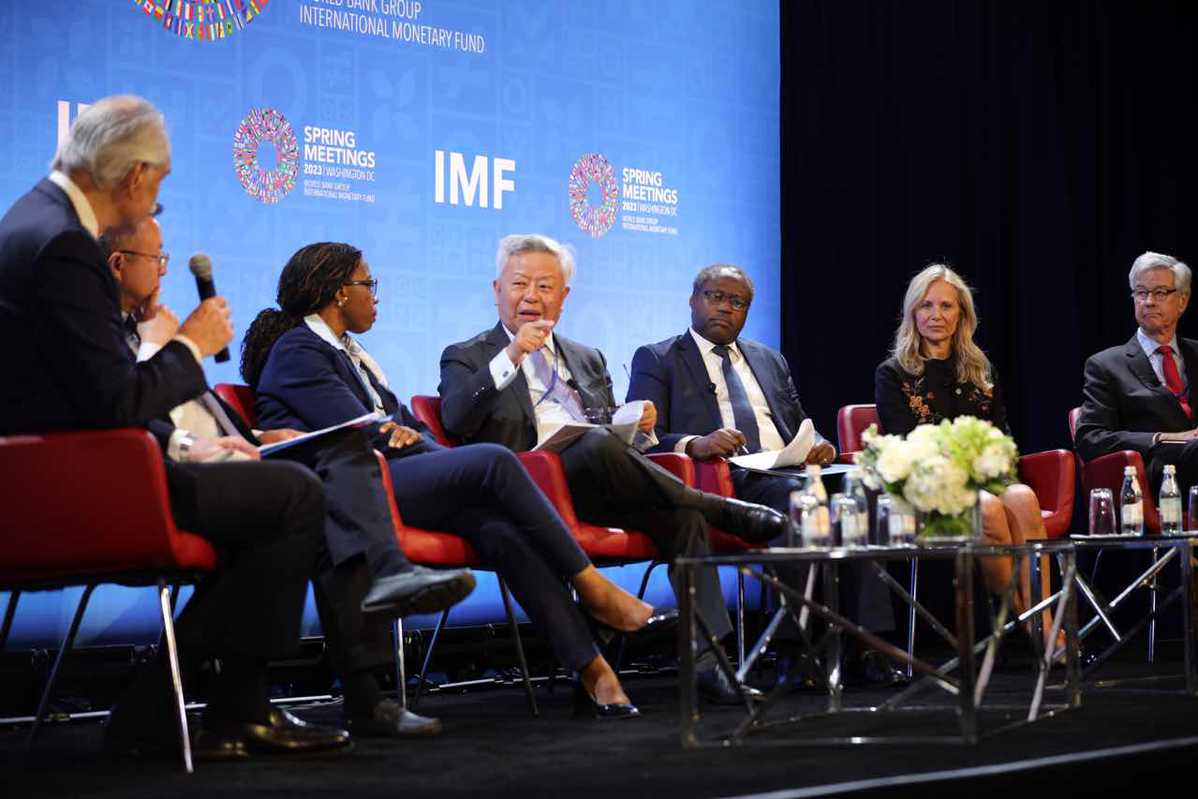
A prominent participant in the recent World Bank/International Monetary Fund meeting used an analogy to describe the challenges to secure funding to fight climate change.
Jin Liqun, president of the Asian Infrastructure Investment Bank (AIIB), said if countries believe climate change is not "just crying wolf", they will "put up" their guns to fight it.
"Please ask yourself, are you really braced for this kind of crisis?" said Jin.
He spoke at a seminar, "Scaling Up Resilience and Sustainability Financing", on day one of the weeklong World Bank/International Monetary Fund Spring Meetings, which concluded on Sunday.
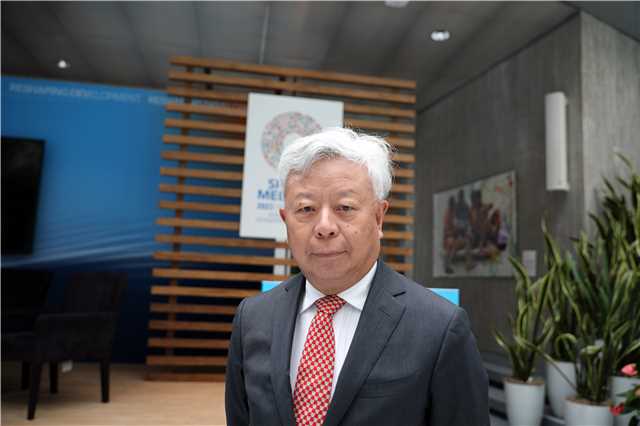
"This is the clear and present danger; this is really the existential threat to the human society. So there's no reason whatsoever to relax the efforts on the issue of climate change," Jin told China Daily on the sidelines of the meetings on Saturday.
During the sessions, practitioners, influencers as well as many policy-makers had called for ramped-up efforts to deal with climate disasters, for which "only a fraction" of needed funding is ready, as Li Bo, IMF deputy managing director, put it.
Many governments, even those without huge surplus resources, managed to allocate funds to cope with the COVID-19 pandemic because they realized it was a matter of survival, Jin said.
The International Energy Agency said in its latest assessment that to reach net-zero emissions by 2050, annual clean energy investment worldwide would need to more than triple by 2030, to around $4 trillion.
The Climate Policy Initiative, a nonprofit research group and international climate policy organization based in San Francisco, also said in a 2022 report that the world need at least $4.3 trillion in annual finance flows by 2030 to avoid the worst impacts of climate change, up from $653 billion in 2020.
Jin said that the AIIB is doubling down on efforts in climate financing. It has set a very ambitious target of reaching at least 50 percent climate finance share by 2025, cumulating to about $50 billion by the end of this decade.
"In 2022, we delivered a record $2.4 billion in climate finance, or 56 percent of our total financing, reaching our climate finance goal three years early," he said.
Meanwhile, the AIIB plans to direct 50 percent of its funding to the private sector by 2030 to help it play a larger role in climate mitigation.
"The private sector must play its part. AIIB is laser-focused on mobilizing private sector expertise and capital," Jin said. "We are investing in opportunities with the potential to leverage even greater amounts of private capital toward green infrastructure investment."
That echoed a call from IMF Managing Director Kristalina Georgieva that everyone — multilateral institutions, national authorities, and the private sector — has a role to play to finance countries' climate action.
Jin, who had worked for nearly two decades in China's Ministry of Finance and at two other multilateral development banks (MDBs) before becoming the inaugural president of the AIIB in 2016, said he wants to take a further step to enhance the role of multilateral institutions in providing concrete solutions.
"How the multilateral system performs in this dawning era of uncertainty will shape the future of human prosperity," Jin said in a keynote speech at a discussion at The Rockefeller Foundation office in Washington on Wednesday.
"To meet the challenges ahead, our multilateral system must focus on getting fit," he said.
Jin proposed institutionalizing the dialogues of international financial institutions to discuss progress and actions on climate finance.
"If humanity's moonshot to net-zero is to be successful, then coordination and collaboration in climate finance is mission critical," he said.
In that regard, MDBs must strengthen their ability to operate holistically as a coordinated system, which could start with holding a joint meeting of the heads of the MDBs every two years.
"We could target 2025 — the year that global emissions must peak to meet our 1.5 C degree warming pathway — as the year that MDBs come together to deepen their coordination on climate action," he said.
Jin also suggested setting up a marketplace for climate projects, which would be a platform that matches financing for technical assistance and projects.
"The climate-financing obstacles ahead are tough, but they are not insurmountable. Reform of the multilateral system and the international financial system should be welcomed, and it must be ongoing," he said.
The AIIB was initiated by Chinese President Xi Jinping in 2013 and began operations in 2016, Membership has grown from 57 to 106, and it has been triple-A-rated by the major international credit rating agencies.
Jin said that the AIIB is now "broadly recognized" as a multilateral development bank with the same high standards with its peers, such as the World Bank, the Asia Development Bank and the European Bank for Reconstruction and Development.
The bank's commitment to environmental, social and governance (ESG) standards; the development objective to help its members to achieve net-zero transition; and its efforts in helping many members to overcome the COVID-19 pandemic have produced "tangible results", he said.
"The fundamental reason for the success of this bank is that we've met President Xi's expectation that the bank must operate by international best practices and must adhere to high standards," Jin said.