



Villagers find prosperity at their fingertips









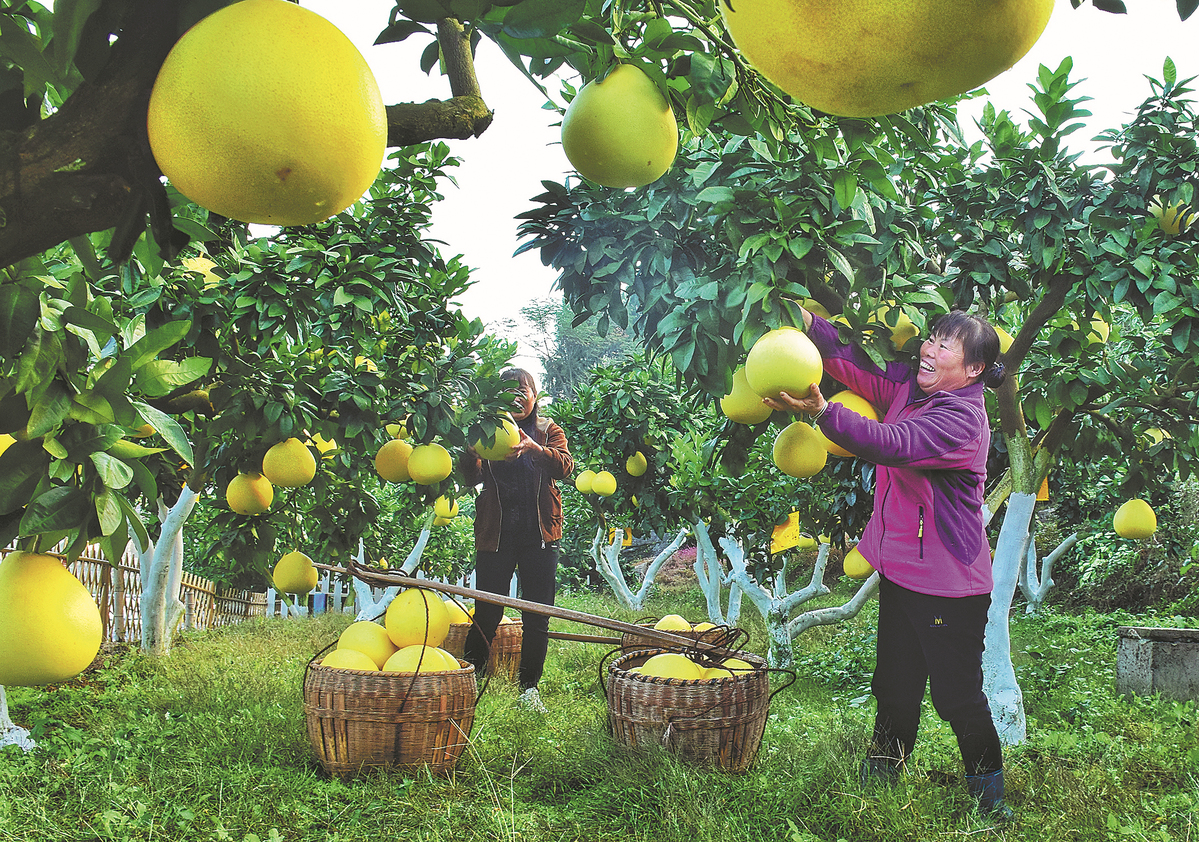
Improved agriculture, infrastructure help to boost nation's poverty alleviation efforts
A little more than a decade ago, Tian Rubing, sensing that the time was ripe, made a prosperous decision.
He left Shanghai, where he had worked for several years, and in 2011 moved back to his home village of Changputang in Central China's Hunan province.
Once home, he joined other villagers who lifted themselves out of poverty by growing fruit trees and seedlings.
Today, Tian is among the many residents of Changputang benefiting from what one official calls "green, precision agriculture". He has an annual income of more than 100,000 yuan ($14,545).
Changputang, which is in Fenghuang county of Hunan's Xiangxi Tujia and Miao autonomous prefecture, has a population of about 2,800.
Before the 1980s, the village was in extreme poverty due to limited land, lack of water and poor roads. The average annual income of villagers, who at that time grew only rice and corn, was about 600 yuan.
New fruits introduced
Wang Anquan, then Party secretary of Changputang, and other officials visited Zhejiang, Henan and Fujian provinces to learn how to grow fruit. They decided to introduce watermelon, citrus fruits including pomelo and Chinese honey oranges, and kiwi to the village, because these were suitable for growing due to the area's humid, subtropical monsoon climate and selenium-rich soil.
Wang recalled that, when President Xi Jinping conducted an inspection tour of Hunan in November 2013, Changputang was the first stop.
"Xi's know-how of fruit growing was impressive," Wang said.
Xi said that better technology and a bigger market were needed to improve agriculture in the village, and he advised Changputang's farmers to keep an eye on the market while looking ahead.
"Xi pointed the way forward for the village's growth," Wang said. "Encouraged by the president, the villagers have worked harder and turned the village into a land of fruit."
The village's 960 hectares of orchards — four times as much as in 2012 — have the potential to produce fruit worth more than 36 million yuan each year.
The rapid, beneficial development of the village's fruit-growing industry was soon followed by the growing and selling of seedlings, which have become another important source of income for Changputang's residents.
In 2021, after the village set aside 86 hectares of land for tea and fruit seedlings, the output value of the seedlings hit 47 million yuan, Wang said.
"Now every family has an orchard and a nursery where young plants and trees are raised," said Tang Jinsheng, an official of Changputang.
"We have built greenhouses for fruit trees where trickle and sprinkler irrigation methods were introduced," Tang said, adding that cameras and sensors have been installed to monitor temperature, moisture, pH levels and trace elements.
"What we are doing is green, precision agriculture," Tang said.
Zhou Zuhui, Party secretary of the village, said, "Changputang village is developing its agriculture and fruit growing through science and technology."
In 2022, Changputang's per capita disposable income was more than 30,392 yuan.
During his Hunan inspection tour in 2013, Xi also visited Shibadong, a once impoverished village where 60 percent of its population lived below the poverty line.
In his talks with Shibadong farmers, Xi first put forward the idea of targeted poverty alleviation. The pioneering notion focuses on tailoring poverty alleviation efforts to individuals, local conditions and the root causes of poverty.
Picturesque Shibadong is popular today, but a decade ago it lacked infrastructure, industry and investment.
Since 2013, however, Shibadong has become increasingly accessible to tourists, thanks to the construction of infrastructure including roads, parking lots and parks and the renovation of buildings.
Villagers were motivated to work and start their own businesses, such as homestays, and they knew the future was promising.
Over the years, Shibadong has developed several industries that build on its strengths.
The village has turned ethnic Miao embroidery into a distinctive industry. In addition, capitalizing on its mountain springs, the village established Shibadong Mountain Spring Water Co in 2017 and has also promoted various forms of farming.
In 2013, the average annual income of Shibadong villagers was 1,668 yuan, just 18.8 percent of the national average. In 2021, the figure reached more than 20,000 yuan, according to Xinhua News Agency.
With a landmark victory in poverty alleviation in 2020, China removed the last barrier on its way to realizing the first centenary goal of building a moderately prosperous society in all respects by 2021.
To advance the cause of eradicating absolute poverty, Xi once visited 14 contiguous impoverished areas and inspected 24 impoverished villages in Hunan, Shanxi and Shaanxi provinces, as well as the Ningxia Hui autonomous region, Chongqing and other provincial-level regions, where he talked with villagers.
"In fighting against poverty, we must avoid paying lip service or setting unrealistic goals," Xi said during his visit to Shibadong in 2013. "Instead, we should follow a reality-based, adaptable, category-specific and targeted approach."
The concept of targeted poverty alleviation was included in the United Nations' first-ever resolution addressing poverty eradication in rural areas adopted by the General Assembly in 2018.
Now China is forging ahead with rural vitalization in an all-around way as the nation marches forward on its path to modernization.
Contact the writers at fengzhiwei@chinadaily.com.cn


- State Council to oversee probe into fatal explosion in Shanxi province
- Jing'an marks 2026 Year of the Horse with light show, Shanghai-style fair
- Flu activity drops in China, but authorities warn of potential virus risks amid holiday travel rush
- China issues action plan to revitalize theatrical arts
- Jimmy Lai sentenced to 20 years in prison
- Beautiful Hebei episode 11: Discover red tourism destinations












