



Higher CPI, lower PPI require nuanced understanding









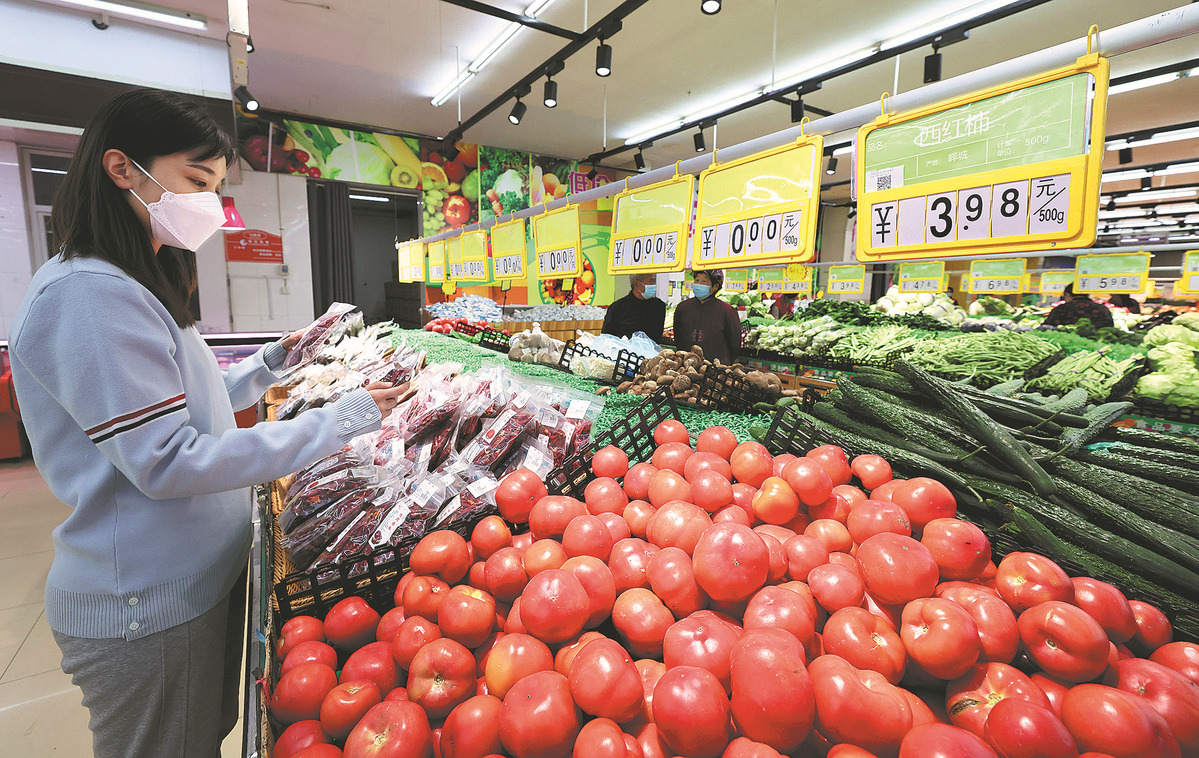
The National Bureau of Statistics and the People's Bank of China released March inflation and financial data on April 11, which led to some concern and confusion in the market. On the one hand, the market is worried that the economy is entering a period of deflation, or decrease in the general price level of goods and services, as China's consumer price index only increased 0.7 percent year-on-year last month while the producer price index was down 2.5 percent. On the other hand, the market is confused about the coexistence of low prices and strong money supply growth, as China's broad measure of money supply, or M2, increased 12.7 percent year-on-year in March, with new yuan-denominated loans and the country's increment in aggregate social financing far exceeding market expectations.
It can be interpreted that the current declining trend in price growth is not deflation, but is related to base effects, the impact of noneconomic policies on business confidence and a decrease in peoples' risk appetite after the COVID-19 pandemic. Prices are not continuously falling, nor are they in a tight monetary environment. The country should refrain from adopting a deluge of strong stimulus policies. Instead, it should boost confidence and reshape incentives for local governments, entrepreneurs and residents.
Currently, the Chinese economy is still on track for recovery, with indicators such as the purchasing managers index and social financing reflecting a positive economic recovery trend. China's services sector has performed better than the manufacturing industry and domestic demand has recovered better than external demand. Of course, economic recovery still faces hidden risks and the foundation for recovery is not yet solid, including the impact of global economic downturns and anti-globalization and weak consumption of durable goods as well as the real estate sector still not having fully recovered to pre-pandemic levels.
Deflation has a strict definition and refers to sustained and general declines in prices for goods and services, often associated with a contraction in the supply of money and credit in the economy. Temporary price declines or declines in a few categories of goods cannot be considered deflation.
Deflation is significantly different from normal price fluctuations. Deflation is often synonymous with economic recession, as there is insufficient overall demand, a large number of idle resources, a rising unemployment rate, a gloomy economic outlook and a continuous decline in prices.
Deflation is caused by insufficient effective demand or excess production capacity. For example, due to the impact of the global financial crisis in 2008, China's exports rapidly declined, consumption and investment gradually weakened and China's CPI and PPI quickly fell from an 8.7 percent rise and a 10.1 percent rise to a 1.8 percent decline and an 8.2 percent decline, respectively. China's economy gradually stabilized and recovered after the government implemented a massive spending plan of 4 trillion yuan ($580.61 billion) and adopted a loose monetary policy then.
When an economy experiences deflation, the market fails and strong policy stimulus from the government is needed. Adopting loose fiscal and monetary policies, the government will stimulate overall demand, promote consumer spending and business investment, stop the downward spiral of prices and help the economy recover from recession.
Current prices and the economic situation are clearly different from a deflationary period. From the perspective of price trends, current price declines are not sustainable or widespread in nature.
The current price declines are not sustainable, and the CPI and PPI will rebound after May due to a base effect. Economic recovery is asymmetrical and price changes are differentiated rather than falling generally. The year-on-year growth of the CPI in March was down from the CPI rise in February, dragged down by vegetable and fuel prices as well as relatively sluggish durable goods consumption.
March prices for transport and communication fell 3.3 percent year-on-year and 2.2 percent year-on-year, respectively, both down from the rise seen in the previous month. According to data from the China Passenger Car Association, sales of passenger cars fell by 13.4 percent year-on-year in the first quarter and many automakers lowered prices to promote sales. At the same time, prices of airline tickets, hotel accommodations, transportation rental fees and tourism increased 37 percent, 6.1 percent, 5.9 percent and 5.3 percent, respectively.
In March, the year-on-year decline in the PPI was mainly affected by imported factors driving down prices of domestic oil and nonferrous metal-related industries. However, domestic production and market demand continue to improve, key projects are being accelerated and prices in sectors such as steel and cement have increased.




















