



Step won't help reduce US solar imports









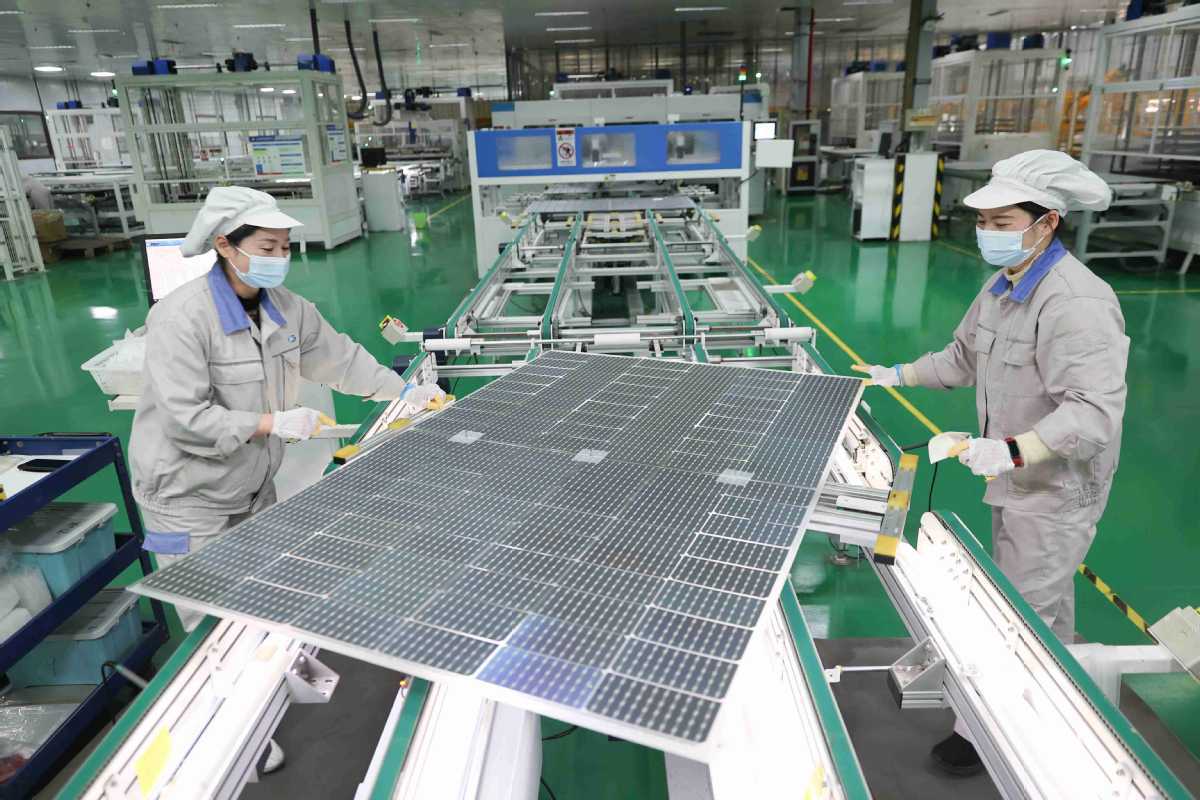
Last week's guideline of the US Treasury Department allowing only US-based solar developers to secure tax credits, would barely affect the country's reliance on Chinese supplies, considering the limited production capacity in the United States, industry experts said.
On Friday, the US government, seeking to speed up reshoring of clean energy supply chains, issued new guideline that would allow only US-based solar developers to secure tax credits offered via the Inflation Reduction Act if they made their cells domestically.
While some investors may see the guideline as a boon for solar manufacturers in the US, others may feel it would do little in the short term to reduce the US dependence on imports from China, said Lin Boqiang, head of the China Institute for Studies in Energy Policy at Xiamen University.
Lin said: "The US attempt to counter China's leading position in global clean tech supply chains might not work as they expect, considering the small solar cell production capacity in the US. It will not change the current situation and the US will still (have to) rely on China in developing clean energies in the short term."
Many of the related manufacturing industries in the US are virtually nonexistent or too small, while Chinese manufacturing competes across the entire industry chain, he said.
According to the International Energy Agency, China produces nearly all of the world's wafers, 85 percent of all cells and 75 percent of all modules. The country is also the world-leading producer of polysilicon, a critical raw material used in solar modules, it said.
The US, on the other hand, currently manufactures 8.9 gigawatts of solar modules, enough to meet only half of 2022 demand and far below China's production capacity of 600 GW, according to Wood Mackenzie, a global energy research and consultancy group.
Some US solar developers, despite the tax credits offered by the US government, may still buy panels elsewhere, including Southeast Asia, India and Europe, due to economic reasons, said Lin.
Panels from Cambodia, Malaysia, Thailand and Vietnam accounted for 75 percent of all solar power capacity export to the US in 2022, according to Rystad Energy, an independent energy research and business intelligence company based in Norway.
"With increasing pressure for carbon neutrality, relying on US manufacturing alone is not only not practical but also far from sufficient, and the US solar component production capacity is insignificant compared to that of China. It will be challenging for the US to establish a competitive position throughout the entire industry chain without support from China," said Lin.
Agreed Pol Lezcano, a senior associate at BloombergNEF, an energy industry data provider, saying the US will still rely on supplies from China directly and indirectly.
Friday's guidance may encourage more solar cell manufacturing in the US, but most of the cells used in US solar projects will continue to come from factories in Southeast Asia, most of them owned by Chinese companies, Lezcano was quoted as saying by Financial Times.
The United States added 20.2 GW of solar capacity in 2022, down 16 percent from the previous year, according to a joint report from Wood Mackenzie and the Solar Energy Industries Association.
Lin said the new regulations are more of a result of a compromise. While the US is eager to reduce its reliance on imported solar panels, it cannot afford to wait for domestic supplies if it does not want to delay the clean energy revolution for several years, he said.



















