



China, Central Asia ties grow stronger









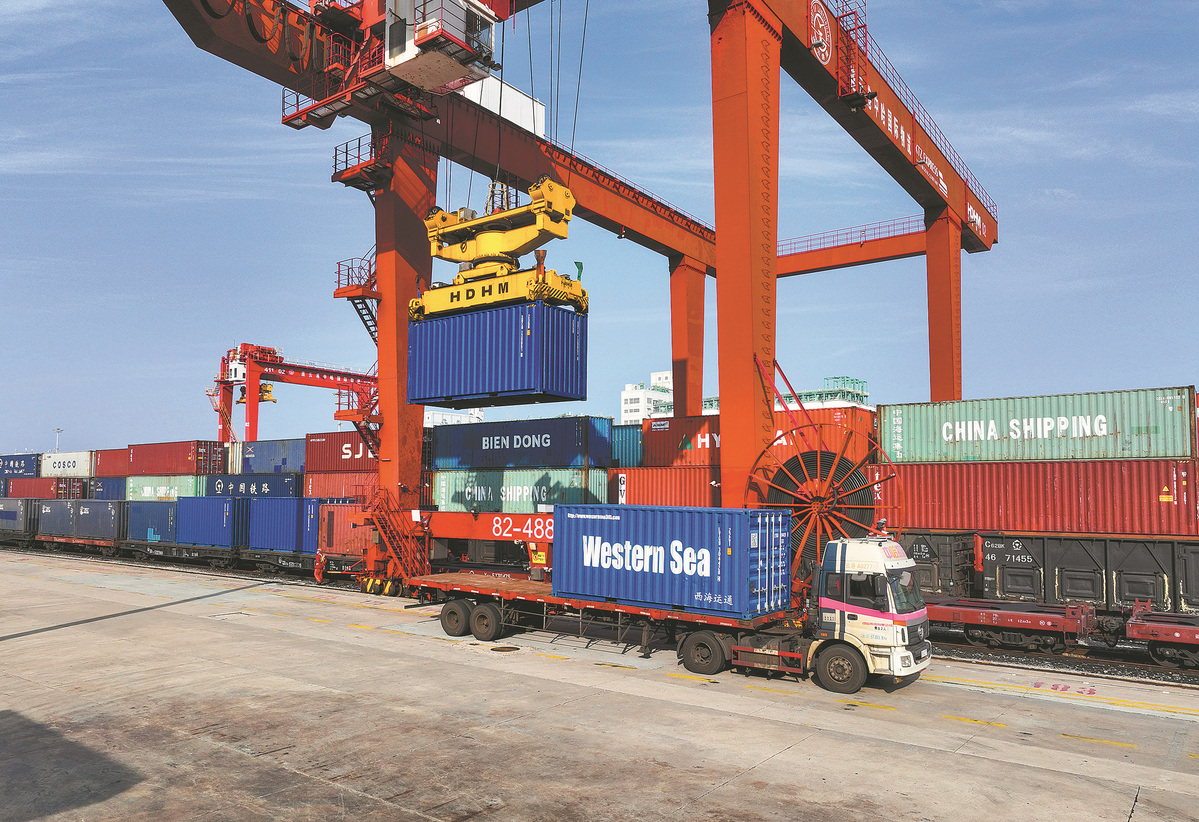
Two sides have made historic achievements in connectivity, trade and policy coordination
More than 2,100 years ago, Zhang Qian set off from what is now the northwestern Chinese city of Xi'an as an envoy of the Han Dynasty (206 BC-AD 220). He braved a world of uncertainties and traveled westward through harsh terrain to Central Asia.
Central Asia is where the Belt and Road Initiative began, as in a speech delivered at Kazakhstan's Nazarbayev University on Sept 7, 2013, President Xi Jinping for the first time proposed building the Silk Road Economic Belt.
Over the past decade, under the strategic guidance of Xi and the heads of state of the five Central Asian countries, the two sides have made a series of historic and groundbreaking achievements in cooperation.
In January last year, a virtual summit was held to commemorate the 30th anniversary of the establishment of diplomatic relations between China and Central Asian countries, and China-Central Asia cooperation mechanisms were created.
In September last year, Xi attended the 22nd meeting of the Council of Heads of State of the Shanghai Cooperation Organization in the city of Samarkand in Uzbekistan, and paid state visits to Kazakhstan and Uzbekistan.
In the past 10 years, the five Central Asian countries have taken an active role in the BRI, turning Central Asia into a demonstration zone for Belt and Road cooperation.
China and the Central Asian countries have strengthened the synergy of their development strategies and actively promoted policy coordination, connectivity in infrastructure and facilities, unimpeded trade, financial integration and people-to-people bonds.
Kazakhstan
President Xi and Kazakh President Kassym-Jomart Tokayev agreed in February last year to work together to create another 30-year golden period of China-Kazakhstan relations, which has charted the course for the long-term development of bilateral ties.
Kazakhstan stands ready to work with China to faithfully implement the important consensus reached by the two heads of state and usher in a new golden 30 years of bilateral relations, Kazakh Foreign Minister Mukhtar Tleuberdi said, adding that Kazakhstan has introduced a 14-day visa-free policy for Chinese citizens and looks forward to further facilitating people-to-people exchanges and deepening sub-national exchanges and cooperation.
China-Europe freight trains through Central Asia, the China-Kazakhstan Horgos International Frontier Cooperation Center and the China-Kazakhstan International Logistics Base in the eastern Chinese port of Lianyungang have all helped open the door to global markets for Central Asian countries. The enhanced interconnectivity has also encouraged many Chinese companies to invest in the region.
Uzbekistan
China and Uzbekistan issued a joint statement last September on promoting their comprehensive strategic partnership and advancing all-round cooperation.
A chemical complex cooperation project under the framework of the BRI has changed the country's dependence on imports of polyvinyl chloride and caustic soda, and created a large number of new jobs, which is of great significance to the economic development of the country.
In March, a fleet of 800 buses manufactured by leading Chinese bus maker Yutong Bus departed Zhengzhou in Central China's Henan province for Uzbekistan. The batch, including 500 compressed natural gas buses and 300 electric buses, was China's largest bus export to Uzbekistan.
Yutong Bus has built a complete after-sales service system, a spare parts storage warehouse and an after-sales service team in Uzbekistan to provide better services.
Kyrgyzstan
The 433-kilometer Bishkek-Osh highway, which connects the northern and southern parts of Kyrgyzstan, is of strategic importance for the development of the country, said Tagai Alimbaev, Asian Development Bank project monitoring and public relations specialist at the Ministry of Transport of Kyrgyzstan.
The construction of the road is divided into three phases with two phases having already been completed by China Road and Bridge Corporation. The third phase is under construction.
After completion of the project, the north-south highway will become the main transport artery connecting north and south Kyrgyzstan and an important international transport channel in Central Asia.
During Xi's state visit to Uzbekistan in September last year, China, Kyrgyzstan and Uzbekistan signed a memorandum of understanding on cooperation on the Kyrgyz section of the China-Kyrgyzstan-Uzbekistan railway, making significant headway in the construction of a transport corridor in the Eurasian continent.
Tajikistan
China and Tajikistan are friendly neighbors and comprehensive strategic partners, and the strategic guidance of Xi and Tajik President Emomali Rahmon is the biggest political advantage and a solid guarantee for bilateral relations.
Xi called for more concrete results in China-Tajikistan relations, and underscored China's readiness to enhance practical cooperation with Tajikistan, expand the import of quality Tajik agricultural products, elevate the scale and level of bilateral trade, advance cooperation in such areas as infrastructure, water management and transportation, discuss cooperation in green technology, digital economy and artificial intelligence, and assist Tajikistan in promoting cross-border transportation capability.
During his meeting with Xi last September, Rahmon said Tajikistan is ready to strengthen coordination with China in the United Nations, the Shanghai Cooperation Organization, the Conference on Interaction and Confidence Building Measures in Asia and the C+C5 framework to deepen security cooperation and jointly safeguard regional security and stability.
In 2011, the Tajik government and China's TBEA energy company jointly launched the Dushanbe-2 thermal power station project, a combined heat and power plant with total installed capacity of 400 megawatts.
Completed in 2016, the station enabled the restart of central heating for Dushanbe residents after a 15-year hiatus.
Turkmenistan
The visions, goals and interests that China and Turkmenistan share mean that the two sides need to work together on the road to development and rejuvenation to leverage complementary advantages, tap cooperation potential and achieve common development, Xi said after meeting with his Turkmen counterpart Serdar Berdimuhamedov in Beijing in January.
As the second-largest state in Central Asia and the southernmost of the five republics in the region, Turkmenistan acts as a corridor for China to reach important import and export markets in South Asia, the Middle East, Eastern Europe and beyond, as well as to access the Caspian Sea, which lies on the country's western border.
According to statistics from China's Ministry of Commerce, in 2020, China's direct investment in Turkmenistan reached $211 million. By the end of 2020, China's accumulated direct investment in Turkmenistan was $336 million.
Turkmenistan's largest export market is China, which accounted for 76.6 percent of all products in the first quarter last year. China has also been a major investor in Turkmenistan's gas fields, as well as gas pipelines.
The 3,666-km Turkmenistan-China Gas Pipeline, also called the Central Asia-China Gas Pipeline, travels from Gedaim, on the border between Turkmenistan and Uzbekistan, to Horgos, in western China's Xinjiang Uygur autonomous region. The natural gas pipeline system and its extension through both countries make it possible to transport Turkmenistan's gas all the way to Shanghai.
Line D of the pipeline is currently under construction, and will be able to transport 30 billion cubic meters of gas per year, giving the Central Asia-China Gas Pipeline network a potential annual export capacity of 85 billion cubic meters, with Turkmenistan remaining the primary source of the gas exported.
renqi@chinadaily.com.cn


- Lawmakers call for action on 'invisible overtime'
- F1 Chinese Grand Prix returns with major upgrades
- Taiwan's 'goodwill mission' criticized as futile bid for 'independence' support
- Chinese biotech innovator Jacobio Pharma reports its 2025 annual results
- Xinyang aims to become open gateway in southern Henan, says NPC deputy
- Honor launches its latest foldable smartphone Magic V6





