



Experts dismiss US development claims









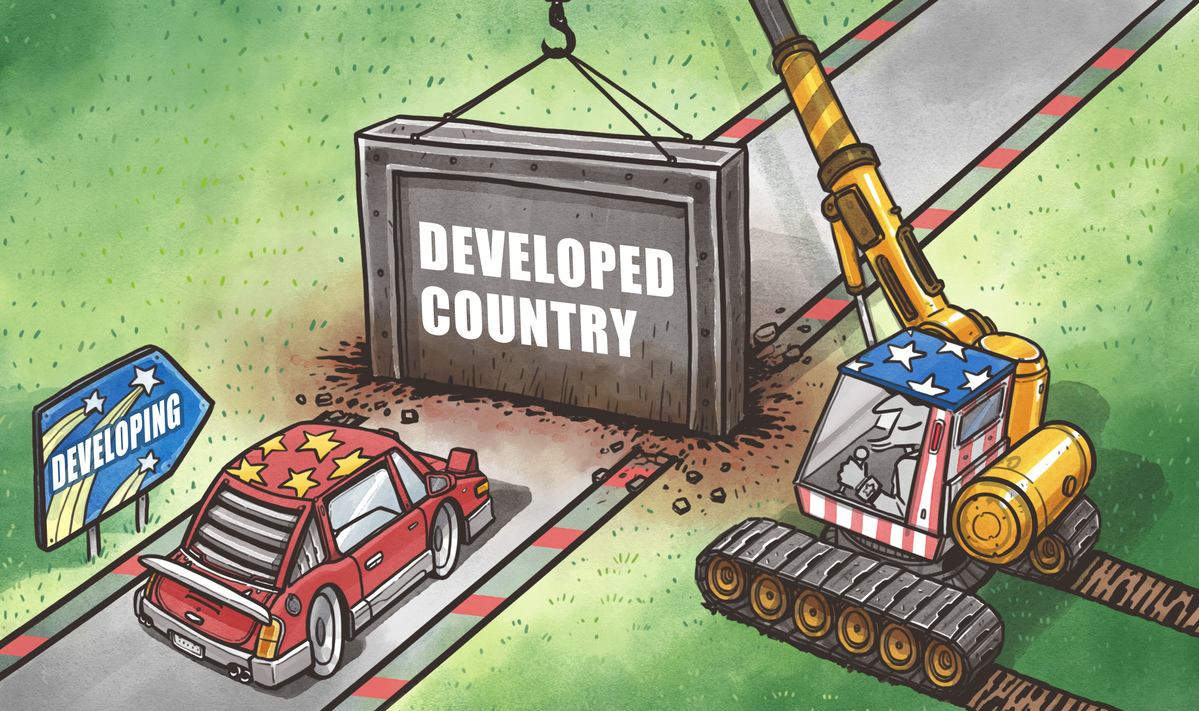
Do glittering skyscrapers, extensive high-speed train networks, and a sizable economy, among other accomplishments, suffice to make China a developed economy?
A panel of global experts tracking the country's development said an overall economic boom is usually an unreliable gauge.
This is especially true for a country as populous and expansive as China, because general prosperity can mask regional imbalances and urban-rural inequality, they said.
"China is still very much a developing country," said Wu Haitao, a researcher of poverty issues at Zhongnan University of Economics and Law in Wuhan, Hubei province.
"The gross data in many cases do not reflect real problems, and a country's real strength is often reflected by the level of balanced economic development," he said.
Ashwani Muthoo, director-general of the New Development Bank's Independent Evaluation Office, lauded China's "incredible" and "highly commendable" progress over the past decades in multiple areas, a result of the Chinese government's efficiency in project delivery.
But he noted that more work needs to be done in a number of areas, especially in addressing rural-urban inequality.
"I have been to a number of rural areas in China, and you can see there's still need for greater connectivity in some places," he said, referring to the shortage of infrastructure in some of China's remotest areas.
Siddharth Chatterjee, United Nations resident coordinator in China, said the country, with its 1.4 billion population and a large territory is still very much an upper-middle income country by the World Bank's standards, which means it is still a step away from acquiring developed-country status.
"While it's done very well in ending poverty, there's still parts of China that need to progress along with the UN family," he said.
The UN coordinator added that the country's 14th Five-Year Plan (2021-25), which laid more emphasis on bridging urban-rural inequalities, creates an opportunity for China and the UN to work together on that front.
Chatterjee said he has confidence that if China progresses at its current pace, it could achieve all of the UN's 2030 sustainable development goals.
The development experts made the remarks in response to the recent legislative effort by members of the United States House of Representatives to strip China of its developing nation status. The legislation, "Ending China's Developing Nation Status Act", was passed by the Senate Foreign Relations Committee on Thursday, and would require the Secretary of State to pursue changing China's status as a developing nation in international organizations.
Mainstream publications in China said the move is politically charged.
A commentary published by People's Daily on April 12 said that China's achievements are recognized worldwide, and it is known as the "top student" among developing economies.
"However, it is far from being a 'graduate' and still faces formidable challenges and difficulties," it said.
There is no universal consensus as to what makes a developing or developed country. For example, the World Trade Organization allows countries to self-declare whether they are developing countries.
However, there are some economic bench marks employed by international organizations to decide a country's development status, and China still lags behind developed countries in most of these.
For example, China's per capita GDP last year was $12,741, according to the National Bureau of Statistics. That is around one-fifth of the average level in developed economies, and 16.6 percent of that in the US.
China is also a developing country by the World Bank's standards.
The organization divides economies into four income groups — low, lower-middle, upper-middle and high income — based on gross national income per capita. The high-income countries, with a GNI per capital above $13,205, are commonly considered developed countries. The latest GNI per capita for China, $11,880 in 2021, however, is below the threshold.
China is also considered a developing country based on the United Nations' Human Development Index. It ranks 79th globally, as compared with 21st for the US.
China kicked off decadeslong fast-paced development when the nation launched reform and opening-up in the late 1970s, and prioritized the development of coastal and urban areas.
Former Chinese leader Deng Xiaoping, the chief architect of reform and opening-up, in a talk with then-prime minister of New Zealand David Lange on March 28, 1986, said: "It is our policy to let some people and some regions prosper before others".
He pointed out with foresight that common prosperity would eventually be realized when the people and regions that prospered first helped those that lagged behind.
Despite rapid gains in rural earnings due to stepped-up antipoverty efforts over the past decade, official data showed the rural disposable income — which was about 20,000 yuan last year — was still just half the level of its urban counterpart.
Wu, the Wuhan-based professor, said the imbalance is still more notable between the country's eastern and western regions. The GDP of China's eastern region, which includes the country's economic locomotives such as Beijing and Shanghai, was 62 trillion yuan, compared with just 25 trillion yuan in the country's western region, which includes Guizhou province and the Xinjiang Uygur autonomous region.
Besides, China's industrial makeup features a greater percentage of agriculture and manufacturing with less added value when compared with developed countries such as the US.
"In many key aspects, China still lags behind developed countries," he said.
Guan Xinping, director of the Institute of Social Construction and Management of Nankai University in Tianjin, said that China has much room for progress in nonnumerical aspects, such as an expansive yet relatively weak social safety net program.
Over the last few decades, China has charged ahead economically by fostering labor-intensive industries, while exports and foreign investment still play a big role in driving growth.
"As a result, China's growth is highly sensitive to labor costs, which limits the overall level of social security protection and creates a large gap compared to developed countries," he explained.
Currently, China has achieved near-universal coverage of the pension fund program and basic health insurance for one-fifth of the global population, which Guan said is a great achievement for a developing country.
On the other hand, with the fast development of e-commerce and platform companies, many flexible workers in urban areas do not participate in the pension fund program. Meanwhile, the pensions that some people receive, especially in rural areas, still lag far behind their urban counterparts, Guan said.
The reimbursement rate of medical insurance is lower than most developed countries, meaning that Chinese people still need to pay a large portion of their medical bills out-of-pocket, he added.
"With the promotion of high-quality development and domestic consumption, and the increased investment in technology, the impact of labor costs on economic growth will be reduced," he said.
"That will create new opportunities for improving the social security system."
Luo Wangshu contributed to this story.




















