In the right perspective
Dynamic economic relations are an important part of the bilateral relationship between China and Germany, not a source of insecurity









Dynamic economic relations are an important part of the bilateral relationship between China and Germany, not a source of insecurity

When the heads of state and government of the European Union members assemble at Brussels at the end of June for the European Summit, they are sure to talk about the bloc's relations with China. Chinese Premier Li Qiang has just concluded a visit to Germany for the seventh round of intergovernmental consultations; he subsequently went to France to attend the Summit for a New Global Financial Pact. The importance of the relationship between Europe and China is highlighted by the fact that Li chose Germany and France for his first trip abroad after taking office. His visit to the two countries came just days after US Secretary of State Antony Blinken made his first visit to Beijing.
German Chancellor Olaf Scholz is to be commended for his pragmatic approach to relations with China. At a joint press conference with Li, he stressed that dynamic economic relations are an important part of the bilateral relationship, and Germany is not interested in any form of economic decoupling from China. Both countries, he said, want to continue their economic growth, benefitting from trade with one another as well as from mutual investments. The consultations laid the groundwork for future close cooperation by instituting a new climate change and green transformation dialogue and scheduling a meeting of the Sino-German Environment Forum and the third China-Germany High Level Financial Dialogue later this year. In a meeting of Li with the CEOs of major German companies, they reiterated their commitment to China.
Scholz's unambiguous stance in favor of economic cooperation is all the more reassuring as there have been some voices in the German media, think tanks and even within his coalition government calling for a more antagonistic position vis-a-vis China. They are worried about the economic consequences of the Ukraine crisis and therefore concerned about a possible crisis in East Asia that might have repercussions on global trade. That is why they advocate a "de-risking" strategy that would make Germany and Europe less dependent on other countries, in particular China.
There is of course nothing wrong with striving to reduce risks in economic activity. All countries, including China, do it, for example when they diversify their energy supply. But de-risking and diversification should not be used as the code for obstructing, or even discontinuing, relations with one country only.
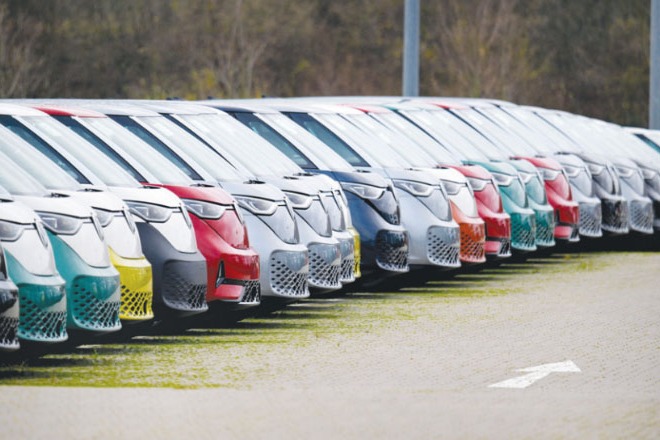
This was made abundantly clear by Li when he, somewhat jokingly, pointed out that Chinese patients who were treated with German medical technology or Chinese drivers of German cars did not fear to run any risks. That is, of course, true. Scholz in turn pointed out that gaining access to the Chinese market and fair competitive conditions are at times still challenges for German companies. Once more he asked for a "level playing field" for foreign companies in China. Remarkably, on the next day, the European Chamber of Commerce in China reported that according to a survey conducted in February and March some progress was made on precisely that issue. Still, a lot remains to be done, including in the areas of medical and automotive technologies.
Those who advocate de-risking often exaggerate the significance of China for the German economy. China has indeed been Germany's most important trading partner for more than half a decade. But the significance of trade with China is even more important for the United States. It is also at least one-sided to frame trade only as dependence. While the long-held German mantra "change through trade" may not work — if it did, Germany as one of the world's major trading nations would have to be concerned about undue influences from all the countries with which it trades — trade and investment do promote contact and understanding between states. Furthermore, Chinese investment in Germany is, in international comparison, not particularly high: From 2005 to 2022, China invested $102 billion in the United Kingdom and $61 billion in Switzerland, but only $54 billion in Germany. In 2022, more than 14,000 jobs were created in Germany by investment from the US and the UK — but only 4,600 by Chinese investment. There is therefore only a limited "danger" of German overdependence on China.
A responsible de-risking strategy would also have to take into account all the major risks that could be a threat to the German economy. The possibility of a crisis in East Asia with an ensuing disruption of supply chains indeed needs to be considered. But the same is true for, say, the scenario of the election in 2024 of a US president critical of Germany and the EU, as was the case with former president Donald Trump. An even greater danger for the German economy could be the election of a French president who distrusts Germany: In the first round of the elections in 2022, nationalist candidate Marine Le Pen received 23.2 percent of the vote, whereas Macron received 27.8 percent. In 2027, Macron cannot run again, and there is a real risk of an adverse outcome for Germany — and, so far, few German think tanks talk about de-risking from France.
Over the past year it has become clear that the Ukraine crisis has had a negative impact on the world economy, and in particular on its major trading partners: China, Europe and the US. In such a situation, irresponsible de-risking could have a devastating impact. All three partners should therefore work together to increase trade and international investment and refrain from simply equating interdependence with insecurity. In order to make this possible, all three should cooperate with a view to ending the Ukraine crisis in line with the United Nations Charter, namely the principles of sovereignty, territorial integrity, non-interference in the internal affairs of other states, and the return of all troops to internationally recognized borders.
The author is a former member of the German Foreign Service and a researcher at the German Studies Center at Tongji University. The author contributed this article to China Watch, a think tank powered by China Daily.
Contact the editor at editor@chinawatch.cn.