10-year fishing ban improves biodiversity in Yangtze River









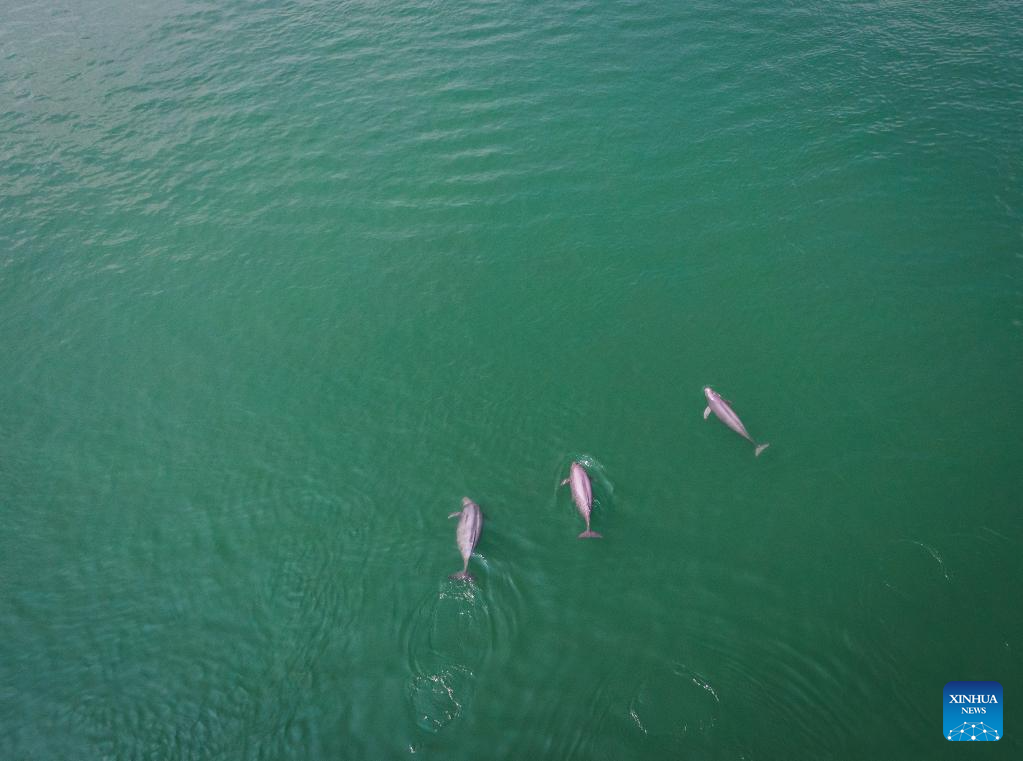
WUHAN - Undeterred by the scorching summer sun, 64-year-old photographer Yang He patiently awaits at the bank of the Yangtze River in Yichang city of Central China's Hubei province every noon to capture finless porpoises with his shutter.
"At noon, the ray of sunlight is strong enough to penetrate the river surface, so I can see what's going on in the water. Moreover, there's a higher likelihood of finless porpoises coming to the surface when the water gets warmer," said Yang, who started taking photos of finless porpoises five years ago.
He told Xinhua that the finless porpoises are reminiscent of his childhood. "I have vivid memories of playing by the riverbank and witnessing herds of finless porpoises frolicking in the water," recalled Yang, adding that as human activity intensified in the Yichang section of the Yangtze River over the years, it became increasingly challenging to catch sight of these magnificent mammals.
Known as the "giant panda of the water," the Yangtze finless porpoise is under top-level state protection and serves as a barometer of the Yangtze River ecology.
To restore the biodiversity along the river, China imposed a full fishing ban in 332 conservation areas of the Yangtze River basin in January 2020. The move has since been expanded to a 10-year moratorium along the river's main streams and major tributaries, effective Jan 1, 2021.
By the end of 2022, China had channeled over 26.9 billion yuan ($3.71 billion) to support fishermen after they gave up using nets and boats on the Yangtze River.
The fishing ban and removal of the big polluters have improved biodiversity in the Yangtze River. According to the Ministry of Agriculture and Rural Affairs, the population of the Yangtze finless porpoises had increased to 1,249 in 2022, up 23.42 percent from five years ago. The species has been more frequently spotted in Poyang Lake, Dongting Lake, and the middle and lower reaches of the Yangtze River.
"Back in 2017, capturing even a single photograph of finless porpoises in Yichang throughout the entire year was a challenge," said Yang. "However, things took a turn in 2020 as more sightings of finless porpoises began to be reported. Once I saw a pod of five or six of them and tirelessly searched along the river for months until I eventually discovered that they had settled in the Dianjun district.
The chemical industry was once the backbone of the district's economy. For instance, the Tiantian Chemical Plant, which was set up in the 1970s, could generate tens of millions of yuan in tax revenue each year. For the protection of the Yangtze River's ecology, however, the plant was closed in 2017.
"Now I can put my hand on my heart and say that I can capture finless porpoises with my camera every day," Yang said.
Other aquatic bioresources in the key waters of the Yangtze River have also seen a recovery. According to the Ministry of Agriculture and Rural Affairs, in 2022, 193 varieties of fish were spotted in these waters, marking an increase of 25 varieties from 2020.
"Protecting the Yangtze finless porpoise is protecting the aquatic biodiversity of the Yangtze River," said Wang Ding, an academician with the Institute of Hydrobiology, Chinese Academy of Sciences.
Noting that the recovery of the mammal is an encouraging sign, Wang said there is still a long way to go in terms of protecting the species and the Yangtze River as a whole.
"We should continue to focus on the protection of finless porpoises, and use scientific investigations to know the status quo of all the aquatic species and their habitats along the Yangtze River. Meanwhile, the possible risk factors and the effects of protection measures should be analyzed to further formulate targeted protection plans," Wang added.





- Former Jiangxi official sentenced to life for bribery
- China secures first extradition from South Africa
- China’s drug-related cases decline, but new drug challenges emerge
- Fuzhou announces free metro and bus services during Spring Festival
- One family's journey reflects changes in travel during Spring Festival
- Judicial oversight campaign tackles improper enforcement against businesses