EU should seek new synergies with China to promote collaboration









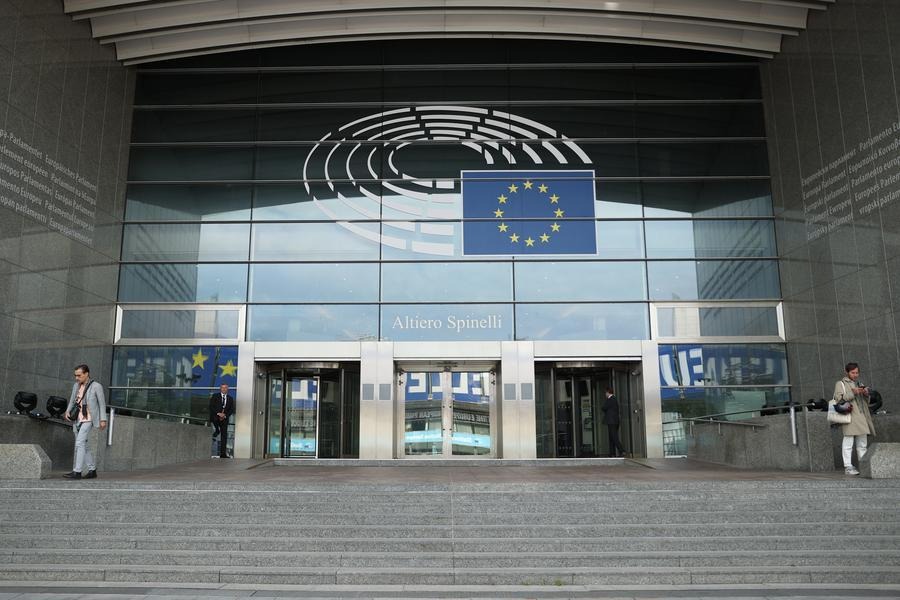
The European Union's industrial policy aims at strengthening the competitiveness of the continent's industry. China is an important partner of the EU in the industrial field, and the EU should seek new synergies with it, not view it as a "systemic rival".
As Premier Li Qiang stated recently in both Paris and Berlin, as well as at the Summer Davos Forum in Tianjin, "Businesses are in the best position to assess risk."
Governments should not overreach, still less stretch the concept of risk or turn it into an ideological tool, which means avoiding the politicization of economic issues and industrial policies.
But in Europe, some governments are interested in equating politics and economics, and industrial policies with geopolitics. For example, equating China's industrial policy with Russia's, although they are profoundly different.
Some months ago, the newspaper Le Monde published an interview with Martin Brudermueller, head of leading global chemical giant BASF. Questioned about BASF's business in China, Beijing's geopolitical stance and the potential risk of investing huge sums of money in China, he replied with figures that should be viewed as trajectories and trends. BASF is convinced that by 2030, China will represent 50 percent of the world chemical market, and if a company wants to be a global chemical giant, it is senseless not to be interested in half of the market. If the company is not there to exploit such growth, another company will take its place.
Highlighting this, the EU has seen its share of the global chemical market fall by a fifth in the past decade to 14.4 percent in 2020, and BASF's projection says that it will be almost 10 percent by 2030.
Or let's take the case of German car manufacturing, till now at the vanguard in China and the world. In the decade from 2007 to 2017, BMW, Volkswagen and Mercedes-Benz established five research and development sites in Chinese territory, whereas in the five years since 2018 they have opened at least 11. The three companies have stepped up their R&D investment according to proven logic.
Competition drives improvement. China is akin to a fitness club that forces European companies to strive to be "a little bit faster, a little bit better", as Joerg Wuttke, former president of the EU Chamber of Commerce in China, has repeatedly said.
Are there concerns about presumably stronger Chinese competition in the long term? Of course, but that logic is also valid in Europe among European competitors — not to mention well-known traditional entrepreneurial competition as well as industrial and trade competition between Europe and the United States.
"Systemic rivalry" should not be used in any future industrial policy vis-a-vis China. We live in interdependent times, and we have reached such a technological level that we urgently need to cooperate closer with Beijing in defining the limits of artificial intelligence before it is too late, as was mentioned at the Tianjin Summer Davos Forum in late June.
Last but not least, one important thing is for the EU to recognize in the most realistic terms where it is now. With all its inherent disagreements typical of a successful organization made up of 27 members, the EU is more united than ever since the 2008 economic crisis. Yet, at the same time, it is more dependent than ever on the US, at a time when the US is facing a risky game of its own. The next US presidential election is looming, and the country is trapped in a dysfunctional democracy.
The EU should regard the aforementioned factors as a compass for a more resilient industrial policy. We will see if and when it may come into reality.
The author is a professor at the Esade Educational Institution of Ramon Llull University and director of the Dialogue with China Project in Spain. The views do not necessarily reflect those of China Daily.