Bridging the gap
Narrowing urban-rural income divide is imperative to advance Chinese modernization and achieve common prosperity









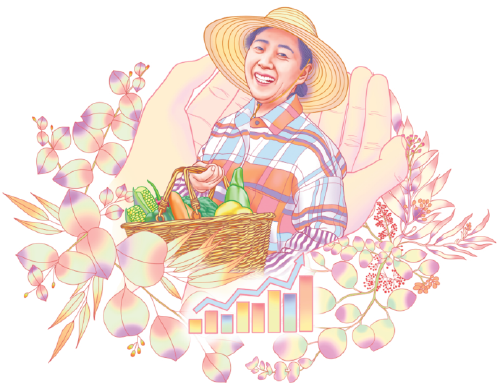
Narrowing urban-rural income divide is imperative to advance Chinese modernization and achieve common prosperity
Since the reform and opening-up policy was launched in China, driven by economic and social development, the impoverished population in rural areas has been decreasing year-by-year, and China has achieved the goal of eradicating extreme poverty in rural areas and farmers' incomes have increased along with the country's rapid economic growth.
That said, the income disparity between rural and urban residents had widened as a result of economic growth and urbanization, becoming a focus of the government.
Since the 18th National Congress of the Communist Party of China in 2012, by virtue of a range of policies and measures aimed at narrowing the gap, the urban-rural income divide has been shrinking. The per capita income of urban households was 2.5 times that of rural households in 2021, down from 2.71 times in 2017. Narrowing the gap has become imperative to advance Chinese modernization and achieve common prosperity.
Farmers' incomes cannot be raised within a short period of time, but should be gradually raised alongside the modernization process. In 2020, in the per capita income of rural residents, 40.1 percent was from income of wages and salaries, with 35.5 percent from net business income, 2.4 percent from net income from property and 21.4 percent from net income from transfers. This income structure remains largely unchanged.
On the one hand, China needs to advance agricultural modernization through reforms and innovation to raise the income of farmers that is generated by farming, and create new room for the development of rural economy. On the other hand, China should develop more farmer-led institutions and mechanisms to increase their income. Only by doing so can the income of farmers be raised and their ability to secure wealth be promoted in tandem with China's modernization process under institutional guarantee.
Increasing the income from nonagricultural sectors is a key measure for raising the income of farmers. With the urbanization rate over 60 percent, China's rural population is decreasing year-by-year. The agricultural sector currently accounts for around 20 percent of China's total employment. The role of villages has transformed from agricultural production toward an integration of the primary, secondary and tertiary industries. In particular, new types of comprehensive rural economy have been growing such as the rural leisure tourism industry. The trend of people going back to the villages to set up businesses and staying there for work has created new room for farmers' employment in non-agricultural sectors and a new way for raising the income of farmers in many regions across China.
Currently, various sorts of cooperatives are the major form of business operation entities in rural areas. By the end of 2022, there were 2.23 million farmers' cooperatives nationwide. However, making sure that farmers play a dominant role in business operations is a challenging task.
During my own investigations, I have found that although there exist all sorts of cooperatives across the nation, many cooperatives face the aforementioned challenge. For instance, one village established a farmers' cooperative for developing the strawberry industry with funding support from the government. With help from organizations designated by the state to engage in fixed-point poverty alleviation efforts, the cooperative could bring each member villager over 10,000 yuan ($1,397) in additional income every year. However, after the help left, village cadres were incapable of managing the cooperative and outsourced it to a company, which only pays the village 50,000 yuan in contracting fees every year. Village cadres' limited energy and a lack of professionals specialized in business operations and professional management personnel have made many rural cooperatives "empty shells".
Thus, cultivating market operation entities in rural areas with farmers as the mainstay provides the institutional guarantee for keeping the farmers' profits from village operations.
Currently, aside from ensuring food security, ensuring a stable increase in rural residents' income is a priority in rural development and rural vitalization. Meanwhile, villages shoulder the responsibility of protecting the ecology and preserving the farming culture. Therefore, rural development and rural vitalization must focus on farmers.
In addition, China also needs to improve the interest allocation mechanism to better benefit farmers. The rural areas have long provided talent, capital and raw material support for the country's industrialization and urbanization. But they have been left behind during the process. Many resource-abundant villages are faced with a severe shortage of capital and talent. Even when capital flows to the villages to develop the local resources, the majority of profits do not stay to benefit the villages.
Thus, improving the interest allocation mechanism for rural resources is of great significance to increasing farmers' income. For instance, in an ethnic Miao village in Yiliang county, Zhaotong city, Yunnan province, where people just got lifted out of poverty, local government authorities invested 12 million yuan to improve infrastructure and 5 million yuan to develop agricultural tourism businesses. To ensure that profits generated from developing local resources stay in the village, the village has established a cooperative and hired professional managers. The village has turned government investment into the collective assets of villagers and combined such assets with farmers' idle houses to develop rural homestays, restaurants and coffee shops. The village collective and villagers share the earned profits 65/35. Apart from the professional management team's salary, the operational cost and salary for farmers taking part in the daily operations, the rest goes to a village dividend.
China's economic and social development has determined that rural development has entered a new period of rural-urban integrated development, wherein the industrial sector back-feeds the agricultural sector and the urban area supports the rural area. As the country beefs up its support for rural areas, rural infrastructure and social public services will substantially improve, creating unprecedented opportunities for increasing the income of farmers and promoting their ability to secure wealth.
The author is lead chair professor of China Agricultural University and honorary dean of the College of International Development and Global Agriculture. The author contributed this article to China Watch, a think tank powered by China Daily. The views do not necessarily reflect those of China Daily.
Contact the editor at editor@chinawatch.cn.