



'Decoupling' more detrimental to US tech









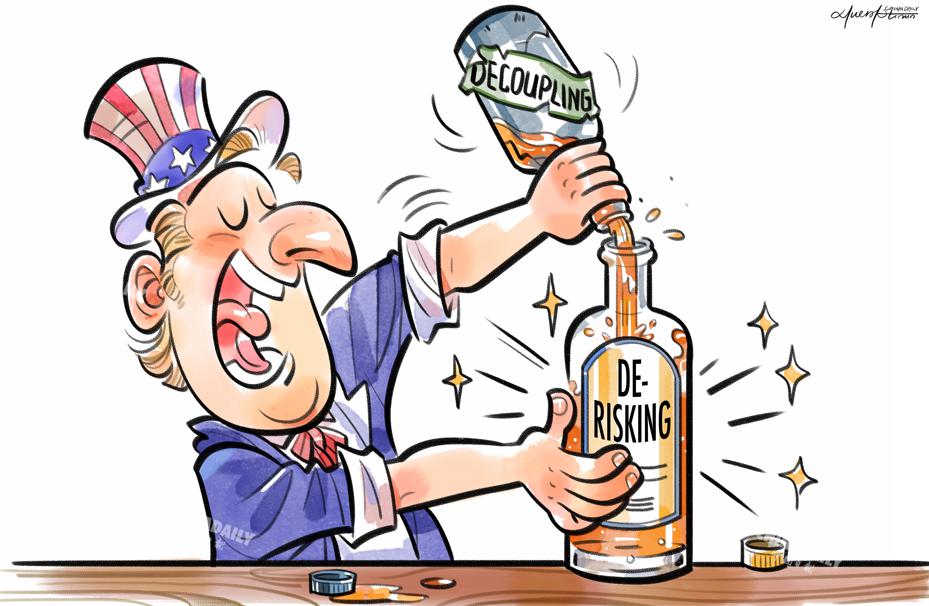
On Wednesday US President Joe Biden signed an executive order to restrict high-tech US-based investments going toward China, which covers advanced computer chips, micro electronics, quantum information technologies and artificial intelligence.
This executive order is just another "decoupling" move, which targeted China but will eventually be more detrimental to US industries and enterprises.
Collaboration in technology should have been the most mutually beneficial part of overall cooperation between China and the US. Scientists and technologists from the two countries have been forging connections in different fields since 1978.
However, since former president Donald Trump took office in 2017, Sino-US tech collaboration has become a casualty of bilateral political and trade disputes, leading to a noticeable decline in global technological progress and the international community's ability to address global challenges.
Instead of correcting the Trump administration's policies, the Joe Biden administration has intensified them under the guise of "strategic competition" to the detriment of both sides and further harmed global tech cooperation. Sino-US tech collaboration and overall bilateral relations have reached one of the lowest points since the establishment of diplomatic relations. Regrettably, the downward trend shows no signs of abating, leaving tech experts on both sides disheartened. The US has been abusing its tech and financial hegemony, with various kinds of sanctions imposed on more than 1,000 Chinese entities.
Sino-US tech "decoupling" may lead to the gradual fading of the friendship and goodwill built by countless Chinese and US scholars and students over the past more than four decades. Hostility and the "chilling effects" of "decoupling", or later in the name of "de-risking", will diminish the atmosphere of cooperation between the two countries, and coerce multi-national enterprises to take sides.
The US administration has called for cooperation on common challenges such as climate change, but its actions such as decoupling in eco-friendly green industry prove to be opposite to the goals. Emerging technologies such as artificial intelligence could have significant ethical and existential impacts on society, necessitating global coordination and regulations to safeguard humanity's safety and common interests. However, since the US seems hell-bent on decoupling its AI industry from China's, collaborating in the sector appears almost impossible.
Also, the deepening partisan divide in the US political circle prevents stable policies from being implemented in critical areas of global public interest. For instance, the Trump administration's withdrawal from the Paris Agreement, relaxation of regulations on the fossil fuel industry, and quitting international organizations such as UNESCO have caused irreparable damage to global common interests. While the Biden administration has rejoined the international treaties and organizations, the losses cannot be recovered nor can the consistency of policy be guaranteed in case of a government change in the next US presidential election.
More important, Washington's "decoupling" policy may hasten the end of the US' global leadership in high-tech, which is a core pillar of US hegemony. As a matter of fact, China's rising competitive potential is partly a result of the US' push for tech "decoupling" from China.
Due to China's advantage of scale and market vitality, "decoupling" from China will cause huge losses of US enterprises, and accelerate the end of the US' global tech leadership, and the Sino-US divide could slow down global tech progress.
Because tech "decoupling" will significantly impact the US' tech development. China and the US are each other's top partners in many fields of technology, with China's talent and funding providing strong support for the US' tech advancement. And finding other partners to compensate for reduced cooperation with China will be very challenging for the US.
Moreover, tech "decoupling" will prompt China to intensify research and development in order to become self-reliant in technology. China's deep integration into the global tech innovation system, since the launch of reform and opening-up has helped consolidate the US' global tech leadership. But the US' push to "decouple" will prompt China to develop independent tech capabilities. This will cause the US' influence on the new global tech innovation system centered on China to diminish, offering China opportunities to catch up or even overtake the US in many fields, such as space exploitation.
The US' "decoupling" policy will also blunt American tech companies' competitive edge in China and foster strong global competitors. Chinese companies have long believed the US will uphold the principle of fair competition and not abuse its advantages in the global supply chains to suppress competing countries. This belief is what helped Chinese tech companies to establish close cooperation with their US counterparts in the global supply chains.
But Washington's "chokehold" on tech has made US tech companies unreliable suppliers, shaking Chinese companies' confidence in cooperation with their US counterparts and prompted them to pursue local options.
China has grown within the US-dominated global tech innovation system and has been both a beneficiary and contributor to the system. China does not seek to replace the US' position; rather it aims to share its global responsibilities according to its capability. However, confrontation between China and the US may lead to the upheaval of the existing global tech innovation system.
"Decoupling" will deal a blow to Chinese tech sectors, but it will only be more detrimental to its tech hegemony in the long term.
The author is an associate research fellow on innovation studies at Development Research Center of the State Council. The views don't necessarily reflect those of China Daily.
The opinions expressed here are those of the writer and do not necessarily represent the views of China Daily and China Daily website.
If you have a specific expertise, or would like to share your thought about our stories, then send us your writings at opinion@chinadaily.com.cn, and comment@chinadaily.com.cn.





