



Holistic approach transforms desert









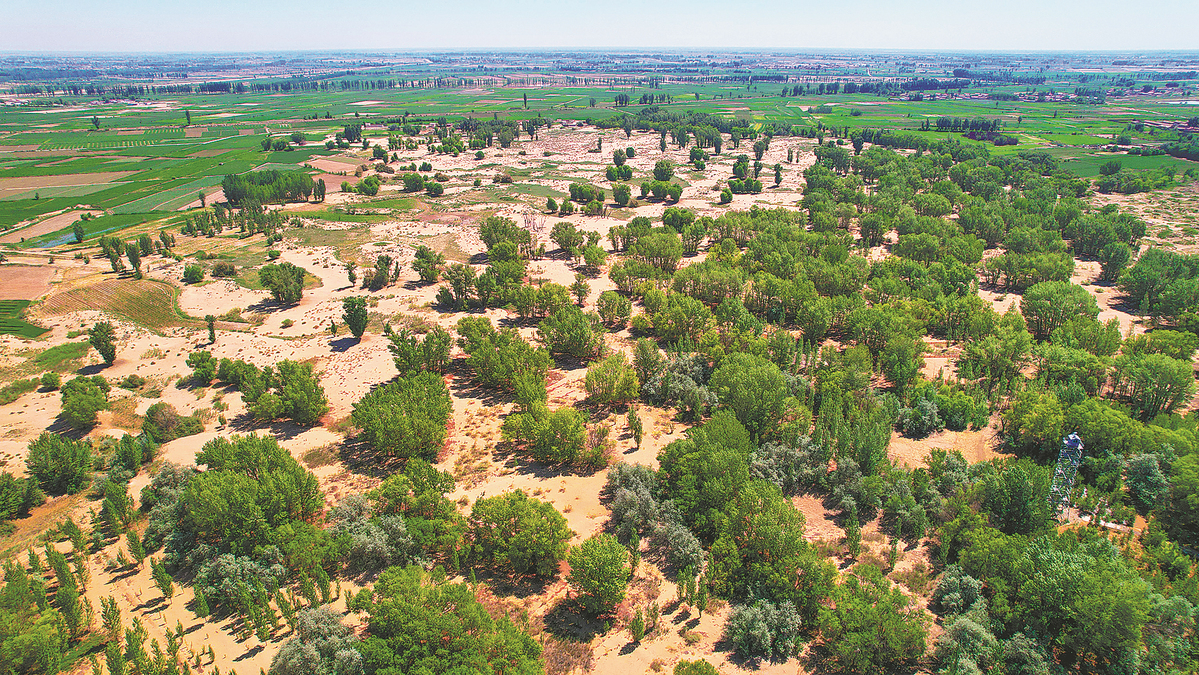
Decades ago, farmers in Bayannuur in the Inner Mongolia autonomous region, planted seeds in the spring, but seldom reaped a successful harvest. Wheat sown in spring was often buried or damaged by sandstorms and required repeated planting, said Li Fengqi, a retired forest farm worker from the city.
The impact of the sandstorms extended beyond the farmland. Houses in the area were often covered in sand, which even reached the rooftops of some, the 69-year-old said.
In 1960, the State-owned Xinhua Forest Farm was set up to carry out afforestation to control sand from deserts nearby, including the Kubuqi and Ulan Buh.
So far, the forest farm has planted 4.3 million trees, reducing the sandy areas from 1,433 hectares in the 1960s to 333 hectares today, the farm said.
Efforts to prevent and combat desertification require dedication. Any relaxation of these efforts could result in setbacks, according to Li.
Li, who joined the farm in 1976, recalls the early days when he and his colleagues took years of effort to see the first results.
The survival rate of seedlings was only about 50 percent. It was not uncommon for a whole year's worth of planting to be lost due to lack of rain.
The farm eventually improved the seedling breeding technology and began using planting machines to expand the forest area.
In the early stages, villagers had poor awareness of environmental protection and would often graze their cattle and sheep in the forest, despite being advised not to do so.
Li patrolled the forest, walking several kilometers to prevent unauthorized grazing.
The farm is part of the Three-North Shelter Forest Program, launched in 1978. The program's aim is to plant trees across 13 provinces in northern China by 2050, according to the National Forestry and Grassland Administration.
The fight against desertification in northern China has come a long way over the past 45 years, but challenges remain, Yue Taiqing, deputy head of the Forestry Bureau of Three-North, told a news conference in July.
From the 1950s to the 1970s, the northern region suffered from severe wind erosion and desertification. Sandstorms were a frequent occurrence, causing significant damage to farmland and grassland.
During this period, the annual desertification land area expanded by 200,000 to 300,000 hectares, impacting 400 million people.
So far, the program has planted and conserved 32 million hectares of forests and restored 85 million hectares of degraded grassland, Yue said.
Challenges remain in sand control and desertification prevention, Yue said.
"Despite achievements in the program, the work remains challenging due to the wide distribution and severe condition of desert land," he said. Recognizing the importance of desert ecosystems in regulating climate and sustaining a balanced environment, authorities realized the need to shift from an approach of confronting nature to working in harmony with it.
The philosophy behind the project is to work with, rather than against the desert, allowing for sustainable development and coexistence, the administration said.
Qiao Wenguang, a senior engineer from the Inner Mongolia autonomous region's Geological Survey Institute, said that once the ecosystem is restored, it should be able to maintain itself without constant human interference.
"Restoring nature should not rely on human efforts in the long term. When the holistic approach to conserving mountains, rivers, forests and farmland runs well, nature can restore itself.
"For example, the forest and grassland restoration efforts have not only enhanced water retention capabilities and reduced sandstorms in the region, but have also protected the surrounding farmland from sand erosion," he said.


- Labubu lights up Shanghai lantern show
- Cherry blossom festival in Yongfu town celebrates agricultural innovation and cultural exchange
- China's first domestically built cruise ship welcomes its 1 millionth guest
- The Devil Still Dances: High Vigilance against Japanese Militarism's Infiltration in Sports and Culture Fields
- 189 historical artifacts of Japanese invasion donated to museum in NE China
- Death toll rises to 8 in North China factory explosion












