


The flow of ingenuity










Generational effort
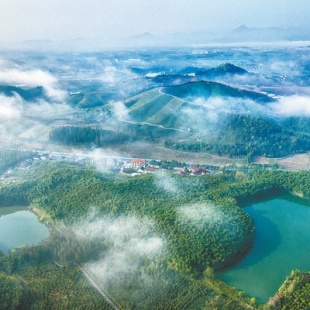
Nowhere else was this ingenuity put on more irrefutable display than with Liangzhu's extended water conservancy system, so far the earliest discovered in China on such a scale. It was composed of three parts: the high-dam system at the mouth of the valley, the low-dam system down on the plain and a 5,500-meter-long, 2.7-meter-high embankment erected along the southern foothill of the Dazhe Mountain — 2 kilometers further south is where Liangzhu City's palatial complex was being built.
"These days, we often talk about the 11 dams that had made up Liangzhu's water system, but, in fact, more than 30 such dams have been discovered to date," says Wang.
Among them, they formed three reservoirs with surface area totaling 13.29 million square meters. Collectively, they were capable of holding more than 46 million cubic meters of water. During the rainy season, the reservoirs would collect the water rushing down from the mountains, preventing it from flooding the acres of paddy fields on the low plains, while saving it for use during the dry season that would follow. (Despite popular belief, every year for a certain few months, severe drought ravages the area, threatening the survival of crops.)
"One story I heard about the dams is that, around 2005, workers from a local construction company were digging up earth considered ideal to build their own dam, at a place in the mountains called Laohuling (the Tiger's Ridge)," says Wang. "No one had any idea that they were actually digging at an ancient Liangzhu dam until four years later, when archaeologists made their discovery on the same spot of an earth dam running for about 135 meters in a northwest-southeast direction," says Wang.
"Of course no digging is allowed since that discovery. But the workers were absolutely right in thinking that the earth there was the best choice."
According to Wang, to understand the Liangzhu dams, one only needs to look at the modern-day core dams — dams with a central section or core composed of an impermeable material to stop water from seeping through it. These days, the cores are routinely made of clay or concrete, and are often surrounded on the outside by compacted rockfill which is responsible for the stability of the embankment body.
"The Liangzhu dams were no different, except that the Liangzhu people used something else," Wang says. "In place of the rockfill they had residual soil, developed as a result of the weathering of rocks. This type of soil, after ramming, becomes so stable that it would neither crack under the heat of sun, nor collapse during a downpour. No wonder the workers wanted it."
On the other hand, the Liangzhu people's answer to the clay core was a sedimentary silt, an extremely thick, gluey sludge found in the swamps. Believed to be even more impervious to water than clay, the same material was used around 2,800 years later, during China's Western Han Dynasty (206 BC-AD 24), to seal off the coffin of an aristocratic lady, keeping the tomb-owner completely intact until her discovery in the early 1970s.
At the Liangzhu dams, the silt was either used alone or as oval-shaped, straw-wrapped silt blocks, each approximately 40 centimeters long. The latter, often found on the upstream side of the dam, can be compared to the sandbags commonly used nowadays to prevent flooding. And the arrangement of these bags, laid on top of one another in a crisscross pattern, also allowed the straws to function as reinforcement for the structure.
"The Liangzhu people made the most of what they had at hand: the soil, the silt, the silver grass growing in the marshes, and their spare time," says Wang. Further sample analysis shows that the grass used to bundle up the silt was only cut off for use after its annual flowering, that is, during the dry autumn and winter seasons — downtime for local farmers then and now.
Therefore, the system took decades and generations to build — the total volume of soil needed to construct Liangzhu's water conservancy system is estimated at 2.88 million cu m. Behind that number is the enormous cost in terms of human labor, and the vision and power that motivated that labor.
"Judging by how the dams worked with one another, the entire project was planned out and thought through from its outset," says Wang, who in 2011 hit upon the idea that the dams were an interconnected whole while studying a picture taken of the area by a US reconnaissance satellite back in the 1960s.
"There, between two mountains is a short white line bridging them together. After being discontinued, that line seems to have re-picked itself up and run intermittently, extending to the northeast, before veering eastward," Wang recalls. "That's when it clicked in my head."
What the experienced map-reader was looking at was a series of dams which had collectively formed the lowdam system leading up to the embankment in front of the Dazhe Mountain.
"One intriguing aspect about this embankment, or causeway as some call it, is that it was partly a doubledam structure. A certain section of it actually features two dams running parallel to each other, effectively forming a canal between themselves," says Wang.
On its east side, the structure is open-ended, and was most probably connected to a natural river. This has led archaeologists to speculate that the double-dam may have served to channel water into the river and eventually into the city, the traffic of which was mainly waterborne.
But there may never be a definite answer, according to Wang. "The structure of the embankment is so complicated that we may never be able to completely decipher all its secrets. However, there's one thing that we know for sure: Like all other dams and reservoirs in the Liangzhu water conservancy system, it served multiple purposes. Transportation was probably one of them."
But were the Liangzhu people heavily rewarded by their gargantuan project and their heroic efforts to harness nature and bend it to their advantage? "Without that effort, the Liangzhu civilization wouldn't have existed," Wang concedes.