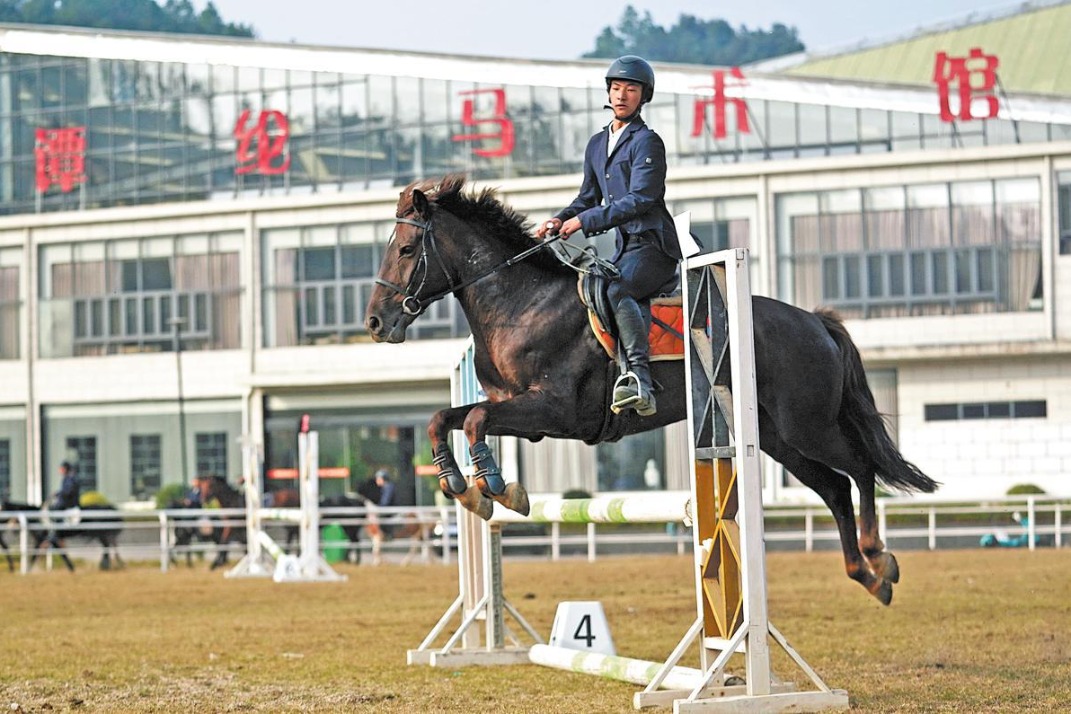
Tonglu firmly in the saddle after Asiad equestrian success










Major contributor
Bond said the MOU was structured around the Jockey Club's core expertise.
"We focused on areas where we have rich experience, so from a technical perspective, it wasn't too challenging," she said.
Still, the club was committed from its senior leadership down to ensuring the equestrian events were run successfully.
Since autumn last year, some 14 core club staff members and 20 other members have taken on various roles, traveling to Tonglu every month to prepare for the Games, in addition to their full-time work at the Jockey Club. In addition, six veterinary and farrier professionals were engaged by the club to offer professional guidance and support.
The Hong Kong contingent worked closely with local counterparts to share expertise, offer guidance, devise strategies and implement plans — contributing the combined experience to help the events from the preparatory stage to conclusion.
For example, with more than 100 horses from around the world arriving and departing at varying times for competitions, equine transportation was a complex task that required early strategic planning.
Horses housed safely in air stalls were flown on designated aircraft from worldwide hubs to Hangzhou Xiaoshan International Airport. To protect their health, they passed through a dedicated biosecure channel directly from the airport to reach Tonglu in specially designed air-conditioned trucks.
The HKJC shared its experience in equine transportation with event organizers, recommending to them a logistics partner with wide experience in flying horses to competitive events.
The club advised local government departments on maintaining the special biosecure channel — successfully bringing the horses to the Games and returning them safely to their home countries.
In addition, the club played a supporting role in setting up an intricate and challenging project, the Equine Disease-Free Zone, or EDFZ.
Stringent hygiene standards were upheld in the zone to protect the horses from potential risks from imported diseases. Establishing such zones is crucial for international equine sport to ensure the health and safety of horses. This work requires close cooperation with local government departments, effective communication with the international community, and approval from the World Organisation for Animal Health.
In the past, China faced obstacles in hosting major events due to a lack of epidemic-free zones. For instance, the equestrian events for the 2008 Beijing Olympic Games were relocated to Hong Kong due to the absence of a quarantine-free zone for horses on the Chinese mainland at that time.
For the 2010 Asian Games in Guangzhou, capital of Guangdong province, the club helped the city establish the mainland's first EDFZ.
In Tonglu, the club shared its successful experience of setting up EDFZs, collaborating with government departments on the mainland, and communicating with the international community. This work helped Tonglu successfully establish a vast disease-free zone covering about 1,300 square kilometers.
The club also played a significant role in establishing a comfortable environment to help the horses perform to their best. It ensured they were provided with exceptional accommodations, food, medical treatment and other essential services upon arriving at the center.
It also offered a wealth of advice on building and managing stables and competitive equestrian competition areas.
The center boasts 240 individual stables, with each horse housed in 16-square-meter rooms where the temperature is maintained at 24 C. To prevent accidents, non-slip rubber mats lined all the passageways and surfaces on which the horses trod.
The stables were open from 5 am to 10 pm, offering athletes and support teams sufficient time to spend with the horses. At night, a security team protected the horses' safety.
Sand in the competition areas was maintained at an optimum depth of 20 centimeters.
Construction of the 778-square-meter veterinary clinic at the center was supervised by veterinary experts from the HKJC. This state-of-the-art facility provides first-class medical care for horses, with those that require medical attention receiving the best treatment as soon as possible.
The horses have their own dietary preferences. Before the Asian Games, the club and the organizers collated the feeding preferences of all the horses and resolved various procedural difficulties to ensure their feed could be imported to Hangzhou from destinations across the world.
Bond said, "We supported the organizers in achieving approval for hundreds of different types of feed to be imported so that the horses could eat what they eat at home."
The club also helped the organizers coordinate with international stakeholders.
It assisted in liaising with the Asian Equestrian Federation, which is based in Qatar, and with the International Federation for Equestrian Sports, headquartered in Switzerland, as well as with shipping agents from the United Kingdom. It also helped liaise with representatives from national federations attending the Asian Games.
Bond said that to liaise with different parties, club members often sacrificed sleep to hold meetings across different time zones. "It's been a bit like working for the United Nations," she added.
In addition, the club helped provide training for about 60 volunteers from Hong Kong to further assist with the Games.
It gave lessons on equestrian history, equine care and other basics to equip volunteers for various roles. After arriving in Hangzhou, volunteers worked as translators, provided hospitality services, performed media and publicity work, among other tasks.
"We made sure they understood equestrian sport. No matter an individual's specific role at the venue, he or she could answer questions about the events and competitions," Bond said.
"Everything ran smoothly. With the athletes — both humans and horses — able to perform at their best, we could return to Hong Kong happy."