


Building on the bridges between nations










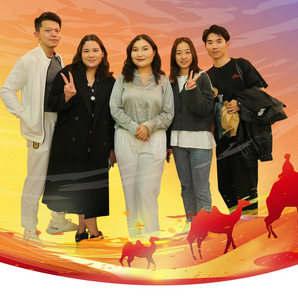
Young people from China and neighboring countries give their perspectives on the Belt and Road Initiative and the Silk Road Economic Belt, Li Xinran reports.
Over the past decade, the Belt and Road Initiative (BRI) has brought about significant benefits to over 150 countries and more than 30 international organizations. The BRI has created countless opportunities for underdeveloped regions and demonstrated China's commitment to shouldering greater international responsibilities. In 2013, President Xi Jinping introduced the Silk Road Economic Belt during a speech at Nazarbayev University in Kazakhstan. In the latest episode of Youth Power, which aired on Sept 30, a group of young people revisited the origins of the BRI and shared their personal stories and reflections on its impact.
Lashyn Zeiin, a sophomore at Nazarbayev University, embarked on her Chinese language journey 10 years ago. Her mother's involvement in business led her to visit Yiwu in Southeast China's Zhejiang province, home to one of the world's largest retail distribution centers.
"It was like a new world to me," said Zeiin, recalling her experience. "It was a breathtaking and amazing experience. From that visit, I knew the initiative was going to be a huge framework that can bring a lot of opportunities."
She also highlighted examples in Astana, the capital city of Kazakhstan, where China Railway International Group is contributing to the development of infrastructure, including the construction of the light rail transit system.
Kairat Bekmurzayev hails from Zharkent, a small town in Kazakhstan and located only 35 kilometers from China's northwest border. According to him, the local economy primarily relies on agriculture. Thanks to the BRI, an international center for cross-border cooperation has emerged, resulting in the construction of new schools, homes, and a highway connecting Zharkent to the major city of Almaty.
"This center has helped improve the quality of life for my people," said Bekmurzayev.
Apart from highways, high-speed railways have also been constructed. These infrastructure developments not only provide employment opportunities for local residents but also have a profound impact on fostering closer ties between countries.
"After building this infrastructure, we can travel. And after traveling to each other's countries, it will help us understand each other more," said Russian student Temelidi Yulia.
Botakoz Yelshibek, also from Kazakhstan, pointed out the historical significance of the ancient Silk Road, dating back over 2,000 years, which played a pivotal role in shaping civilizations. Today, it continues to offer educational opportunities. Yelshibek herself studied Chinese in Southwest China's Guizhou province and is currently a graduate student at East China Normal University in Shanghai.
Reflecting on history, the role of Zhang Qian, the Chinese envoy in the Western Han Dynasty (206 BC-AD 24) who traveled along the Silk Road, demonstrated that differences and disputes among different countries are inevitable. However, effective communication based on mutual respect and the overarching goal of mutual development remains crucial.
Wang Zongnan, a Chinese student studying at Tsinghua University, drew parallels between the ancient Silk Road and the BRI.
"They are not about colonization. We do not force other countries to use their labor for us or take away their goods. That's the basic difference between colonization and what we call globalization or the cooperation between countries," he said.
Yulia pointed out the differences in communication between ancient times and the present, where technological advancements have made communication more convenient and frequent. However, she also acknowledged the potential problems.
"In ancient times, the influence of media wasn't an issue. But now there are many eyes watching how our countries collaborate," she said.
Wu Shanshan, a student at Duke Kunshan University in Suzhou, Jiangsu province, shared her classroom experience which echoed Yulia's concerns. Wu encountered a critical article in class that portrayed China's collaboration with African countries negatively, alleging ulterior motives, but the article didn't provide any concrete evidence.
"I think maybe the main reason behind this article is national interests. Each country will defend its own interests," she said. "And there's also the issue of stereotyping. I think it's human nature that people tend to judge others subjectively, instead of thinking in others' shoes."
While it is true that some voices in the world criticize the BRI as a source of debt traps and an instrument for imposing influence, Wang believes that the initiative's tangible progress will ultimately speak for itself. And it is not just seen in the highly visible major infrastructure projects.
Referring to one of the many economic opportunities created by the BRI, Wang noted: "We can see visible progress such as the construction of ports, harbors and railways. I also know that once in a live-streaming sale, 120,000 cans of pine nuts from Afghanistan were sold out in only three seconds!"
Some of the Western countries may view the BRI as a potential threat to their interests. But Wang suggested that it is essential for Western markets to assess the benefits and focus on the positive aspects of the initiative.
"We should think about the future of humanity as global citizens," he added.
As Generation Z global citizens, Wang emphasized the pivotal role of youth in effecting change.
"We were teenagers 10 years ago, and now we are the youth. In another 10 years, it will be our time, the era of youth power," he said. "We understand that it is through the voices of young people that true change will be achieved. Previous generations and the BRI have 'planted trees' for us. The time has come for us to plant trees for the next generation to enjoy."
Contact the writer at lixinran@i21st.cn