


Coral reefs helping nation meet carbon goals










Editor's note: As protection of the planet's flora, fauna and resources becomes increasingly important, China Daily is publishing a series of stories to illustrate the country's commitment to safeguarding the natural world.
A facility in South China is helping to boost environmental protection, while also drawing large numbers of tourists. Yan Dongjie and Chen Bowen report from Sanya, Hainan.

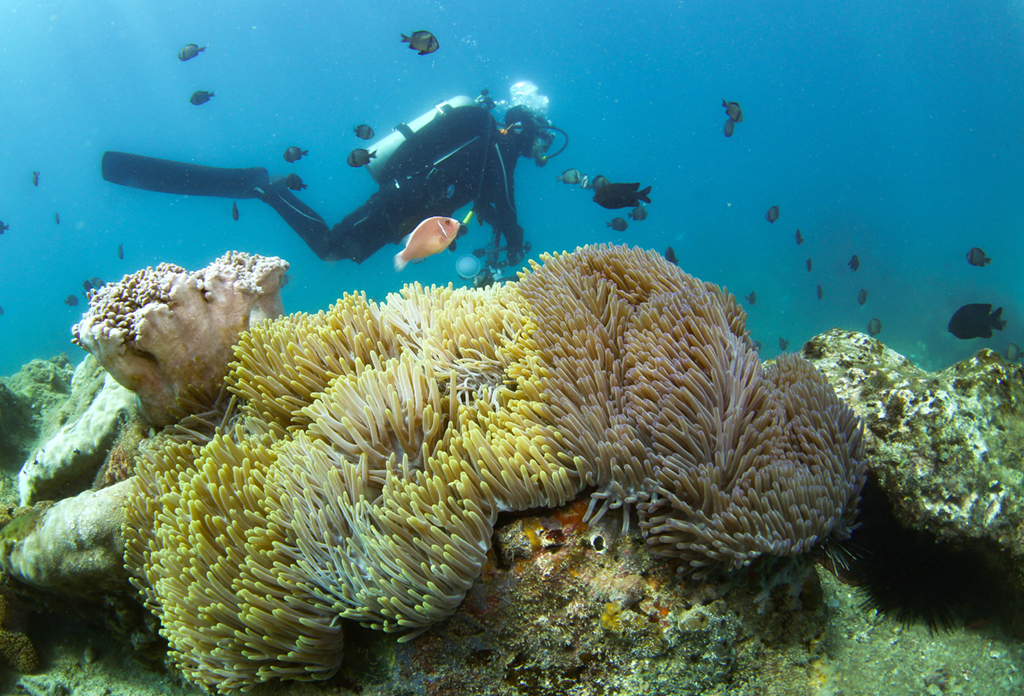
In the waters around Wuzhizhou Island in Sanya, Hainan province, more than 50,000 artificially transplanted corals are teeming with over 100 species of fish.
When tourists descend into the diving area at depths of 6 to 12 meters, they can see pintano (a type of damselfish), groupers, wrasse, clownfish and giant clams living among the corals. The colorful marine life has a close symbiotic relationship with the coral reefs.
Wang Aimin, a retired professor of marine biology at Hainan University, said that although algae and other lifeforms that have attached themselves to the reefs can hinder the corals' absorption of nutrients, they are an ideal food source for small fish, shrimps and clams. Moreover, they help clean the attached life-forms, thus forming a symbiotic relationship within the marine ecosystem.
"The Wuzhizhou Island Marine Ranch at Wuzhizhou Island currently supports the growth of nearly 100 species of coral, many of which were artificially transplanted. Planting coral has also become a tourist experience, allowing more people to have a close encounter with rare marine creatures and raising awareness of conservation of the marine ecosystem," Wang said.
Resource conservation
Wuzhizhou Island is a well-known tourist destination in Hainan, with an annual visitor count in excess of 3.5 million, including approximately 350,000 scuba divers.
"Protecting the marine environment is closely linked with the development and construction of the resort. Wuzhizhou Island adheres to the green ecological concept of 'developing while protecting, and protecting while developing'. We attach great importance to the protection of coral reef ecosystems and the restoration of fishery resources. Since 2010, we have been at the forefront of tropical marine ranching in China," said Wang Hao, who leads a public relations team at the island's resort.
Meanwhile, since 2010, Wang Aimin, now chief scientist at the Hainan International Blue Carbon Research Center, and his team have gradually established a group of more than 10 marine experts, thus providing vital scientific research and technical support for the construction of the marine ranch.
By the end of May, approximately 80,000 cubic meters of artificial fish reefs — including more than 2,500 cement-based and 21 made from fishing boats that were sunk on purpose — had been deployed. Also, more than 50,000 corals had been planted, forming an ecosystem of coral reefs, fish, shrimps and clams after 13 years of development.
"This has resulted in significant achievements in the restoration of the marine ecosystem and the conservation of fishery resources," Wang Aimin said.
The marine ranch, which currently covers 66.6 hectares, is among the fifth group of national marine ranch demonstration areas approved by the Ministry of Agriculture and Rural Affairs in 2019. It is also the first national marine ranch demonstration area in Hainan, and China's first national tropical marine ranch demonstration area.
Wang Aimin said that the placement of artificial fish reefs is an important measure for building marine ranches.
"During World War II, Japan attacked Pearl Harbor in Hawaii and destroyed many warships. Later, local fishermen noticed that there were many fish on the sunken warships. It turned out that algae and shellfish had attached themselves to the sunken vessels, attracting small fish and shrimps to gradually form a small ecosystem. It was then that people discovered the role of fish reefs," he said.
The artificial reefs at the marine ranch have also undergone several generations of changes. Initially, they were ordinary cement fish reefs, but later, some reefs were formed from vessels sunk deliberately. In 2016, coral planting began, forming large areas of reef.
Wang Aimin said that the technology for coral planting in marine ranches is constantly evolving. Initially, coral was planted on artificial cement fish reefs, while volcanic rock was tried later. Now, reinforced steel mesh is the most commonly used material.
"When cement is immersed, the alkalinity of the surrounding water rises, and it needs to be washed by seawater for a period of time to become a suitable environment for biological growth. However, the reinforced steel mesh does not have this problem, and we unexpectedly found that corals grow particularly quickly on it," he said.
Wang Aimin said that after the COVID-19 epidemic started in 2019, the research team did not visit the marine ranch for about three years. However, when they did visit, the researchers discovered that the centimeters-long coral planted in 2019 had grown to more than 1 meter.
"The growth rate of coral reefs is usually 1 to 2 centimeters per year, so this growth rate is very surprising," he said.
As a result of the development of nearshore fishing and aquaculture, the species and quantity of marine life in related areas that host human activities are greatly affected. The placement of artificial fish reefs is an important way of restoring marine ecosystems and building marine ranches, he added.
According to recent surveys, the fishery resources in the waters around the marine ranch have doubled in the past decade, while those in the vicinity of the artificial fish reef are more than five times higher than those in surrounding areas. Additionally, the live coral coverage rate has risen from 18 percent to 25 percent.
Recording system
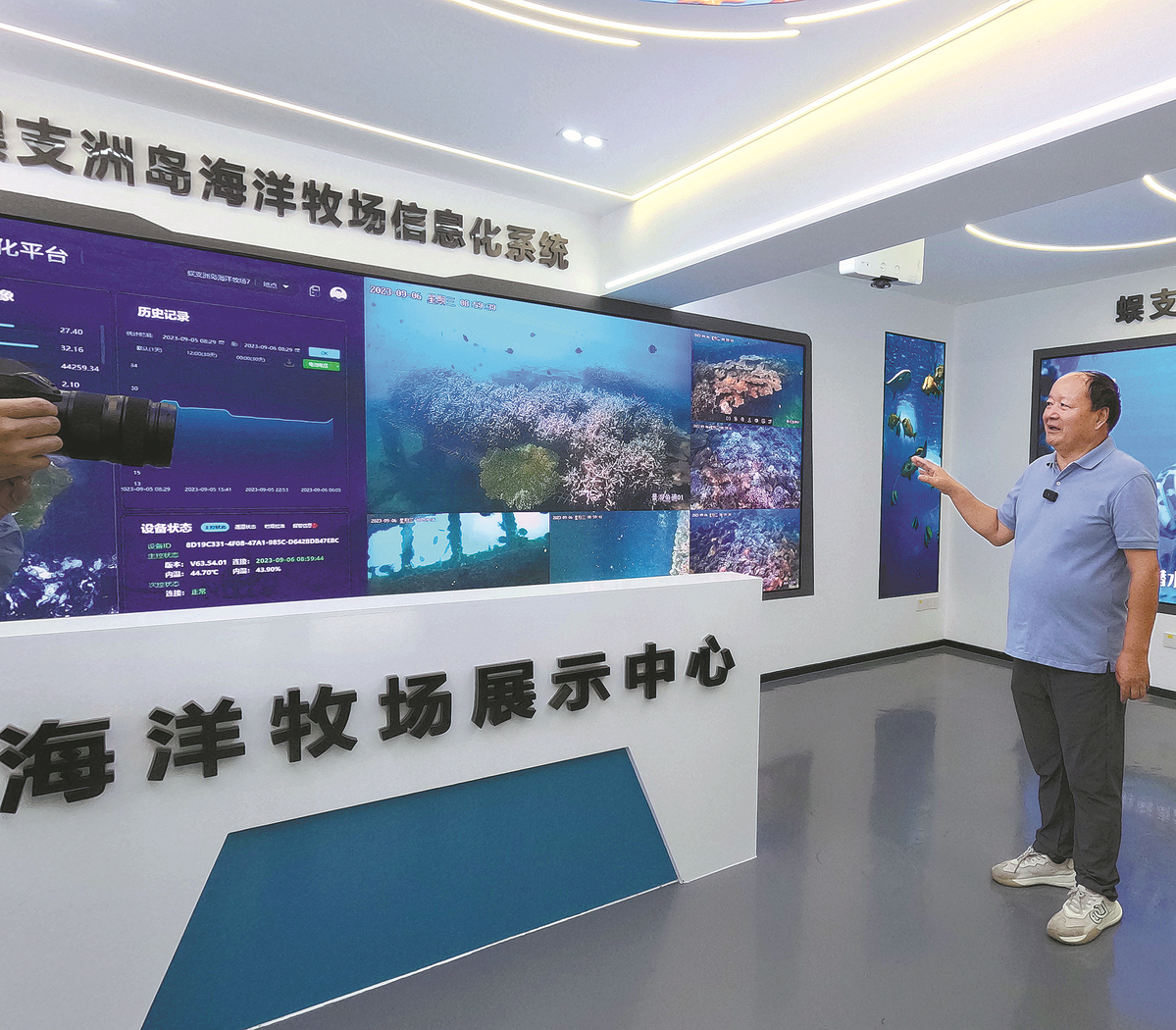
The marine ranch has established an information recording system and deployed 14 cameras and monitoring devices at seven observation points. Visiting marine organisms are recorded and monitored in real time, and research indicators such as levels of seawater salinity, pH, temperature and dissolved oxygen are recorded and displayed on screens.
Wang Aimin said that this is a pioneering global achievement, providing more advanced conditions for marine-related scientific research and related protection. In the past 13 years, experts from countries including the United Kingdom, Israel and the United States have shown interest in the marine ranch.
Wang Aimin recalled that when a British research team visited 10 years ago, one of the experts said that although the coverage and variety of coral were not high, the marine conditions were excellent. The experts said that, given a professional team and government attention, the place would become a paradise for coral and other marine life within 10 years.
As those experts predicted, Wuzhizhou Island is now not only a hot tourist destination, but also a paradise for marine life.
Wang Aimin said that the next step for the marine ranch will be to keep expanding and to establish a blue carbon research center to contribute to China's goal of realizing peak carbon emissions before 2030 and carbon neutrality before 2060.





