


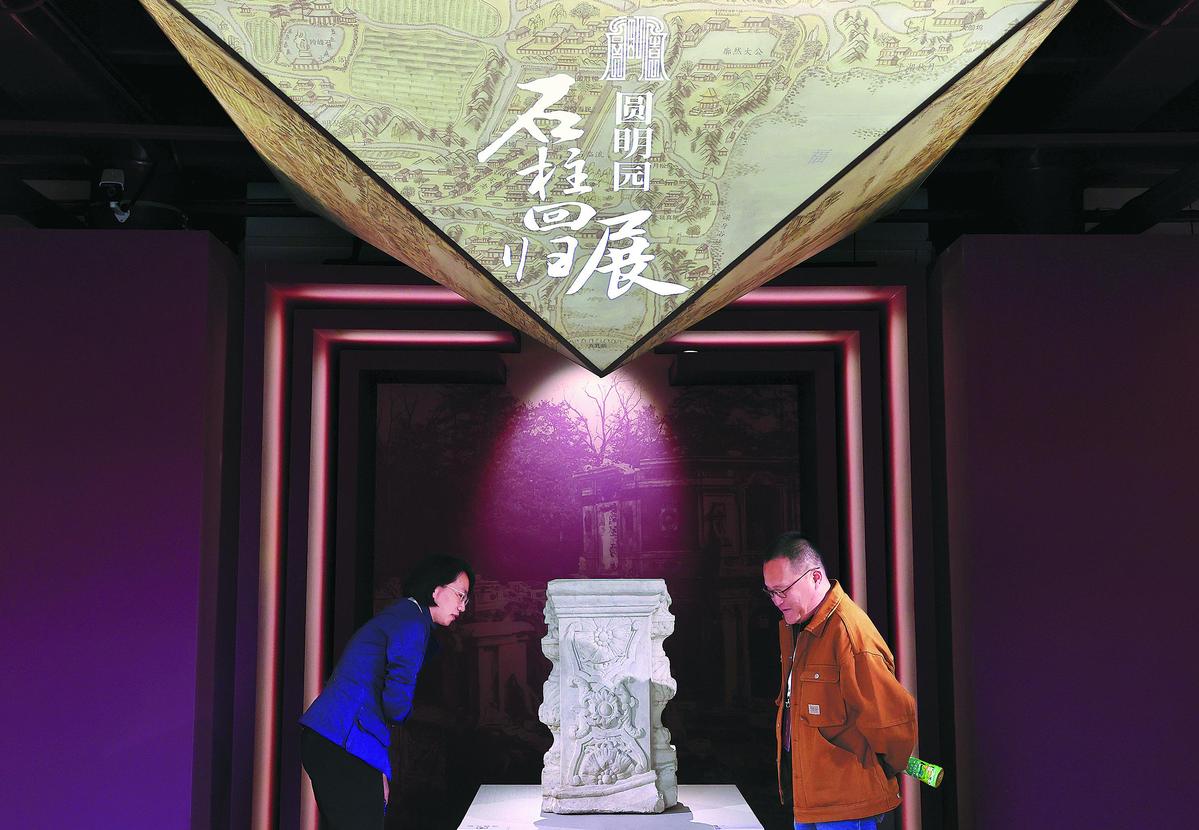
After a long odyssey overseas, seven marble columns from the ruins of Yuanmingyuan, or the Old Summer Palace, in Beijing which were recently repatriated from Norway to their home site were publicly exhibited for the first time on Friday.
The columns were originally from the Western Mansion (Xiyang Lou) area of Yuanmingyuan. A long-term exhibition displaying these relics, together with related old pictures, has opened at the Zhengjue Temple of Yuanmingyuan Ruins Park.
As the royal resort of the Qing Dynasty (1644-1911), Yuanmingyuan, which literally means "the garden of perfect brightness", was widely considered the apex of Chinese gardening art. The complex of gardens, temples, palaces and pavilions once spread over 350 hectares — roughly five times of the size of the Forbidden City — in the northwest of Beijing in its peak time.
This architectural splendor was brutally burned down and looted by the invading Anglo-French forces in 1860 during the Second Opium War (1856-60). It gradually fell into ruins in the following decades, and its numerous constructional components were stolen and sold, many of which were lost overseas.
The destruction of Yuanmingyuan has thus been considered as a national tragedy in China.
"It's a key achievement of cultural relic repatriation as we bring the columns back to their original place," said Li Qun, director of the National Cultural Heritage Administration.
"Governments, education institutions and the private sector have closely cooperated with each other with lasting efforts. This will contribute as an example for the return of more lost relics."
Johan Wilhelm Normann Munthe (1864-1935), a Norwegian who lived in China for half a century, once collected thousands of Chinese cultural relics, including the columns. They were later housed in the West Norway Museum of Decorative Art in Bergen, Munthe's hometown, now part of museum complex of KODE.
In 2013, Chinese entrepreneur Huang Nubo visited the museum. Seeing the columns, he then proposed their repatriation and originally expected to permanently exhibit them in his alma mater, Peking University. Huang offered a donation to KODE and reached a trilateral agreement to launch a series of cultural exchange programs.
The Norwegian government approved the return of the marble columns in 2018, and China's National Cultural Heritage Administration decided to transfer them to the administration of the Yuanmingyuan Ruins Park.
Disturbed by outbreak of the COVID-19 pandemic, their long-awaited and postponed journey back to China was made in June.
"Their return marks the rise of national strength and is a reflection of the times," Huang said.
Construction of Yuanmingyuan began in 1707 during the reign of the Emperor Kangxi (1661-1722). It was expanded and renovated during the reigns of the next five emperors. Because of its more comfortable living environment than the imperial palace of the Forbidden City, Yuanmingyuan also functioned as a major royal residence.
From 1747 to 1760, the Western Mansion area was gradually formed in Yuanmingyuan, featuring a combination of craftsmanship in Chinese and European Baroque styles.
According to an appraisal panel combining researchers from the Chinese Academy of Social Sciences, the Palace Museum in Beijing, Peking University and Sichuan University, the baroque columns, 80 to 92 centimeters high, match those stone relics that remained in the Western Mansion area. They are thought to have been originally set on roofs and by stairways.
Some of their frontal facades feature typical Western decorations while the sides were carved with Chinese auspicious patterns such as orchids, lotuses, peonies and chrysanthemums.
Petter Snare, director of KODE, noted that the columns, as a part of Yuanmingyuan, were evidence of cultural communication between China and Europe in the 18th century.
He also expected stories of the returned relics to educate people and inspire more cross-cultural dialogues.
"Under the framework of international laws, we'll seek more ways of practical cooperation in the repatriation of lost relics," said Li, from the National Cultural Heritage Administration.








