It's bean a fresh brew for trade opportunities









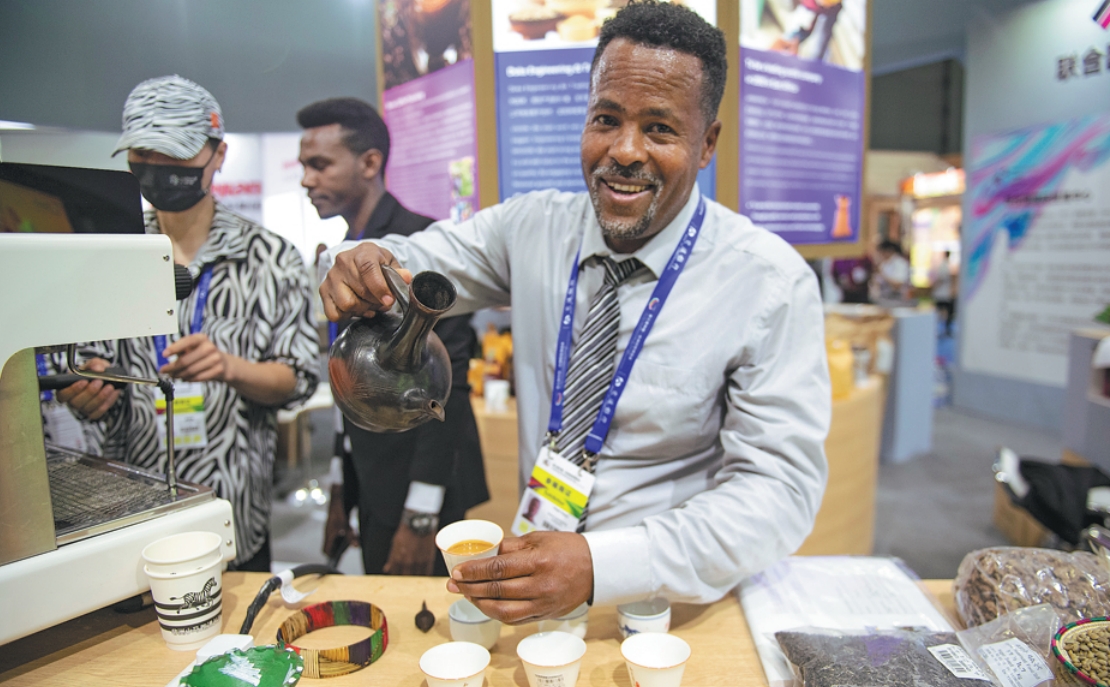
Coffee finds its way into booming Chinese market under the Belt and Road Initiative
Like the aroma of freshly brewed coffee, something is definitely in the air in world trade and commerce — opportunities. Few people are more aware of it than Hebert Ely Vasquez.
Vasquez, from El Salvador, has mastered the art of coffee roasting. Not only can he sniff the rich aroma of coffee beans, but he can also sense the myriad possibilities arising from its trade.
While doing his PhD in aquaculture, Vasquez fell for a young Chinese woman, Tong Taohui. After visiting Vasquez's home country in 2018 with her parents, Tong, in turn, fell for the beans from El Salvador's six major coffee-growing regions.
"El Salvador is not a prolific coffee producer, but it does boast high-quality beans," Tong said. It was not long before she became an expert on the subject.
The couple soon came up with the idea of exporting El Salvadoran coffee to China. "We decided to show Chinese customers the very tasty flavor of our coffee from El Salvador," Vasquez said. "That was the idea when we started four years ago."
With that objective in mind, Vasquez and Tong exhibited their products along with those from many other countries at an event titled Cafe Show China in Beijing last month.
"The most important thing is the possibilities China offers for coffee and the opportunities that open up for us," Vasquez said.
El Salvador's coffee exports to China have soared in recent years, particularly after the two countries established diplomatic relations in 2018. China is now one of the biggest customers for El Salvador coffee.
Soon after diplomatic relations were established, the two countries signed a memorandum of understanding on together building the Belt and Road Initiative.
The initiative, proposed by China in 2013, aims to spur global growth by making it easier for countries to trade with each other through improved connectivity and infrastructure.
"The Philippines is an early supporter of the Belt and Road Initiative," said Jaime Adriano FlorCruz, ambassador of the Philippines to China. "I know in the past China only drank tea or water, never coffee. But I know it's very popular now because the young people are very open-minded."
Tea, which originated in China, has been the beverage of the masses along the Silk Road since ancient times. But now, under the BRI, coffee is gaining a strong foothold in China.
China traded 231,200 metric tons of coffee and related products valued at 9.35 billion yuan ($1.3 billion) last year, China's customs data showed. The value of coffee trade more than doubled that of 2017, according to Beedata, an agriculture data provider.
China and the Philippines signed a memorandum of understanding on e-commerce cooperation in January, China's Ministry of Commerce said. China has signed memorandums of understanding on e-commerce cooperation with 30 countries, China's State Council Information Office said earlier this month.
"We're happy that our Philippine coffee has finally arrived in China," FlorCruz said. "We are lesser known as a coffee producer, even though we've been producing coffee for many years."
The country needs to update its coffee marketing strategy, he said.
"Digitization is the next step. We are also organizing our coffee makers into associations so we can improve our marketing and project our good products to markets like China."
With the BRI, "we are exploring practical cooperation projects", he said. "We need badly infrastructure projects, agricultural projects, interconnectivity projects. And that falls into the BRI system. So we hope to be an active participant in the BRI, and we are very happy that China pioneered (the BRI) 10 years ago."
Boosting cooperation
Over the past 10 years, China has signed more than 230 cooperation documents related to the BRI with more than 150 countries and over 30 international organizations, according to official figures.
"We hope to benefit from the BRI," FlorCruz said. "We just need to identify where BRI and our needs intersect.
"We want more globalization rather than fracture, falling into factions or different kinds of fighting groups of nations. We support globalization."
El Salvador and the Philippines are not the only countries jumping on the bandwagon of promoting coffee in China.
Rwanda's Ambassador to China James Kimonyo sold more than 3,000 bags of imported coffee in just one second during a livestreaming event in China in 2020, according to media reports.
"This made me feel the huge demand in the Chinese market and the charm of e-commerce," he said.
Ethiopia's Plenipotentiary Minister Munteha Jemal Seid shares Kimonyo's enthusiasm for e-commerce as a channel for promoting coffee.
"We're trying from time to time to make Ethiopian (products) online and to send Ethiopian coffee, especially value-added coffee, roasted coffee and the grounded coffee online.
"When we talk about the relationship between Ethiopia and China, it is about more than 50 years of diplomatic relations," she said.
The ties have borne fruit, including in the form of flagship projects in Ethiopia, such as the Ethiopia-Djibouti railway and the headquarters of the Africa Centres for Disease Control and Prevention, which have the financial backing of China.
A forum held in the capital Addis Ababa in July on the corporate social responsibility of Chinese companies in Ethiopia heard that China's direct investment projects in the country reached 1,835, with an accumulative investment of about $4.8 billion.
The many initiatives China has advanced, including the BRI, give us a broad chance for trading and doing all our activities, Munteha said.
Over the past 10 years, the value of goods traded between China and countries involved in the BRI has doubled to $2.07 trillion last year, China's Ministry of Commerce said.
Julio Rios, a Spanish expert on China, said the BRI is widely popular among developing countries and has become a public good, contributing not only to China but also to modernizing the world.
China's National Development and Reform Commission said last month that the China-Europe freight train had made 77,000 trips over the past 10 years, providing services for 217 cities in 25 European countries.
Over those years, the initiative has generated more than 3,000 collaborative projects involving an investment of nearly $1 trillion, China's Ministry of Foreign Affairs said, creating 420,000 jobs in countries involved in the initiative.
The Mombasa-Nairobi Railway in Kenya has added more than 2 percentage points to local economic growth, the ministry said.
In addition to giving an economic fillip and creating jobs, China is also playing a role in training people, an example being Luban workshops that are helping young people in more than 20 countries to acquire vocational skills.
The Jakarta-Bandung High-Speed Railway, a fruit of the China-Indonesia Belt and Road collaboration and the first high-speed railway in Southeast Asia, reduces travel time between the two cities from three and a half hours to about 40 minutes. Operations have begun.
"With the BRI, China promotes infrastructure development and connectivity across continents, offering a chance for countries to enhance their trade networks and expand their economic potential," said Seun Sam, a policy analyst at the Royal Academy of Cambodia in Phnom Penh.
Through its rich aroma and global appeal, coffee trade is flourishing under the BRI, which aims to boost connectivity and exchanges.
"Before, it was like a dream to start coffee business in China, but now we can see that has become true," said Vasquez from El Salvador.
shaoxinying@chinadaily.com.cn