



Envoy details intricate charm of Chinese language at premiere









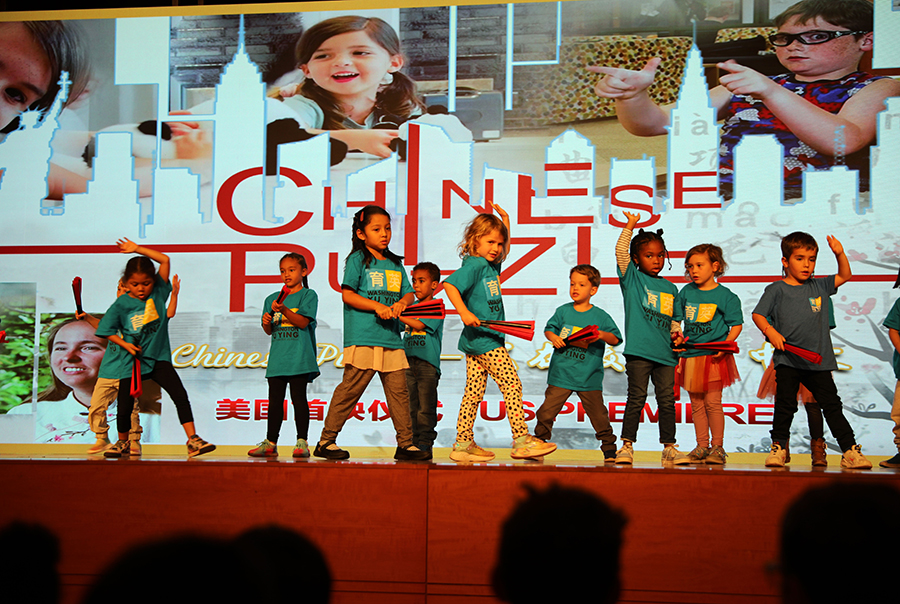
The top Chinese envoy in Washington became a teacher of Chinese when he taught a "crash course" on the characters, idioms and proverbs of the ancient language to an enthusiastic American audience at the Chinese embassy.
Speaking at the premiere Tuesday night of Chinese Puzzle, a documentary on Chinese-language education in the United States, Ambassador Xie Feng shared what he called "the taste of the unique charm" of the world's most spoken language, whose characters are the only pictographs still in use.
Enshrined in the language is the Chinese people's wisdom, philosophy and humor that are inspirational to China-US relations, which have found "the strongest impetus" in the friendship between the peoples, partly facilitated by language learning, according to Xie.
Each Chinese character is like a friend telling its unique story, Xie told 400 guests, including the professors and students featured in the documentary, and representatives of US elementary and high school teachers and students.
For instance, the character for human, ren, is made of two strokes backing up each other, symbolizing that only through mutual support can one stand firm and upright in the universe dignified and undaunted.
"This is exactly the way we Chinese get along with each other," he said.
Two students in the packed hall raised their hands to read two other characters that Xie was about to explain. The first one, xin, consists of two parts: The left part means human while the right one means word. Together, they mean keeping one's own word brings credibility.
Another character, wu, for weapon, martial arts or military is structured in such a way that it includes two components, one means stop and the other fighting.
For that character, Xie said that military forces should never be abused, and maintaining a certain degree of strength is for ultimately bidding farewell to arms and beating swords into plowshares.
"This is how we Chinese understand military power and peace," he said.
As the class went on, there were more interactions between Xie and his audience. For each Chinese idiom — which he called "gems of the Chinese culture" — and Chinese proverb, US students would come up with an American equivalent.
For example, for the Chinese idiom that means "we are in the same boat", Americans say "We are in this together", and while Chinese brand a person as unwise by "picking up a sesame seed but dropping off a watermelon", an American student says that is simply "penny wise, pound foolish".
"All these have proven again that both Chinese and American people are talented peoples, and for all our differences in culture, there are striking similarities between us," Xie said.
The Chinese Puzzle was produced by the Shanghai Media Group, which has traveled across 15 states over half a year to present a panoramic view of how Chinese is being taught and studied in the US.
Xie expressed thanks to all the teachers, volunteers and advocates of Chinese teaching in the United States, saying that their efforts have shown that the friendship between the peoples will be the strongest impetus for China-US relations.
Two panel discussions followed the premiere.
James B. Heimowitz, who led the New York-headquartered China Institute in America since 2014 until early this year, underscored the necessity of working "really hard not to weaponize or politicize" Chinese-language learning.
Heimowitz, who was one of the first American students to study in China in the 1980s, noted that the numbers of American students going to China to learn about China and Chinese and Chinese students coming to the US have dropped drastically.
"I hope that each one of us here can make a commitment, double down, and say this is not OK. We need to rekindle, restart, send more students, establish more exchanges. This is the foundation for how friendship works," he said.
He said that learning a foreign language can make one become a cultural ambassador, and learning Chinese is "so important to the shared future of the planet", on which the US and China are the two of the most important countries.
"Those of us in this room who have bilingual skills will be able to direct that future and see it come to life in a way that's going to be more positive for everyone on the planet," he said.
Howard Stephenson, a former Utah senator who sponsored a bill for dual-language immersion programs, said the state now has 20,000 students learning Mandarin, and they graduate a few credits short of a minor in college.
"We have so many children now learning it in Utah, and I would like to expand that to the rest of the nation, because America's biggest danger is being a monolingual nation," Stephenson said.
"Every child should be entitled to be bilingual, because it will help our nation to connect bridges across the world," he added.
Both Heimowitz and Stephenson were featured in the documentary.
Quoting Stephen Hawking, "Mankind's greatest achievements have come about by talking, and its greatest failures by not talking," Galal Walker, professor of Chinese at The Ohio State University, highlighted the role of language learning in facilitating communication.
"Our goal is to create long term — starting with at the age of our guests here — the ability to just talk, no matter what your role in life is, or occupation you have, being able to communicate with people in Chinese, and being open to people from China communicating with you," he told an audience that included dozens of American children.
Other panelists shared tips on how to learn Chinese well.
Sam Baum, a sophomore at Northwestern University, said, "I've benefited greatly from being able to spend as long as I did there, so if you have the opportunity, go to China, spend as long as you can, and immerse yourself in the culture."










