A supercontinent of opportunities
Eurasia has good foundations to start the second and later decades of the BRI partnership in the pursuit of new pathways of cooperation









Eurasia has good foundations to start the second and later decades of the BRI partnership in the pursuit of new pathways of cooperation
Editor's note: The world has undergone many changes and shocks in recent years. Enhanced dialogue between scholars from China and overseas is needed to build mutual understanding on many problems the world faces. For this purpose, the China Watch Institute of China Daily and the National Institute for Global Strategy, Chinese Academy of Social Sciences, jointly present this special column: The Global Strategy Dialogue, in which experts from China and abroad will offer insightful views, analysis and fresh perspectives on long-term strategic issues of global importance.
This year marks the 10th anniversary of the announcement of the Belt and Road Initiative, which has since become a flagship project of international cooperation on a large scale. Anniversaries serve as a good opportunity to review the past and look toward the future.
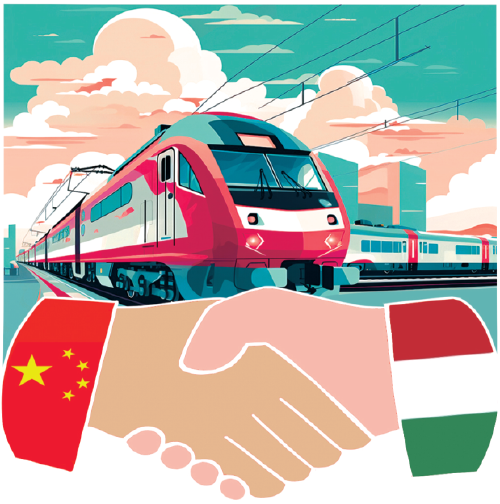
After 2010, Hungarian Prime Minister Viktor Orbán and his government announced the Eastern Opening Policy to tap the huge potential of the Eastern hemisphere. For the same reason, Hungary was among the first countries to join the BRI, the development initiative announced by Chinese President Xi Jinping in 2013. The BRI's first decade was a huge success, as it supported the economic and infrastructural development of many countries around the globe. As we know, infrastructure is the base of everything, and infrastructural spending can spur investment demand and boost employment. The importance of the initiative can be gauged from the fact that trade between China and the countries participating in the BRI has doubled in the past 10 years, highlighting the economic opportunities beneath. Also, until now, more than 150 countries across the globe have joined the BRI through memorandums of understanding and investment partnerships. Since 2013, the BRI has grown from a vision to serve as a possible multilateral platform for international infrastructure development.
The Eastern Opening Policy and the BRI have jointly formed a bridge across our nations and regions. Thanks to the appreciation of transcontinental cooperation, Hungary and the Central East European region have become a key area of 21st century geopolitics, providing a connection between Europe and Asia. The Magyar Nemzeti Bank, the central bank of Hungary, developed close relations with the People's Bank of China, and in 2013, among the firsts in Europe, the two institutions signed a bilateral swap agreement that has been renewed many times. Since the start of the Magyar Nemzeti Bank's Renminbi Program in 2015, it has encouraged the world to join the process of the Chinese currency renminbi's internationalization, supporting it to become a global currency.
When Hungarians look at China, they see a wise country with 5,000 years of civilization, and long-term plans. These long-term plans helped China to lift 800 million people out of absolute poverty, to build a strong middle-income group, and to realize a broad-based economic transformation, which has provided new development opportunities. What China accomplished is unique in the history of mankind, therefore we must learn from it.
The early 2020s have proven once again that economies tend to be cyclical, particularly 50- and 80-year cycles that bring turning points in technology, energy markets, institutional arrangements, and international relations. In this sense, our decade has much in common with the 1940s and 1970s.
The impact of external shocks is very visible. Just take the case of energy price shocks, which require more energy efficiency and innovation, and also put competition for energy sources at the forefront of global politics. At this point of the 21st century, it is necessary to pay close attention to these long-term cycles — both economic and geopolitical — so that the global community is better prepared to address the key challenges of our age.
In the 21st century, we have megatrends, such as the new long-term sustainable economics, a digital, knowledge-based economy, and spatial structures and geo-fusion as the rise of regional and megaregional integrations. It is crystal clear that all of these changes require a new kind of out-of-the-box thinking, long-term visions and measurable targets.
Eurasian cooperation is namely the engine of these aforesaid patterns. The world's economic center of gravity is returning to the heart of Eurasia, due to the rise of China and other emerging Asian economies in the past decades. We are witnessing the turnarounds of economic policy in Eurasia in the form of successful industries of the future, big data, data centers, green and clean technology, electromobility, biotechnology and future of healthcare, as well as central bank digital currencies.
Eurasia is a supercontinent which is one geographical unit, and it has seen thousands of years of strong economic, social and cultural relations. New Eurasian networks are the engine of a new sustainable growth paradigm because Eurasia has many power centers in the new multipolar world. These centers exhibit very special innovation capacities, allowing knowledge to spread internationally and achieve the exponential curve through sharing, and resharing of new ideas.
In this set of changes, the BRI sets the path toward the age of Eurasia: it is eliminating barriers of trade and investments, providing greater scale of products and services through the new or renovated trade routes, and offering a supportive business environment for financial cooperation, such as increasing the international weight of the renminbi. The BRI offers sustainable restructuring and knowledge sharing, and this innovation is very visible in the financial technology sector. In summary, the BRI has the capacity for innovation, economic policy coordination, and to create new channels and forms of finance. Besides it is a great source for people-to-people exchanges through mobilizing cultural resources and facilitating the emergence of top universities. Therefore, it offers opportunities for both Europe and Asia.
To win the 21st century, we must take advantage of these high value-added business activities, including knowledge- and technology-intensive BRI projects, to raise our competitiveness to a new level. In this regard, knowledge transfer and co-creation of added value are keys for us in our partnership with China and other BRI partners.
Multilateral development of the BRI will increase its global reach and enable the initiative to play a greater role as a new platform for global governance. In Eurasia and globally we have good foundations to start the second and later decades of the BRI partnership, exploring new pathways of cooperation.


The author is the governor of Magyar Nemzeti Bank, the Central Bank of Hungary. The author contributed this article to China Watch, a think tank powered by China Daily.
Contact the editor at editor@chinawatch.cn.