


Exhibition explores potential of biomaterials










As the impact of climate change on our planet increases, Powered by Nature ? Powering the Future highlights the ability of art to envision a sustainable tomorrow in an exhibition that turns bio-garments and seaweed furniture into reality.
Opening at the National Natural History Museum of China in Beijing on Sept 26 and running until Sunday, the exhibition is organized in conjunction with the World Wide Fund for Nature, the Center for Environmental Education and Communications of the Ministry of Ecology and Environment, and the Art and Science Research Center. It is composed of 42 exhibits, including specimens, art and interactive panels, divided into three sections: the power of nature, the power of humans and the power of neutrality.
"The aim is to encourage the public to rethink our relationship with nature, to call attention to urgent concerns caused by climate change, and to reflect on our lifestyles and methods of production," Wan Shilin, the museum's Party secretary, said at the opening ceremony. "We should know that achieving carbon neutrality will require a broad and profound systemic change at the economic and social levels, and will influence everyone."
The surface of a 3D-printed bio-plastic ball at the entrance to the exhibition is covered with mushroom roots (mycelium or hyphae), which will either penetrate the ball, or produce aerial mycelium, according to Miao Yuyan, the museum's exhibition development director. Some hyphae can be helpful in reducing plastic consumption, while also reducing the energy used and carbon dioxide produced by making plastic.
As the introduction to the exhibition states: "The only way to cope with unpredictability is to innovate, to use breakthroughs in science and technology to explore areas that have not been explored before, and to find energy solutions. The good news is that humans are wise, and fortunately, wisdom is renewable."
Another exhibit demonstrating this "wisdom" is a garment made of bacterial cellulose, a sustainable biomaterial produced by a type of bacteria known as Acetobacter xylinum, which is self-synthesizing and produces cellulose, and can grow into any shape. Natural biodegradable bacterial cellulose may help pave the way for the development of sustainable textiles and manufacturing practices in the future.
With the bio-garment, designers are trying to convey the message that a sustainable fashion industry can make a positive change to global warming, as textile production is currently estimated to be responsible for about 10 percent of global carbon emissions.
Besides clothing, a tea table made of seaweed and algae offers a possible solution for making future furniture from algae, which is more environmentally friendly.
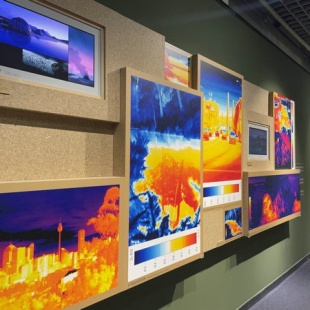
Through the exhibition, designers and artists are exploring high-tech alternative materials that may help reduce carbon emissions and raise public awareness of sustainable living. An interactive mountain-shaped installation with a purple thermochromic coating encourages viewers to touch it. The heat from their hands turns its surface pink, before disappearing after a few seconds through heat loss.
"This helps visitors visualize how human activity influences our planet and enhances their understanding of the relationship between humans and nature," Miao says.
Visitors can also see mosaics by Canadian artist Julie Sperling and a series of digital paintings by US artist Alisa Singer.
Through the lens of Paris-based digital artist Cristina Tarquini, visitors can dive into acidifying oceans courtesy of data from the Washington DC-based National Oceanic and Atmospheric Administration, and see for themselves the effects of rising carbon dioxide levels on our oceans - coral bleaching, disappearing fish populations, dissolving shells, the boom in jellyfish populations, and garbage-filled seas.
"With the wheels of industrialization rolling forward and environmental alarm bells ringing, the Earth's ecosystem faces a severe test," Wan says. "From water conservation to research on renewable energy, green and low-carbon development is the necessary road to harmonious coexistence between humans and nature."
wangqian@chinadaily.com.cn