


In 2005, when floods destroyed part of the road to the station, supplies, especially water, could not get through, and Jiao and his colleagues had to drink water thickened by dust because it had been kept outdoors for a long time. Drawing from the lesson, a water cellar was built later to better keep water inside the station.
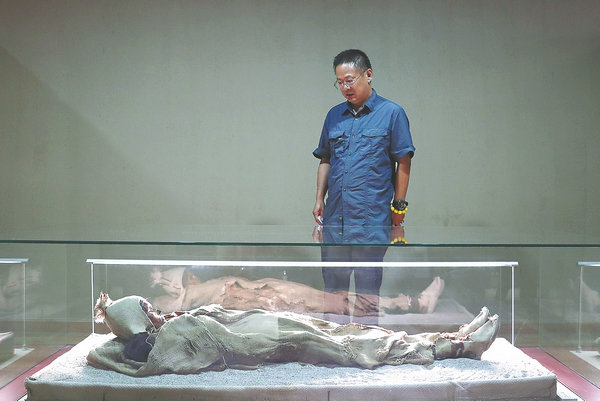
In the Loulan Museum in Ruoqiang today, visitors often marvel at a 3,800-year-old female mummy with clearly visible features, down to details like her eyebrows and eyelashes. The mummy is called the Loulan Beauty. In fact, it was Jiao and his colleagues who discovered her, completely by chance, in 2004.
They were patrolling the area, and when they sat on a high platform to have a rest, Jiao found that the earth was not very stable and that there was an object underneath. They removed the surface earth and found the mummy underneath.
They brought it back to the station, which consisted of several tents, and contacted people to come and collect it. At that time, it still took days to reach the station from downtown Ruoqiang. They wrapped the mummy in bedsheets and put it in a tent.
Feeling uncomfortable, Jiao's colleagues refused to sleep near it, but Jiao didn't mind and slept beside it for nearly a month until it was finally transported to the experts.
"I didn't feel strange at all. All I thought about was how to better protect it, fearing it would become oxidized," says Jiao.
Also in that year, Jiao found the mummified remains of a child and wrapped it in his jacket, taking it to downtown Ruoqiang by car — a journey of more than 330 kilometers. Since the road was bumpy, he held it carefully in his arms trying to protect it from being damaged.
In the following years, conditions at the protection station continued to improve. Houses were gradually built, while electricity and a TV set were installed. Moreover, staff at the station started to raise dogs and chickens to add color to their lives.
"The living conditions have improved significantly, although compared with places outside Lop Nur, it's still far from perfect," says Jiao.
That may explain why it's so difficult to keep people at the stations. Some could only tolerate staying for a few days, before leaving.
"It's a matter of personal choice. When I took the job, I found it amazing, since I'm interested in history. The more I understood Loulan and its history, the more I wanted to continue learning. When you really have an interest in your job, it doesn't feel like torture," says Jiao.
According to Feng Jing, director of the Loulan Museum, study of the Loulan site started in 1979. Since 1988, several projects to protect cultural relics have been carried out in the area, but no major archaeological excavations have taken place yet.
"In the year before last (2021), when we cleaned and consolidated the pagoda and sanjianfang (remains of a structure believed to be a government office) at the Loulan site, we discovered many cultural relics, like manuscripts. Therefore, we believe a systematic excavation will bring more important discoveries," says Jiao.
"But before that, we must properly protect them. It's not only about our respect for our ancestors, but also our responsibility to our offspring. If the remains are destroyed in our time, we will feel guilty," he adds.
Over the years, five stations of this type have been built in Lop Nur, and altogether employ 20 people to safeguard heritage, according to Feng.
Jiao retired two years ago, but he often wants to revisit Lop Nur. "From the establishment of the Loulan station until today, I experienced so many things there. It became my home in some ways. I do have a deep emotional connection with the place," he says.
Zhang Xiao contributed to this story.








