



Dolphin deaths in Amazon River spark concern amid warmer days, drought









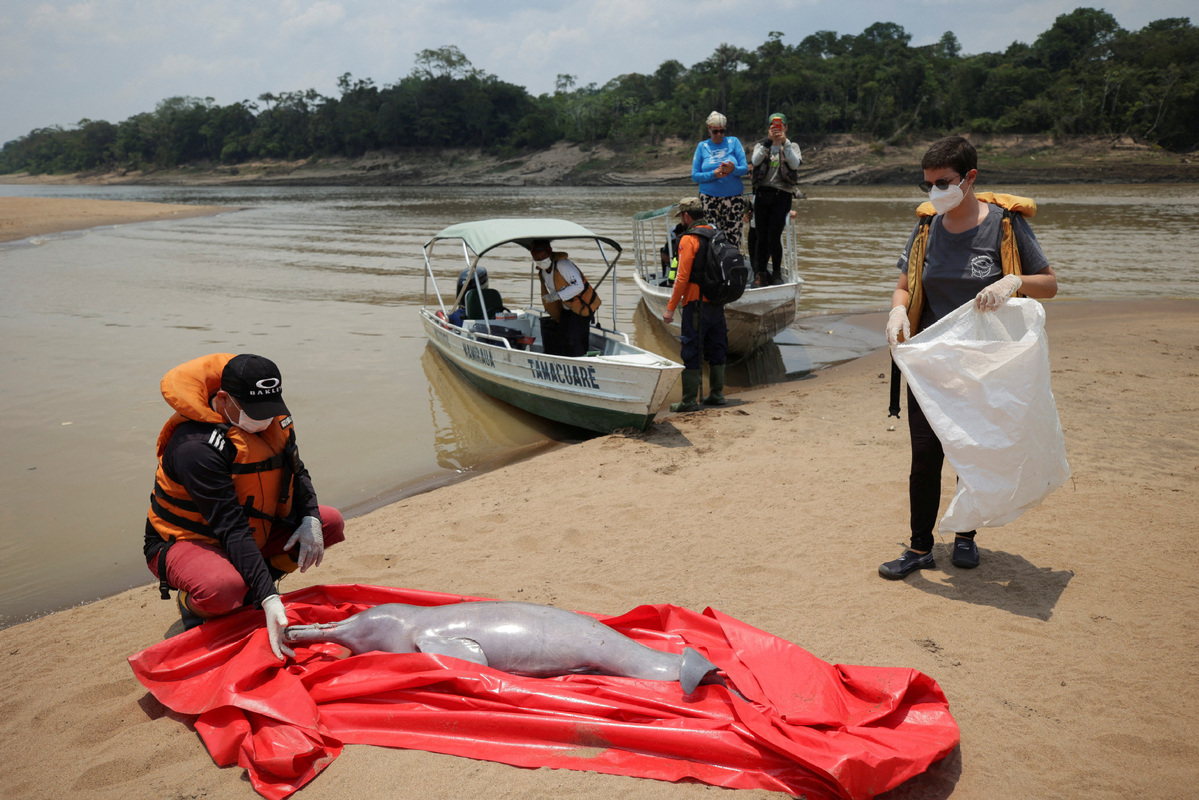
As dozens of the endangered animals perish in the Brazilian Amazon lake, experts see the tragedy as linked to climate change
At least 130 river dolphins have died in Lake Tefe in the Amazon, creating an unprecedented emergency and sending experts searching for what might have killed all those animals.
"In the last weeks, the Brazilian Amazon has been facing the worst drought of the last 43 years, which is affecting energy and food production (especially artisanal fishing), access to water in cities, and all ecosystems in the area," Pedro Tunes, a biologist in Brazil, told China Daily.
Temperatures have been regularly soaring above 40 degrees Celsius in some regions – about 10 degrees higher than the average records for this time of the year – and water levels in rivers in the area are dropping by as much as 14 centimeters per day, according to Servi?o Geologico do Brasil, a research company.
The dropping water levels and high water temperatures have impacted the food supply and sanitary conditions of the rivers, likely leading to the deaths of dozens of dolphins.
"The survival of the remaining river dolphins is seriously threatened, and they urgently require our intervention to preserve the population," said Oceanografic Valencia, the largest aquarium in Europe, located in Valencia, Spain.
The aquarium joined an international effort in the Amazon to cope with the mass deaths. Local organizations along with the Nuremberg Zoo, from Germany, the National Marine Mammal Foundation (NMMF), from the United States, and other organizations from Argentina, the US and Europe, have drafted an emergency plan to deal with the situation in the Amazon.
On the ground, the Mamiraua Institute, a non-profit funded by Brazil’s Ministry of Science, Technology, Innovation and Communications, has led the research and response to the crisis.
"Such a high percentage of Amazonian dolphin losses is alarming. If these numbers increase, we could be facing a possible extinction of the species in Lake Tefe," Miriam Marmontel, the lead investigator, said in a release.
About 80 percent of the dolphins that have died belong to one species, Inia geoffrensis, while the other 20 percent are Sotalia fluviatilis. To date, about 10 percent of the known dolphin population in the lake has died. The lake is in the heart of the Amazon, in North-western Brazil.
"We don't know enough about dolphins to know whether it was a direct effect of temperature, bacterial contamination from the dying fish, or a combination of bacterial load and heat-induced immunological breakdown," said William Magnusson, a senior researcher with the biodiversity unit of the National Institute of Amazonian Research, in Manaus, some 530 km east from Lake Tefe.
"We know from the last drought, which was less severe, that the reduction in water volume will cause high mortality in many species. They all seem to have recovered since the last drought, but we don’t know if they will be able to take the higher frequency of droughts caused by climate change," said Magnusson.
According to the Mamiraua Institute, the current working theory is that the mass deaths were caused by a biotoxin, although it is not ruling out the possibility of toxicity, chemical contamination, interactions with fisheries, or a combination.
"The unusual behavior of the animals could also indicate neurological damage. Animals were photographed and, at the end of the day, we witnessed them die before our eyes."
Tunes, the biologist, believes preservation of the forest is key to mitigating the impacts of droughts and climate change — like the rising water temperatures that have killed so many dolphins. This also requires rigorous adherence to environmental regulations and close monitoring.
"This can not only reduce the climate change effects locally but can have a major impact on the climate of the world, especially on the water cycle of South America," he said.
"Although the El Nino (phenomenon) is partially responsible for this drought, the rise of temperatures globally is affecting a major part of this event."
A drought with the intensity of the one currently faced by the region would be unlikely without climate change, he said.
"This warming contributed both to the probability of occurrence and the intensity of the extreme event," he added.
On the ground, researchers and rescue teams expect similar events to happen again and impact the remaining dolphin population in Lake Tefe.
"It was decided not to relocate the animals until we know the cause, so as not to endanger the population in the great Solimoes River in case it is a contagious disease," said the Mamiraua Institute.
"The peak of the dry season in the Amazon is mid- to late October, so we expect much higher mortality… Unfortunately, we expect the water level to drop further in the next week and the number of dead dolphins to increase dramatically."
The writer is a freelance journalist for China Daily.










