



Architecture 'grandpa' builds knowledge online









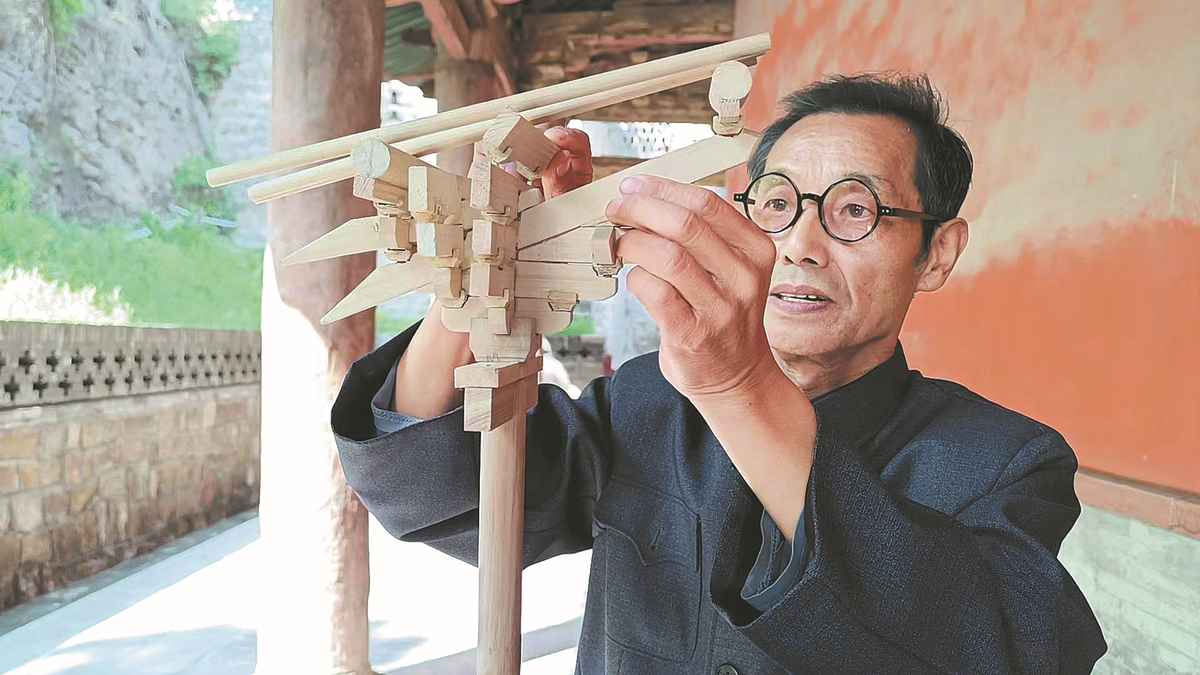
Senior educates new generation on ancient method of construction
After retiring from his job as a cultural relics protection worker 10 years ago, Wang Yongxian maintained his passion for ancient Chinese architecture through teaching.
Now age 73, he continues to write books and theses and teaches a course titled "Conservation and Restoration of Ancient Chinese Buildings" at Taiyuan Normal University in Shanxi province.
His main interest is dougong, a construction method that uses interlocking wooden brackets to form structures. The method was one of the most important features of ancient Chinese architecture.
Wang also started vlogging to better explain dougong to an inquisitive younger generation and has gained a huge following.
His university students showed a strong interest in his course, which he said prompted him to look at ways they could more easily learn about the subject.
Following a suggestion from his students, he became a vlogger using the account name "dougong class". The account is regularly updated with short video clips Wang produces himself.
He said he is surprised that his classes are so popular on social media. The first six lectures on ancient Chinese buildings that he uploaded over a six-month period have received 1.6 million views.
Chinese ancient architectural culture is like a good book, he explained, and is an important way to tell the story of China. The best entry point to studying it is through dougong, he added. "The curriculum should be combined with the sites of ancient architecture, a bibliography of ancient specialties, the anatomy of ancient architectural dougong models, handmade drawings, construction practices and popular science animation," he said.
To make it easier for newcomers to the subject to understand, Wang made a wooden dougong model. Each component is marked with a number or name, and the model can be disassembled and reassembled, a process that Wang filmed and put online. Some netizens said that they had long been puzzled by dougong structures, but finally understood how they work after watching the video of "dougong grandpa".
The method was initially used to join pillars and columns to the frame of a roof. However, it later developed into a complex set of interlocking components and reached peak usage during the Tang (618-907) and Song (960-1279) dynasties.
The flexible structural system cannot only bear high loads, but is also excellent at surviving seismic disturbances and is not prone to deformation, Wang said.
After the Song Dynasty, important buildings became more ornamental than structural, and no longer fit the description of traditional dougong architecture.
Shanxi's role
About 85 percent of wooden structures built before the Yuan Dynasty (1271-1368) that still exist in China are located in Shanxi. The reason they have been preserved is not only due to the conducive climate and geographical conditions of the province, but also the efforts of generations of cultural relics protection workers.
For more than 50 years, Wang was a senior researcher at the Shanxi Ancient Architecture Institute and participated in planning, protection, design and renovation projects of more than 100 ancient buildings in the province. The buildings included Foguang Temple on Wutai Mountain, Chongfu Temple in Shuozhou, Temple of Guangyu in Haizhou, Jinci Temple in Taiyuan and Xuankong Temple in Hunyuan. Wang is about to complete a book, Research on Ancient Chinese Architecture of Dougong, which contains more than 200 illustrations and 800 color photos. The book is based on his research conducted over more than 50 years.
Wang is a native of Wuxiang, Shanxi, which has many temples, including ancient ones, that made an impression on him when he was young. "When I was in primary school, my teacher took me to visit Jinci Temple in Taiyuan," Wang said. "I was immediately shocked at the first sight of the main hall of the temple, marveling at how clever our ancestors were in building that grand and delicate architecture with only wood in most places."
He said that trip sparked his interest in ancient wooden buildings.
After graduating from middle school, Wang went to the countryside during the "cultural revolution" (1966-76).
He later studied art and literature at a school that became part of the Shanxi Art Vocational College. The school invited experts and professors from Beijing to give lectures on the protection of ancient buildings, which rekindled Wang's dream of studying ancient architecture. He soon realized that the ancient temples scattered all over his hometown were historical treasures.
In the early 1970s, he secured a job at the Shanxi Ancient Architecture Institute as a cultural relics protector, turning his passion into a lifelong career. What makes him happy today is not only that the government set aside more money for the research and protection of cultural relics, but also that society is more aware of the importance of such work.
To his surprise, about 90 percent of his more than 100,000 subscribers on short-video sharing platforms are below age 30. That fact makes him more confident that as long as the story of Chinese ancient architecture is told in the right way, it can spark people's interest.


- Cherry blossom festival in Yongfu town celebrates agricultural innovation and cultural exchange
- China's first domestically built cruise ship welcomes its 1 millionth guest
- The Devil Still Dances: High Vigilance against Japanese Militarism's Infiltration in Sports and Culture Fields
- 189 historical artifacts of Japanese invasion donated to museum in NE China
- Death toll rises to 8 in North China factory explosion
- Over 140m train tickets sold for Spring Festival travel rush












