Insisting on the right to development
International cooperation demands partnership such as China's BRI, while developed countries have reneged on their obligation to facilitate development in developing countries









International cooperation demands partnership such as China's BRI, while developed countries have reneged on their obligation to facilitate development in developing countries
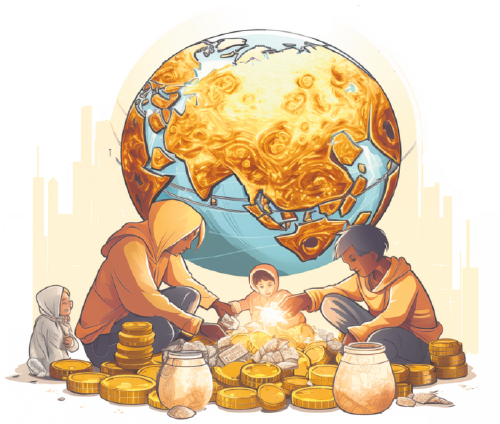
The international landscape is changing rapidly and dramatically, says a recent assessment by PricewaterhouseCoopers, one of the so-called big four international accounting firms. PwC's press release referred specifically to the international tax landscape and warned large cross-border businesses to take these changes "very seriously".
While PwC is correct about the changing international landscape, one might argue that the change has been too slow. The large cross-border businesses, PwC's clients, symbolize the global imbalance in economic and political power that has long inhibited the right to development.
However, PwC is certainly accurate in its analysis of the causes of change. It notes that, "whatever the views of the G7 and other large economies", given the "wishes of the Global South and civil society to promote the United Nations, the UN's agenda on tax matters cannot be ignored".
The right to development was established with the adoption of a declaration by the UN General Assembly in December 1986. It has equal standing with all other human rights and is both an individual and collective right. This means that it applies to everyone, empowering us all to participate in, contribute to, and enjoy economic, social, cultural and political development. The right also relates to all "peoples", that is to nations and cultures without distinction.
Alongside rights, there are duties. These apply to individual states and to the international community. Both have a duty to work together to create conditions favorable to development, "to eliminate obstacles", to promote "more rapid development of developing countries "and to construct "a new international economic order based on sovereign equality, interdependence, mutual interest and cooperation".
The duties also pertain to "all those whose actions and/or omissions have an impact on human rights and on the environment in which these rights are to be fulfilled". This clearly includes most large cross-border businesses.
Global poverty has fallen since the adoption of the declaration. However, this has predominantly been a result of China's economic success, which has lifted 800 million people out of extreme poverty. But, extreme poverty has increased by 75 million since 2020. Governments have been unable to counter the rise because high interest payments have curtailed their fiscal space.
Largely due to China's economic development, between-country income inequality has fallen. Conversely, within-country inequality has increased, sometimes dramatically as in the United States, India and Russia. The result is that the share of the world's income captured by the poorest half of the population is less than half what it was in 1820. During the past 30 years, per capita direct capital investment in rich countries has been eleven times that in developing ones.
The right to development exists in name only. To understand why, it is important to recall that, while 146 nations voted in favor of the declaration, the US voted against it, and eight other rich countries abstained.
The US consistently argues that development is not a right "which every individual may demand from his or her own government". The implication is that the US considers that governments are not obliged to accept responsibility for the economic welfare of their citizens. This, as others have suggested, reflects an unsubstantiated belief that the work-disciplining effect of poverty would be removed, entrepreneurship curtailed and economic liberty infringed.
Developed countries have also reneged on their obligation to provide developing countries "with appropriate means and facilities to foster their comprehensive development".
While it is difficult to demonstrate individual benefits flowing from the declaration, Surya Subedi is representative of international lawyers arguing that it has been "instrumental in integrating economic, social and cultural rights into the workings of international agencies".
The next step is to make the right to development legally binding. In 2018, a committee was established to draft a legally enforceable convention. Just three rich countries, all in the Middle East, supported the move. The Draft Convention is framed as a set of legal principles. Nevertheless, it provides a blueprint for development based on international collaboration. It leaves intact the responsibilities of nation states to promote sustainable development through strategic investment to boost market incomes. Taxation then permits further spending on physical and human capital, with social protection to enhance education and health provisions and to foster social security.
The draft underlines the fundamental duty of nations "to cooperate with each other, through joint and separate action". This means rich countries meeting the International Overseas Development target agreed in 1970 to contribute 0.7 percent of their GNP. The target remains unmet. Indeed, China's estimated foreign aid spending of $843 billion over the past 18 years dwarfs that by the G7 countries.
Cooperation also involves implementing the long-awaited trade reform on which the UN's Sustainable Development Goals were premised. The draft argues for "a universal, rules-based, open, nondiscriminatory, equitable, transparent and inclusive multilateral trading system".
Enhanced representation and voice for developing countries is another requirement. Voting rights, and hence influence within the World Trade Organization, for example, must reflect the current balance of trade, not that of the 1940s when the US vetoed a trade organization run under the auspices of the UN.
The draft addresses the global debt crisis demanding "debt sustainability through policies aimed at fostering debt financing, debt relief and debt restructuring". With increased fiscal space, governments can act in the interests of their people rather than prioritize those of international banks.
It recognizes, too, the need for special funds. The Global Social Protection Fund, proposed by the UN Special Rapporteur on Human Rights and Extreme Poverty, could provide adequate healthcare, education and social insurance for all low-income countries at a minimal cost.
International cooperation demands partnership such as China's Belt and Road Initiative. This investment has created physical and virtual infrastructure linking 150 countries.
Cooperation also requires fair play — "financial integrity and transparency", as the Draft Convention terms it. The recent report on "Inclusive and Effective Tax Cooperation at the UN" prompted by the G77 plus China international grouping is a notable response. While a matter of concern for PwC and its clients, the report's proposals represent a move toward a fairer global order.
The author is a professor at the School of Sociology at Beijing Normal University and emeritus fellow of Green Templeton College at Oxford University. The author contributed this article to China Watch, a think tank powered by China Daily.
Contact the editor at editor@chinawatch.cn.