Discovery of clues to origin of modern humans found in Kenya










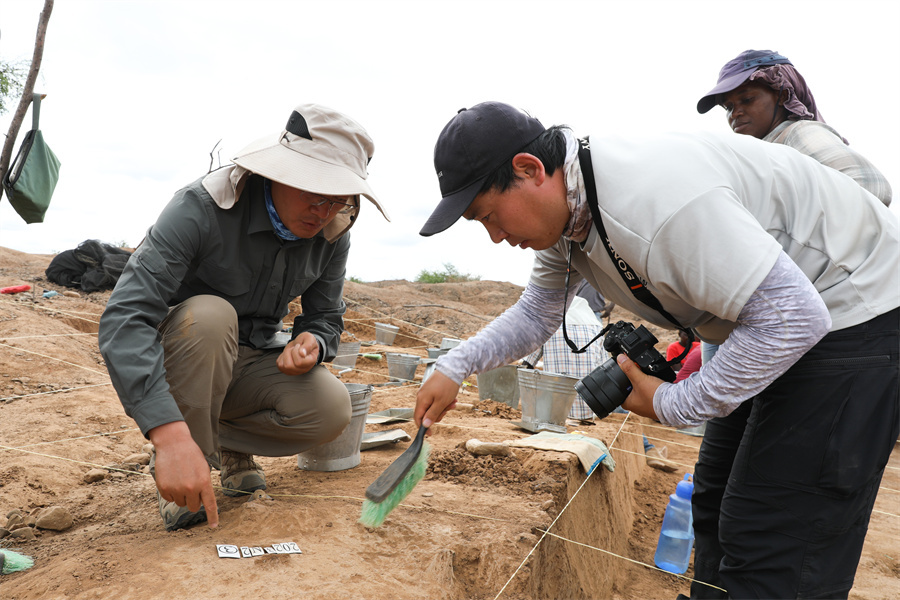
A China-Kenya joint paleontological and archaeological team has discovered in Kenya a number of stone tools made during the Paleolithic period, also known as the Old Stone Age, that date back hundreds of thousands of years, offering new clues to the origin of modern humans.
The stone tools, excavated near Lake Bogoria in Baringo County in western Kenya, feature a refined toolmaking method known as the Levallois technique, which was developed more than 200,000 years ago, according to a leading member of the team, Zhao Qingpo of China's Henan Provincial Institute of Cultural Heritage and Archaeology.
"This period is a crucial stage for the origin of modern humans, and the tools that we have discovered may have been made by modern humans, or intelligent men, at the very early stage," he said, adding that research will be done to determine the exact period in which the stone tools were produced.
Paleontological evidence has shown that Africa is the origin of humans, with human fossils dating back 6 million years having been discovered in Kenya. However, the exact location of the origin of early modern humans is still a matter of debate.
This is not the first time that large-scale archaeological excavation has been done in Baringo. The China-funded joint team, which comprises more than 20 members from institutes including the Henan provincial institute, the Turkana Basin Institute in northern Kenya and the National Museums of Kenya, has been cooperating on excavation in the region since 2017, although efforts were interrupted during the COVID-19 pandemic.
During the latest joint excavation, which began in early October and ended on Wednesday, hundreds of stone tools made during the Old Stone Age have been discovered.
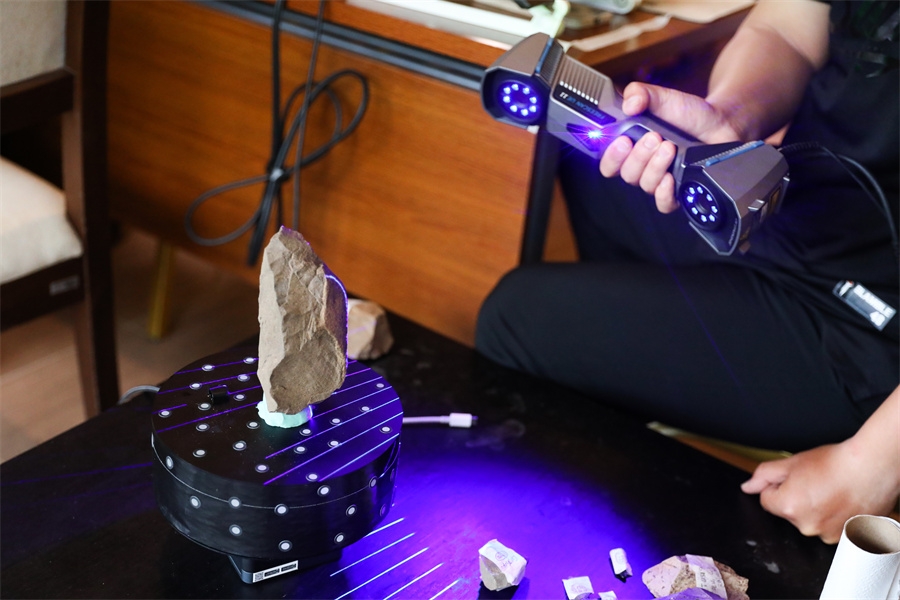
All the excavated stone tools will be photographed, and 3D digital models will be made for further research, Zhao said.
Job Kibii, director of research and science at the Turkana Basin Institute and the China-Kenya joint project director, said Baringo has many artifacts and fossils.
He said that since Oct 3, when joint work began, the team has unearthed more than 600 artifact items, and more than 3,000 items have been discovered since the project began in 2017.
Kibii said the fossils of animals that coexisted with the human ancestors who made the stone tools have also been found. "We have found fossils of ancient pigs, antelopes and elephants in our field work," he said.
The team hopes to specify a time frame for the tools found at the site, he said, adding that the tools can offer clues about who the humans were, how mentally developed they were, what challenges they faced and the resources they used.
He said that each type of stone tool had a specific use, whether for harvesting tubers or slaughtering animals, and therefore can illustrate the mode of subsistence at the time.
Soil samples will be collected and sent to China for dating, Kibii said, noting that there is preliminary evidence that people lived in what is now Baringo County 500,000 years ago.
Faith Wambua, a research fellow at the National Museums of Kenya who has been working on the project since 2017, said that through working with the Chinese team, she has become familiar with new technology such as photogrammetry, which can be used to prepare a 3D model for a stone tool. This makes it possible for Chinese archaeologists to conduct research without having to go to Kenya.
She said the discovery of such items as stone tools helps people understand their origins and appreciate the need to preserve their heritage for future generations.
Rebecca Muthoni, a staff member at the palynology and paleobotany section of the National Museums of Kenya, said she will collect soil samples and process them in the laboratory to understand the type of vegetation that existed in the area, the environment, the wildlife that lived there and what people ate.
Patrick Nyaga, the collection manager at the National Museums of Kenya's paleontology section, said the experience of the past month is memorable because he learned how to identify stone tools, how to handle them during excavation and how to classify them.
"It's a great opportunity to work with the Chinese team. I have learned a lot from them, including their culture," he said.
Nyaga said the joy of discovering a tool makes the difficulty of excavation worthwhile. He added that the tools the team discovered will help researchers and scholars learn more about human history and how technology was developed.
Peng Shenglan, another team member from the Henan Provincial Institute of Cultural Heritage and Archaeology, said this is her first time to go to Africa for joint excavation, and she cherishes the experience.
"We made a big fuss when we first came here, because there are so many stoneworks and fossils," Peng said. "It's like a mecca for Old Stone Age lovers like me."