


Waxing lyrical about preservation









Basking in warm sunshine, the newly restored Jingfu Ge (Hall of Utmost Blessing), which is part of the Summer Palace in Beijing, is like an elderly person with a youthful face.
It possesses the solemnity and magnificence of a royal building, and the gentle elegance that time bestows. Its renovated vermilion pillars shine even more brilliantly in the light, while its mottled white marble steps bear silent witness to the passage of time.
After a yearlong restoration, the ancient building was reopened, enabling the public to see the results during a special open day on Oct 30.
Located on the eastern ridge of Wanshou Mountain in the Summer Palace, the building was initially a two-story pavilion built during the reign of Qing Dynasty (1644-1911) Emperor Qianlong from 1736 to 1796, and known as the Tanhua (epiphyllum) Pavilion.
Unfortunately, it was burned to the ground by Anglo-French forces in 1860, and was rebuilt between 1891 and 1893 during the reign of Emperor Guangxu (1875-1908). Historical records show that Empress Dowager Cixi (1835-1908) often went there to appreciate the views and the weather, and received foreign envoys and their family members in the building, which was not far from her residence in the Summer Palace.
This round of restoration covered the main hall and the surrounding courtyard, with the aim of minimizing interference with the building and not changing its original facade and features.
"When we repaired the roof, we didn't follow tradition to take it down completely for restoration, but only worked on the damaged parts. For example, we once repaired the loose gutters, which led to water leakage. Another time we changed the tiles on the veranda that needed maintenance. This way, we minimized interference with the building," says Rong Hua, head of the department for ancient architecture projects at the Summer Palace.
Although in the past restorers stressed the need to maintain coordination in terms of the building's appearance, while following the principle of minimized interference, nowadays they try not to change undamaged areas and only focus on areas where work is needed, which represents an upgrading of the principle, Rong says.
Based on that principle, the biggest problem facing restoration is how to make a good connection between the areas being restored and those that remain intact. "For some parts, we used zhuojie jialong, a technique of tightly filling the gaps between each component of a tiled roof without disturbing the overall structure, but didn't adopt it for intact sections. So, we had to be extremely careful to finish the joins properly, or the building would suffer secondary damage," says Rong.
She also says that the colorful paintings on the beams were well preserved, so they required no work. "If parts of the paintings had been lost or had become mottled, we would have repaired them. But they seemed fine, and so we decided to preserve them in their current state. We were very careful not to disturb them during the restoration," she adds.
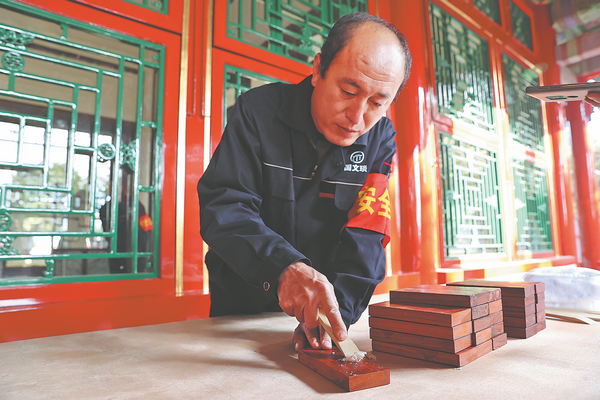
The interior finish of the building has been carefully preserved. Restorers identified the materials and patterns of each wooden component and made a clear record, which will facilitate future restoration work. "In the past, the drawings didn't show details pertaining to the materials of each component, but we recorded that information this time," says Rong.
She also mentions that modern technology, especially three-dimensional scanning, has played a major role in the restoration. "In the past, architectural drawings were two dimensional and linear drawings were used to depict the buildings from different perspectives.
"That made some of the complicated sections more difficult to envisage. But with three-dimensional scans, everything is clear and intuitive. In the future, people will clearly see what we have done this time," says Rong.
The restoration of ancient buildings involves a lot of complicated techniques. In the past, only professionals were responsible for the work, but now ordinary people are expected to play a part in the process as well.
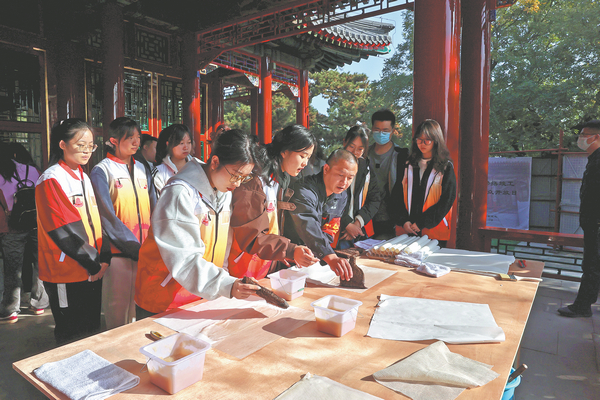
Two ancient Chinese building techniques were on display during the open day, which visitors had the opportunity to get to know and try for themselves.
One was paperhanging, which is used for indoor decoration and helps protect walls and ceilings. According to Jin Ying, a technician who took part in the restoration, the paper used has horizontal and vertical patterns and they paste pieces together by vertically overlapping one sheet of paper with a horizontal texture and one with a vertical texture. In this way, a single layer of paper is formed, which enhances resilience.
Then they paste layer onto layer, and the finished paper can be applied to ceilings, walls and pillars. Jin says that papering a ceiling usually takes four to five layers.
"The technique is often used for rooms that people live in. It makes them feel more comfortable, and not so cold in winter," says Jin.
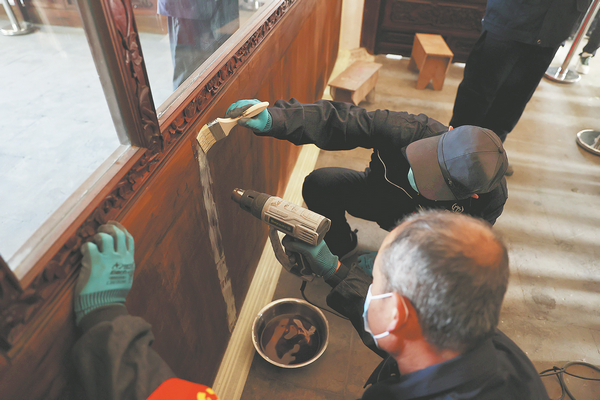
Tangla, another technique on display, involves polishing wood surfaces with melted wax as a form of protection. Shen Wei, a technician who also took part in the restoration, introduced the procedure.
Shen says the area where wax is to be applied is first heated and then covered in liquid wax. The wax is then brushed evenly across the area and allowed to penetrate deeply into the wood.
After that, any extra wax is removed and the surface is polished. A wax layer is left on the wood, protecting it from air, dust and microorganisms, better revealing its original color and texture, and reducing the possibility of cracking.
"We hope to encourage the public to play more of a part in restoration in the future, not only after completion, but also maybe at the beginning and during the process, so that they develop a better understanding of the eight major ancient Chinese crafts of construction, and the sophistication and difficulty of traditional techniques," says Rong.
"We believe it is a good way to spread traditional craft culture, and when people just see a magnificent building, they know how much effort we have invested in restoring and preserving it," she adds.
Yan Bingjie contributed to this story.
Contact the writer at wangru1@chinadaily.com.cn