


Key concept of math may have emerged first in China










Math: Discovery of counting rods 'an important achievement'
The discovery of ancient counting rods made of ivory suggests that the Chinese may have been the first in the world to conceive of negative and positive numbers — 800 years earlier than India — according to recent research.
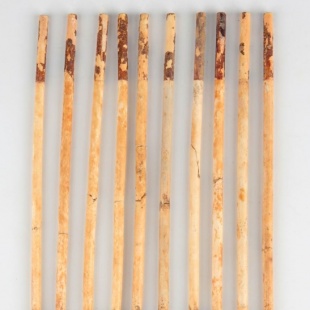
Sixty-one rods were unearthed between 2004 and 2008 in Xi'an, Shaanxi province, at the Qin Mausoleum of Shenheyuan for royalty during the Warring States Period (475-221 BC). They range in length from 18.3 to 18.5 centimeters and have a diameter of 0.49 to 0.54cm. Each weighs about 5.7 to 7.7 grams.
After years of research, experts have concluded that the ivory rods were likely to have been one of the earliest counting tools used to distinguish the concept of "positive" and "negative".
They are the first such painted rods to be found — either red and white or red and black.
In an early text produced during the Han Dynasty (206 BC-AD 220), Nine Chapters on the Mathematical Art, the mathematician Liu Hui mentioned that red counting rods represent positive numbers and black represents negative numbers.
Li Zhenfei, a doctoral student from the School of Cultural Heritage at Northwest University in Xi'an, said on Tuesday that the discovery of the counting rods is "an important achievement in the history of mathematics", as it indicates that Chinese people had developed the concept of negative and positive numbers during the late Warring States Period.
"This was more than 800 years before the arithmetic system for addition, subtraction, multiplication and division involving positive and negative numbers was put forward by Indian mathematicians in the 7th century," Li said. "It reflects the high level of accomplishment in applied mathematics in ancient China."
Li, along with professor Guo Yanli from the School of History and Civilization at Shaanxi Normal University, published the research results in Archaeology and Cultural Relics, a Chinese core journal in the archaeological field.
The tomb's owner was highly prestigious, and most archaeologists believe it was the grandmother of Emperor Qinshihuang. "It is unlikely that those rods were used for mathematical calculations," Li said. "Rather, they were probably counting tools to manage, reward or punish the tomb owner's subordinates. The different colors represent a good deed or a bad deed."
The emergence of the concept of negative numbers predates the establishment of abstract rules of operation. It is generally believed that gains and losses in daily life provides the foundation for the creation of negative numbers, according to the research.
The rods were delicately made, with an almost identical length and thickness. Most were found intact, but several were broken. They are cylindrical, with some narrowing slightly at both ends. They have smooth surfaces and were finely polished, with neat cross-sectional ends.
The middle sections of 30 rods are white, and both ends are red; 28 rods have a black center with red ends. Only one rod is totally white, and two were too damaged to be identified.
Li said the maker of the rods might have colored them with mineral pigment.
"The specific composition requires further scientific research and analysis. In general, the coating may have been made from powdered hematite or cinnabar," he said.
Most early counting rods were made of bamboo, but some were from wood, metal or animal bone, and have mostly been unearthed in tombs from the late Warring States Period to Eastern Han Dynasty (25-220). These were typically 13-14 cm long.
They were often kept in a cloth bag that was tied around a person's waist and carried around. When there was a need to make calculations, they were placed either horizontally or vertically to represent number.
The first counting rods, made from bamboo, were found in 1954 in a tomb in Changsha, Hunan province, according to Li.