Forum on classic works boosts global academic research in field, Yang Yang reports.
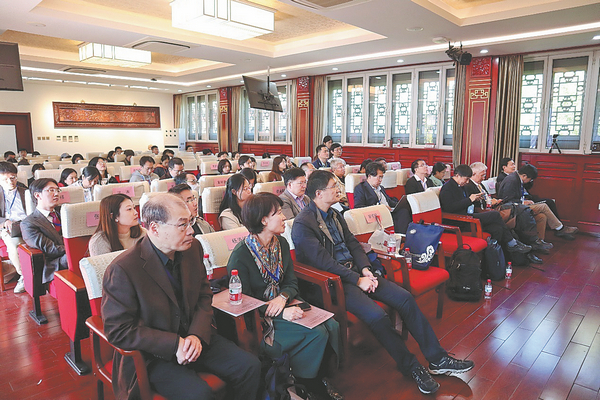
The first World University Forum on Ancient Chinese Classics and Archives was recently hosted in Beijing. The forum was co-organized by the National Committee for the Compilation and Research of Ancient Chinese Classics in Higher Education Institutions, the Center for Ancient Chinese Classics and Archives of Peking University, and the Department of Chinese Language and Literature of PKU.
Scholars engaged in the collection, compilation and research of ancient classics and archives, as well as the digitization of ancient texts from home and abroad, attended the forum in person and online.
Wang Bo, vice-president of PKU, said that ancient classics are important carriers of Chinese civilization, and universities around the world are important collectors of ancient Chinese texts.
Over the past four decades, the efforts of the committee in the full-scale survey, research and protection of ancient Chinese texts at home and abroad have borne rich pickings, such as the compilation and publishing of books including Meiguo Tushuguancang Songyuanban Hanji Tulu (illustrated catalog of ancient Chinese books from the Song and Yuan dynasties collected in US libraries), Riben Zuli Xuexiaocang Guobao Ji Zhenxi Hanji Shisizhong (14 precious ancient Chinese classics of the national treasure level collected in Ashikaga Gakko in Japan) and Yingguo Guojia Tushu Guancang Zhongwen Guji Mulu (the catalog of ancient Chinese classics collected in the British Library).
Wang said that he hopes for closer cooperation among university libraries around the world.
In the keynote presentations, scholars from China and Japan talked about topics including the current compilation of ancient Dunhuang books, the compilation and research of the poems and essays by Gu Lu from the Qing Dynasty (1644-1911), the value of ancient Chinese manuscripts, and problems with the compiling of ancient books.
Rong Xinjiang, a professor from the Department of History at PKU, said that the survey, compilation, photocopying, collation and research of ancient Dunhuang literature around the world, over the years, has made encouraging achievements.
The next step should involve categorizing ancient texts, recording volume numbers, and composing a concise catalog for public use. With high-resolution color images as a foundation, a truly digitized ancient Dunhuang text database that combines image browsing and text search functionalities should be established, he said.

Japanese scholar Koichiro Inahata introduced the compilation process and existing versions of Gu Lu's works, with a focus on discussing the historical transmission to Japan and the publishing of Qing Jia Lu, which is a record of society under the reign of Jiaqing Emperor (1796-1820) during the Qing Dynasty (1644-1911).
Gu's works and calligraphy transmitted to Japan serve as significant historical materials for studying Sino-Japanese cultural exchange and stand as historical testaments to the profound friendship between the two nations, he said.
Professor Zhang Yongquan from the School of Literature with Zhejiang University said in the presentation that the many manuscript archives discovered since the end of Qing Dynasty stand shoulder to shoulder with engraved literature, jointly constituting the precious cultural heritage of the Chinese nation, and they complement each other.
Manuscript literature, including both early copies of handed-down classics and a large number of lost works, not only helps trace the original appearance of ancient books, but also provides assistance in tracing the origins of numerous modern Chinese characters and difficult words. Manuscript literature is the source of engravings, documents, words, and folk history, playing a crucial role in the inheritance of ancient literature in Chinese civilization and fulfilling an irreplaceable function, he said.
Professor Wu Zhenwu from the School of Archaeology at Jilin University offered some thoughts in his speech regarding compiling works about ancient books in the future.
The theory of ancient text compilation is continuously improving in practice. However, many challenges persist in the field, he said.
Currently, there is a lack of unified standards for traditional Chinese character usage in ancient book compilation. Errors still occur due to unfamiliarity with ancient writing styles and a lack of relevant knowledge, he said.
In the future, AI can be used to solve the problems, as it can complete tasks such as text conversion, traditional-simplified character correction, machine-readable punctuation, language annotations, as well as background correlation, theme extraction, and data clustering, he said.
Following the keynote speech, scholars from China and abroad delivered presentations on the themes of "Compilation and Preservation of Ancient Texts", "Digitization of Ancient Texts", and "Young Scholars' Perspectives on Ancient Texts".
After this forum, universities in different countries will regularly take turns hosting future forums, establishing an academic alliance to promote the compilation and research of ancient Chinese texts overseas, and increase communication and cooperation among institutions and scholars from China and overseas.
The forum also aims to explore the value of ancient classics in contemporary times and the development, use and sharing of the digitized resources of ancient Chinese texts today.
Contact the writer at yangyangs@chinadaily.com.cn