



Weizhou Island waters a habitat for rare whales









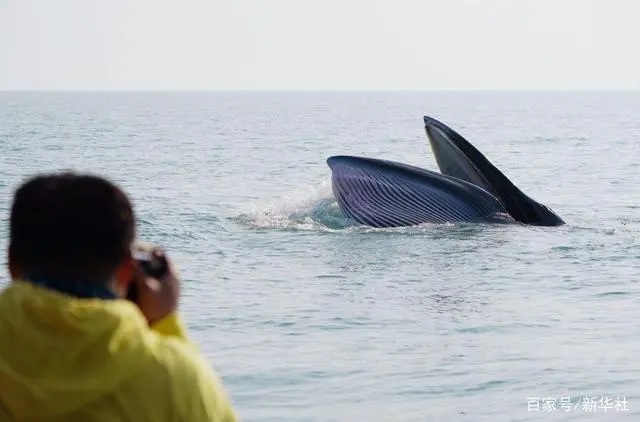
Chen Mo spends nearly one-third of each year on China's youngest volcanic island, Weizhou Island, and has accumulated over 6 terabytes of photos and video footage of the rare Bryde's whales that swim off its coastline.
Chen, 40, is an associate researcher from the Guangxi Academy of Sciences who has been studying the species in the waters near Weizhou since 2016.
"We identified about 10 members of the herd from 2016 to 2018.There are nearly 50 Bryde's whales now, and the herd size is still increasing," he said.
His team has observed the mating behaviors of adult whales and mother whales hunting with their calves for years in the area, making the researchers believe that the island and its surrounding waters are one of the major hunting and breeding grounds for the species.
Weizhou Island sits in the Beibu Gulf, home to a spate of endangered marine wildlife in southern China. Over 1,000 kilometers away lies the Gulf of Thailand, which boasts a well-preserved marine ecosystem and rich food resources and is another essential habitat of the whales.
To jointly research and protect Bryde's whales, Chinese research institutes, including the Guangxi Academy of Sciences, have teamed up with the Department of Marine and Coastal Resources of Thailand to share information and resources.
"In 2019, we jointly conducted field surveys with our Thai counterparts in both sea areas near Weizhou Island and the Gulf of Thailand, heralding the start of our cooperation in the field of studies on Bryde's whales and other marine mammals," Chen said.
Since then, protecting Bryde's whales has become an important area of cooperation between researchers from China and Thailand.
To maintain clean waters and preserve the island's ecological environment, in 2018, the Beihai municipal government of the Guangxi Zhuang autonomous region issued a regulation to prohibit the use of disposable food containers and non-degradable plastic bags and film on Weizhou.
Lai Chaoyun, a 38-year-old native of the island, praised the government's efforts, which included setting up a sewage treatment plant and garbage transfer stations on the island.
"The garbage is mainly collected from various homestays and hotels on the island and then sorted and packaged at the stations before being transferred outside. Every day, there are 62 metric tons of garbage transported to the nearby city of Beihai," Lai explained.
"Many residents on the island, including businessmen, have voluntarily joined local environmental protection campaigns," said Lai, adding that the local tourism industry association and homestay association have also advocated for businesses not to provide disposable supplies to tourists to avoid generating waste.
The rare whales have been recorded more frequently near Weizhou in recent years, indicating that Guangxi's efforts in strengthening its marine ecological protection are paying dividends.
According to data released by Guangxi's oceanic administration, the autonomous region has invested over 6 billion yuan ($834 million) in relevant marine ecological protection projects since 2017, making the Beibu Gulf among China's cleanest offshore marine areas.
"The Beibu Gulf boasts various endangered animals, plants and marine ecosystems. Due to its natural conditions and fewer disturbances caused by coastal economic activities, its ecological diversity has maintained a relatively good state," said Guan Jieyao, director of the key laboratory of the gulf's marine biodiversity conservation center at Beibu Gulf University.
Xinhua


- Labubu lights up Shanghai lantern show
- Cherry blossom festival in Yongfu town celebrates agricultural innovation and cultural exchange
- China's first domestically built cruise ship welcomes its 1 millionth guest
- The Devil Still Dances: High Vigilance against Japanese Militarism's Infiltration in Sports and Culture Fields
- 189 historical artifacts of Japanese invasion donated to museum in NE China
- Death toll rises to 8 in North China factory explosion












